After Medical Crisis, 25 Emergency Rooms Nationwide Reduced
11% More Patients Than Usual... 42% Non-Emergency and Mild Cases
Mass Departure of Emergency Medicine Specialists at Ajou University Hospital
Mokpo Hanguk Hospital, a regional emergency medical center in Jeollanam-do, displayed a message on the emergency room comprehensive dashboard operated by the Central Emergency Medical Center on the 23rd stating that bronchial emergency endoscopy and interventional radiology vascular procedures are not possible. At the same time, Ilsan Hospital in Gyeonggi-do posted messages indicating that emergency treatments for thoracic and abdominal aortic diseases, gallbladder and bile duct diseases, infant intussusception and obstruction, limb replantation, and bronchial emergency endoscopy are unavailable. This means that even if patients with these symptoms come to the emergency room, they cannot be treated or operated on and must be transferred to another hospital.
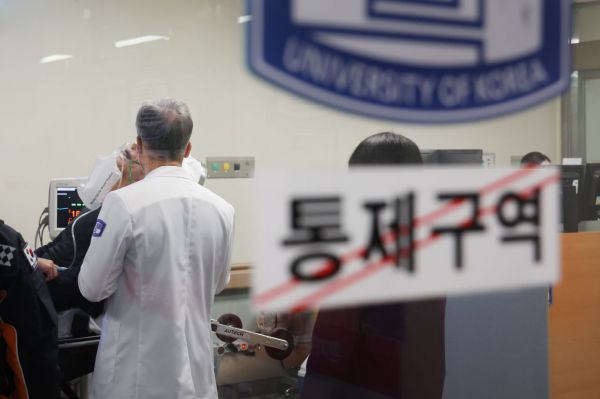
The emergency rooms of major tertiary hospitals have been pushed to the limit due to the mass resignation of residents triggered by conflicts over increasing medical school admissions. As emergency medicine doctors, exhausted after more than six months, continue to leave emergency rooms one after another, and with a resurgence of COVID-19 causing a surge in mild patients, the emergency room operations are on the brink of collapse, a situation literally described as 'the calm before the storm.'
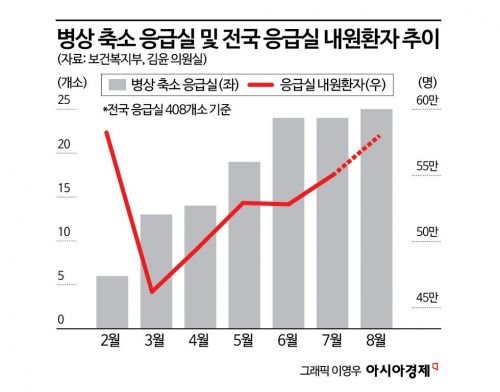
According to the Ministry of Health and Welfare on the 24th, out of 408 emergency medical institutions nationwide, 25 have reduced their bed capacity since the medical crisis in February. According to the office of Assemblyman Kim Yoon of the Democratic Party, only six emergency rooms had reduced beds as of February 21 this year, before the residents' departure, but this number has more than quadrupled in six months.
The number of patients visiting emergency rooms nationwide, which had sharply dropped to about 460,000 in March, has increased again, exceeding 550,000 last month. As of the third week of this month, the average daily number of emergency room visits was 19,784, about 111% of the usual level. If this trend continues, the number of emergency room patients in August is expected to surpass the February figure (580,000).
This phenomenon is due to mild patients visiting emergency rooms more frequently as it has become harder to make appointments at tertiary hospitals, and recently, the spread of COVID-19 reinfections has increased the number of patients with worsened symptoms, especially among the elderly. According to the Ministry of Health and Welfare, about 42% of recent emergency room patients are classified as mild or non-emergency cases, and over 95% of COVID-19 patients visiting emergency rooms were mild to moderate cases.
A head of department in the emergency room of a regional hospital said, "The number of emergency room patients has increased by more than 1.5 times compared to usual, and especially pneumonia patients caused by COVID-19 are difficult to admit, so it is common to call hospitals in other cities and provinces. Even when patients' conditions worsen and they need to be transferred to university hospitals, each hospital says they cannot accept patients due to a shortage of medical staff, so we can only be frustrated."
Professor B, an emergency room specialist in the metropolitan area, said, "Even if there are empty beds in the emergency room, there are no doctors available immediately, and nurses have also been reduced, so even if patients are admitted, they cannot be properly cared for. When residents were present, they could cover night shifts and assist with emergency patients, but now, in departments with only one or two professors left, it is impossible to be on call 24 hours for treatment or surgery."
Although the government announced measures the day before, including raising the patient’s out-of-pocket expenses up to 90% for non-emergency and mild patients using emergency rooms, doubling emergency room specialist consultation fees, and adding regional control rooms, their effectiveness is questionable. Professor B pointed out, "Sometimes patients who walk into the emergency room with severe headaches are found to have subarachnoid hemorrhage after a CT scan, and patients who think they have indigestion are diagnosed with acute myocardial infarction after an ECG. It is impossible to arbitrarily restrict or penalize the treatment of patients who appear to have mild symptoms."
The bigger problem is that emergency rooms are being disrupted as emergency medical staff, who have been on the front lines for over half a year, become exhausted and leave en masse. Previously, emergency rooms at Chungbuk National University Hospital and Sejong Chungnam National University Hospital temporarily suspended operations, and Dankook University Hospital and Sokcho Medical Center’s emergency medical centers also stopped treatment due to a shortage of medical personnel. The emergency room at Hallym University Gangnam Sacred Heart Hospital in Seoul is unable to accept new patients at night except for cardiac arrest cases. Theday before, it was revealed that half (7 out of 14) of the emergency medicine specialists at Ajou University Hospital, a flagship emergency room in southern Gyeonggi Province, had already resigned or planned to resign, raising concerns that emergency rooms are being pushed to the extreme and may sequentially collapse.
Lee Kyung-won, Public Relations Director of the Korean Society of Emergency Medicine and professor of emergency medicine at Yongin Severance Hospital, explained, "Most emergency medicine doctors stay at the forefront to save patients with a spirit of sacrifice, but as manpower shortages worsen and fatigue accumulates, cases of doctors leaving hospitals continue to occur." He added, "There are places barely holding on with the legal minimum of five specialists at regional emergency medical centers. If this situation continues into the Chuseok holiday, when general hospitals close, more patients will flock to emergency rooms, causing delays in treatment and inconvenience to patients, which is inevitable."
© The Asia Business Daily(www.asiae.co.kr). All rights reserved.
![Clutching a Stolen Dior Bag, Saying "I Hate Being Poor but Real"... The Grotesque Con of a "Human Knockoff" [Slate]](https://cwcontent.asiae.co.kr/asiaresize/183/2026021902243444107_1771435474.jpg)

















