Bank of Korea Builds Short-Term Model for Private Consumption
Goods Consumption Expected to Improve from Second Half
GDP Private Consumption Shows Gradual Improvement from Q3
Based on estimates using real-time consumption data such as credit card payments, it is projected that goods consumption will improve starting from the second half of this year. Accordingly, private consumption, which slightly slowed in the second quarter, is expected to continue a gradual improvement trend from the third quarter onward.
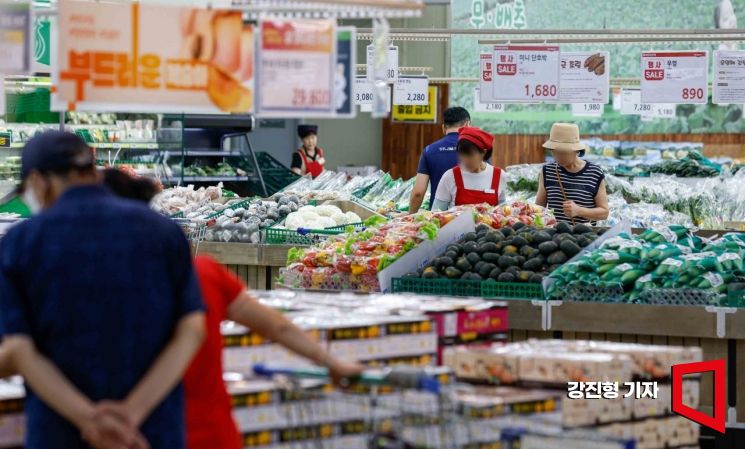 On the 21st, customers visiting Hanaro Mart Yangjae Branch in Seocho-gu, Seoul, are looking at the vegetable stand. Due to the heatwave, prices of vegetables such as lettuce, cucumber, and napa cabbage are rising. In particular, lettuce prices increased by 171.4% and cucumber prices by 98.8% compared to the previous month. Photo by Kang Jin-hyung aymsdream@
According to the 'BOK Issue Note: Big Data-Based Consumption Pattern Analysis and Outlook' released by the Bank of Korea on the 25th, an analysis of consumption inertia as of the end of July, combining real-time consumption data such as credit card payments, internet searches, and news reports, estimated that goods consumption will improve from the second half of the year. Service consumption is expected to maintain a moderate recovery trend. South Korea's gross domestic product (GDP) private consumption is expected to continue a gradual improvement after a slight slowdown in the second quarter, and the consumer price index (CPI) is expected to continue its deceleration trend.
Private consumption has shown increased volatility since the outbreak of COVID-19, making it increasingly necessary to forecast consumption quickly and accurately for effective monetary policy formulation. However, unlike industrial sectors, private economic agents' consumption activities rely on official statistics such as retail sales and household trend surveys, making rapid assessment difficult. Additionally, preliminary indicators such as monthly retail sales and service production have a one-month publication delay, making real-time forecasting challenging. Accordingly, the Bank of Korea's Economic Modeling Office announced that it has established a short-term private consumption forecasting system using the latest techniques such as big data and generative models.
The short-term private consumption forecasting model developed by the Bank of Korea combines credit card payment data, which shows consumption patterns, with descriptive data such as internet and news reports to provide consumption trend information for the same month or quarter.
88% of Short-Term Private Consumption Changes Are 'Inertial Consumption'
According to the model, about 88% of the monthly variation in private consumption is caused by inertial consumption (consumption inertia). Consumption inertia refers to cases where consumption occurs habitually due to seasonal periodic spending, planned consumption, or the continuation of trends.
However, as the forecast horizon lengthens, the influence of macroeconomic conditions changes (consumption adjustment) becomes greater than inertial consumption. Consumption adjustment refers to the portion not explained by consumption inertia and is affected by factors such as household income, government public transfers, consumer sentiment, and interest costs.
Seo Beom-seok, head of the macro modeling team at the Bank of Korea's Economic Modeling Office and author of the report, stated, "This report is significant in that it presents a real-time consumption nowcasting system based on high-frequency big data to support the Bank of Korea's quarterly economic outlook and efficient monetary policy implementation." He added, "The Bank of Korea plans to continue developing models using various big data and the latest techniques to provide rapid and accurate economic assessments and forecasts."
© The Asia Business Daily(www.asiae.co.kr). All rights reserved.
![Clutching a Stolen Dior Bag, Saying "I Hate Being Poor but Real"... The Grotesque Con of a "Human Knockoff" [Slate]](https://cwcontent.asiae.co.kr/asiaresize/183/2026021902243444107_1771435474.jpg)











