Sustainability and Equity Must Be Established for Future Generations
Structural Framework for Low Birthrate and Aging Population Needs to Be Newly Set
Ahn Sang-hoon, the secretary of the People Power Party's Special Committee on Pension Reform, urged on the 22nd that "pension reform must necessarily involve a multi-layered structural reform of the entire old-age income security system, including the Basic Pension, National Pension, and Retirement Pension," and called for the formation of a National Assembly pension special committee.
On the morning of the same day, during the opening remarks at the policy forum titled 'Pension Reform in the 22nd National Assembly: What Needs to Be Done' held at the National Assembly Members' Office Building, Ahn said, "It is difficult to achieve the goals of pension reform by focusing only on parametric reforms such as the National Pension insurance premium rate and income replacement rate." He explained that since the old-age income security system must be financially sustainable and equitable across generations to be maintained beyond the current young generation to future generations, the increase in the income replacement rate should be adjusted together with the retirement pension, and the alleviation of elderly poverty should be coordinated with the Basic Pension.
Kim Sang-hoon, the Policy Committee Chair of the People Power Party who also attended the forum, emphasized, "South Korea is a country with an unprecedented total fertility rate of around 0.7 and is entering a super-aged society. The number of people paying into the pension is steadily decreasing, while the number of people receiving pensions is increasing exponentially," and stressed that pension reform that establishes a new structural framework is desirable.
The fact that Ahn hosted the forum is interpreted as an effort to counter the Democratic Party’s argument, which insists on strengthening old-age income security through parametric reforms based on the results of the 21st National Assembly Pension Special Committee’s Public Deliberation Committee, and to support the government. It is known that President Yoon will hold a national briefing as early as the end of this month to announce a National Pension reform plan, including differentiated premium increases by generation and automatic fiscal stabilization mechanisms.
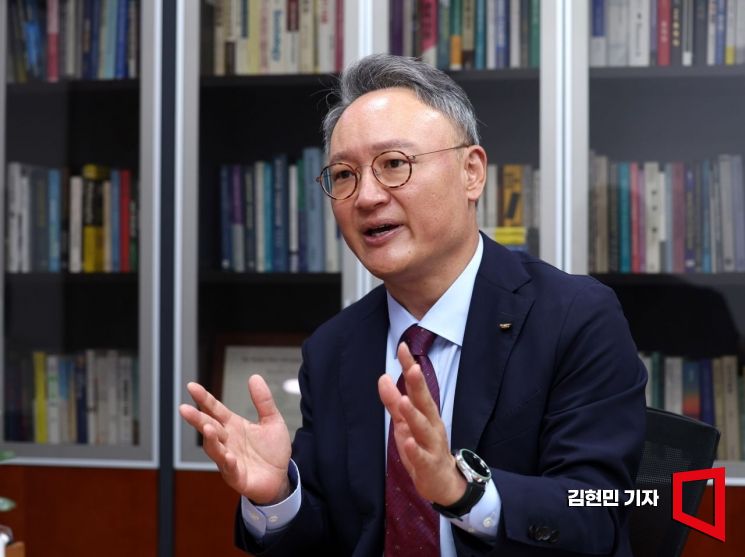 Ahn Sang-hoon, a member of the People Power Party, is giving an interview to Asia Economy at the National Assembly on the 11th. Photo by Kim Hyun-min kimhyun81@
Professor Kim Su-wan of Gangnam University, who presented on the topic 'What Did the 21st National Assembly’s Pension Reform Discussions Leave Behind?', diagnosed that there was no consensus on the 'direction of pension reform' and 'understanding of future generations' during the 21st National Assembly pension reform discussions. Professor Kim said, "Discussions proceeded without a common agreement on the direction and purpose of the reform, so there was no consensus on what the reform was for," adding, "In the process of deriving survey questions from stakeholders and the public deliberation process, opinions were collected limited to the current generation, resulting in a discussion structure that could not sufficiently reflect the interests of future generations."
Professor Kim also suggested that the 22nd National Assembly should build consensus among participants on the necessity of reform and thoroughly review and share the outcomes that the reform proposals would bring. He mentioned that, similar to Canada’s two-stage pension reform involving fiscal stabilization, additional premium rate increases, and raising the income replacement rate, a minimum reform should be implemented by finding common ground on premium rates and income replacement rates, followed by the establishment of a discussion body for further pension reform.
Oh Geon-ho, Policy Committee Chair of the Welfare State We Make, who was deeply involved in the past Democratic Labor Party’s (now Justice Party) pension reform plan, also emphasized at the forum that "a mid- to long-term vision for National Pension fiscal stability, including raising the premium rate and retirement age and enhancing fund returns, must be established, and reforms for sustainability such as converting the Basic Pension from a fixed benefit to a minimum guaranteed income are necessary," adding, "Differentiated premium rates by age and class should also be proactively considered."
© The Asia Business Daily(www.asiae.co.kr). All rights reserved.
![Clutching a Stolen Dior Bag, Saying "I Hate Being Poor but Real"... The Grotesque Con of a "Human Knockoff" [Slate]](https://cwcontent.asiae.co.kr/asiaresize/183/2026021902243444107_1771435474.jpg)
















