The National Institute of Forest Science has raised the forecast level for the American white moth outbreak from "interest" to "caution." This measure was taken due to signs that the damage caused by the American white moth is spreading nationwide again this year, following last year.
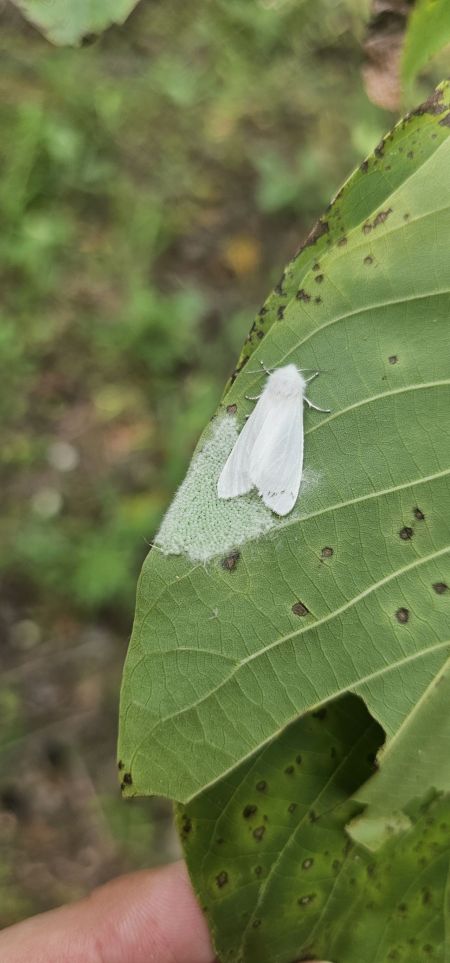 Adult American white moth and deciduous tree leaves eaten by American white moth. Provided by National Institute of Forest Science
According to the Institute of Forest Science on the 23rd, the American white moth is estimated to have been introduced to Korea from North America in 1958. Since its introduction, it has mainly been classified as a pest that damages urban street trees and ornamental trees.
The adult American white moth typically appears twice a year, but depending on climatic conditions, it can appear up to three times. During the summer, the larvae feed on the leaves of broadleaf trees such as cherry and poplar. It is known that the damage caused by the second generation larvae is greater than that caused by the first generation larvae each year.
The Forest Pest Research Division of the Institute of Forest Science estimates that based on the damage rate of the first generation this year, the damage rate of the second generation is expected to increase by 15.1 percentage points, from 21.6% last year to 36.7% this year.
Based on this, the Institute of Forest Science raised the forest pest outbreak forecast from "interest" to "caution" for all regions nationwide except Jeju Island as of the 21st, and requested related organizations to strengthen monitoring and control of pests around residential areas.
The "caution" level is issued when regional-scale outbreaks of the same pest occur in the period and areas where foreign or sudden pests have occurred in the past, including trees and forest products.
Han Hye-rim, head of the Forest Pest Research Division, said, "Due to the impact of climate change, the survival rate and activity of the American white moth are increasing, and the outbreak period is advancing, which may lead to greater damage. We ask that active pest control be implemented in the field in accordance with the outbreak forecast from the Institute of Forest Science."
© The Asia Business Daily(www.asiae.co.kr). All rights reserved.

















