Possibility of Increased Impact on Intermediate Goods Exports if US Economy Slows
Limited Impact on Automobile and Machinery Exports
"Companies Need to Prepare for Future Uncertainties"
Concerns have emerged that if the U.S. economy slows down more than expected, South Korea's exports of intermediate goods such as steel, chemical products, and petroleum products could be adversely affected.
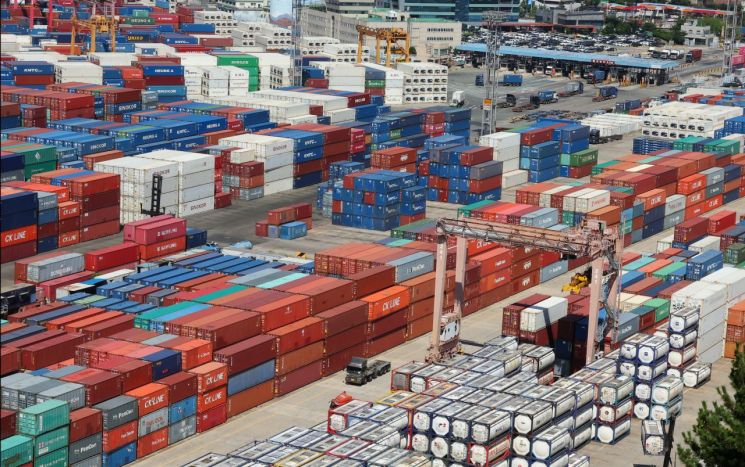
According to the report titled "Recent Evaluation of U.S. Economic Trends and Assessment of the Impact on Exports to the U.S. if Growth Slows," released by the Bank of Korea on the 23rd, if the slowdown in U.S. growth expands more than anticipated, there is a high likelihood of negative effects on South Korea's exports to the U.S.
In particular, there is an analysis that downward pressure on exports of intermediate goods such as steel, chemical products, and petroleum products will be significant. This is because the correlation between U.S. domestic demand and South Korea's intermediate goods exports to the U.S. has increased compared to before. The correlation coefficient between South Korea's intermediate goods exports and U.S. private investment rose from 0.68 in the past (2000?2024) to 0.85 in the recent four years. The correlation coefficient with U.S. private consumption also increased significantly from 0.37 to 0.71 during the same period.
On the other hand, the correlation coefficient between South Korea's capital goods exports and U.S. private investment slightly decreased from 0.22 to 0.21 over the same period. The correlation coefficient between consumer goods exports and private consumption also dropped significantly from 0.28 to -0.07 during the same timeframe.
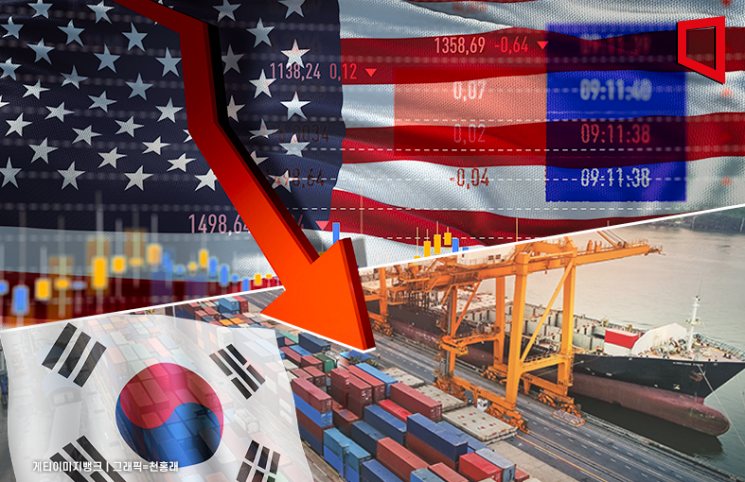
Limited Impact on Automobile and Machinery Exports... Due to Non-Cyclical Factors
It is assessed that the impact on automobile and machinery exports will be limited even if the U.S. economy slows down more than expected. The increase in exports of these items to the U.S. since 2020 is attributed not only to cyclical factors such as U.S. domestic demand but also significantly to non-cyclical factors such as increased preference for Korean products within the U.S. and the influence of U.S. industrial policies. While about half of South Korea's export growth to the U.S. from 2010 to 2016 was due to U.S. economic factors, the influence of non-cyclical factors has increased substantially for both automobiles and machinery since 2020.
Looking at the export conditions for these items, South Korea's automobile exports to the U.S. have recently expanded significantly, centered on eco-friendly vehicles such as electric and hybrid cars. South Korea's automobile exports to the U.S. grew at an average annual rate of 11.3% from 2010 to 2019, but this growth accelerated to 16.5% after 2020. This is mainly due to domestic car manufacturers expanding their market share in the U.S. with strong competitiveness in eco-friendly vehicles and compact sport utility vehicles (SUVs). Although demand for electric vehicles has slowed considerably this year, exports of hybrid vehicles have increased sharply based on their high competitiveness, contributing to the overall positive trend in exports to the U.S.
Machinery exports have also shown favorable performance due to the influence of U.S. industrial policies. Since 2022, the implementation of the U.S. Inflation Reduction Act (IRA) and the CHIPS Act has accelerated the transition from fossil energy, replacement of aging power infrastructure, and establishment of semiconductor production facilities in the U.S. Accordingly, South Korea's machinery exports to the U.S., centered on power equipment such as transformers and semiconductor manufacturing equipment, increased at an average annual rate of 18% from 2022 to 2023.
U.S. industrial policy-related spending is expected to continue expanding steadily in the future, suggesting that South Korea's machinery exports to the U.S. will maintain a favorable trend. Recently, South Korea's plant orders in the U.S. have expanded significantly, and U.S. big tech companies continue to invest in AI sectors such as data center construction. As a result, if power demand increases, exports of related items are expected to be supported.
A Bank of Korea official stated, "The recent strong performance of South Korea's exports to the U.S. is due not only to cyclical factors in the U.S. economy but also to structural factors such as the high competitiveness of eco-friendly automobiles and U.S. industrial policies," adding, "If the U.S. economy does not slow down sharply, the impact on exports is expected to be limited."
However, the official also noted, "There are still considerable risk factors for automobile and machinery exports," citing "the possibility of a prolonged electric vehicle chasm (temporary demand slowdown) in the automobile sector; cases where investment in new growth and eco-friendly sectors in the U.S. has been delayed or halted due to China's overproduction and policy uncertainties; and the uncertainty over whether high tariffs will be imposed depending on the upcoming U.S. presidential election," emphasizing that South Korean companies need to prepare accordingly.
© The Asia Business Daily(www.asiae.co.kr). All rights reserved.


















