"Our Bread is Only in Daejeon"... Seongsimdang of Determination
The Secret to Surviving in Daejeon, Truly Loving 'Flour'
The popularity of Seongsimdang, a bakery in Daejeon, shows no signs of waning. 'Open runs' (lining up before opening) to buy bread are a daily occurrence, and popular cakes sell out early. The once highly sought-after 40,000 won mango siru cake was even resold on secondhand markets for around 90,000 won. Established in 1956, Seongsimdang is a steadfast bakery that sells bread only in Daejeon. Nevertheless, it surpassed 100 billion won in annual sales last year, becoming the first single bakery brand to do so, demonstrating the strength of a local brand. What is the secret to its success?

'True Love for Flour' in Daejeon... The Secret to Seongsimdang's Survival?
Daejeon is a city with a strong preference for flour-based foods such as kalguksu (knife-cut noodles) and bread. According to the Data Teller report from the Daejeon-Sejong Research Institute, as of last year, there were a total of 849 bakeries in Daejeon, which amounts to 5.9 stores per 10,000 people. This is higher than the national average of 5.6 stores per 10,000 people based on 28,890 bakeries nationwide, and ranks just behind Seoul (6.1) and Daegu (6.1).
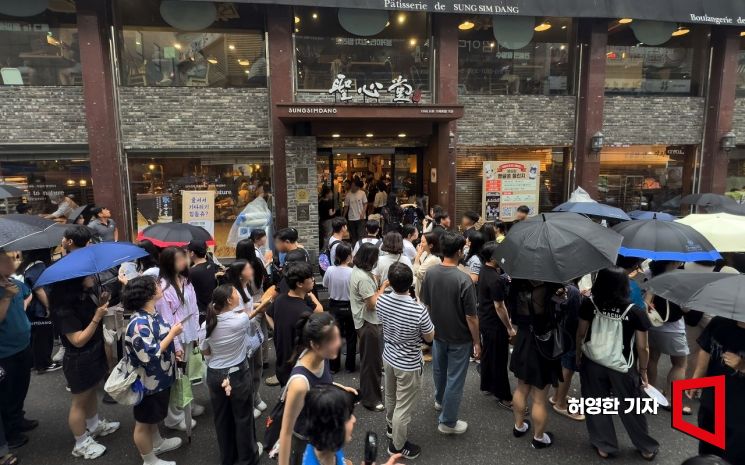 Visitors are lining up in front of the Seongsimdang main store, a representative attraction of Daejeon, to purchase bread. Photo by Heo Young-han
However, the average operating period for bakeries in Daejeon is 5.5 years, the second shortest among the seven major metropolitan cities, following Daegu (5.1 years). This is interpreted as reflecting that consumers in Daejeon have high standards for bread and are sensitive to trends, resulting in a high closure rate for stores that fail to meet expectations. A local expert explained, "Daejeon is considered a testbed for bakery pop-up stores. If a bakery succeeds in Daejeon, it is said to sell well anywhere. This means that the thoughts and tastes of Daejeon residents regarding bread are above average."
In this environment, the biggest reason Seongsimdang has survived for nearly 70 years is its 'cost-effectiveness' (performance relative to price). The signature 'Siru' series cakes?strawberry, mango, tangerine, and fig?are all priced at 43,000 won for the first version. Despite the significant rise in fruit prices, to the extent that the term 'fruitflation' (fruit + inflation) has emerged, Seongsimdang has gained a reputation for including more fruit than bread or cream at a relatively affordable price. It is also praised as having 'hotel cake-level quality.'
Seongsimdang's 'Instagrammable' elements have also been effective. When cutting the Siru cake, the sight of fruit tumbling down has spread on social media, prompting the MZ generation (Millennials + Generation Z) to visit Seongsimdang to take photos for SNS. Seongsimdang actively targets the MZ generation's desire for 'Instagrammable' content by sharing news of new product launches and events through Instagram, Twitter, and other social media platforms.
Seongsimdang's active social contribution activities have recently attracted consumer attention. The bakery donates leftover bread to local welfare centers, continuing a tradition from its founder who used to distribute unsold bread to war orphans and homeless people. It also strives to nurture the next generation of pastry and bakery chefs by creating educational manuals. A caf? owner in Galma-dong, Daejeon, said, "Seongsimdang is known for being strict when hiring people. The internal regulations are tough, but they provide good training, so many former employees who leave go on to successfully run their own bakeries."
Seongsimdang's bread is recognized for its local symbolism and is currently used as a return gift under the hometown love donation program. Currently, donations made to Daejeon Metropolitan City Hall or Jung-gu district can receive Seongsimdang gift certificates or bread sets in return.
However, although Seongsimdang is evaluated as operating better than large corporate franchises, the issue of rent remains an unresolved challenge. Seongsimdang is currently in conflict with Korail Distribution over increased commission fees for its store at Daejeon Station. Korail Distribution proposed a rent of over 400 million won, which Seongsimdang opposed as being higher than the surrounding market rates. The conflict over the commission fees has escalated into debates involving Korail's abuse of power, protecting local commercial districts, Seongsimdang's preferential treatment, and public gentrification.
In a recent column regarding the rent conflict at Daejeon Station, the Urban Reform Center of the Citizens' Coalition for Economic Justice (CCEJ) pointed out, "While Seongsimdang pursued profit, it lacked recognition of the benefits and public nature arising from monopolizing public space. The monopolistic position of a local company within the region has created a public opinion rallying effect."
© The Asia Business Daily(www.asiae.co.kr). All rights reserved.
![Clutching a Stolen Dior Bag, Saying "I Hate Being Poor but Real"... The Grotesque Con of a "Human Knockoff" [Slate]](https://cwcontent.asiae.co.kr/asiaresize/183/2026021902243444107_1771435474.jpg)












