August Monetary Policy Direction Meeting Resolution
The Monetary Policy Committee of the Bank of Korea announced on the 22nd that it has kept the base interest rate steady at 3.50% for the 13th consecutive time, stating that "the trend of slowing inflation continues and the recovery of domestic demand is sluggish," but also noted that "it is necessary to further examine the impact of the government's real estate measures and changes in global risk aversion sentiment on financial stability factors such as housing prices in the Seoul metropolitan area, household debt, and the foreign exchange market."
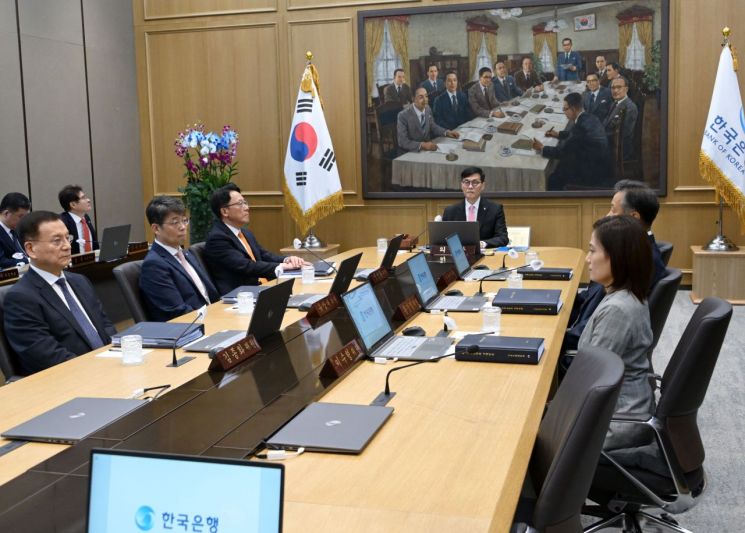
In the resolution of the monetary policy direction meeting held that morning, the Bank of Korea's Monetary Policy Committee stated, "Going forward, monetary policy will maintain a tightening stance while carefully examining the trade-offs among policy variables such as inflation, growth, and financial stability, and will consider the timing of lowering the base interest rate."
Regarding the domestic economy, it said, "With exports continuing to increase and consumption gradually recovering, a moderate growth trend is expected to continue," and added, "The growth rate for this year is projected at 2.4%, slightly lower than the May forecast of 2.5%, reflecting that the temporary factors behind the strong growth in the first quarter were larger than expected."
On inflation, it stated, "Domestic inflation is expected to continue its slowing trend due to the base effects of last year's sharp rise in international oil and agricultural prices and low demand pressure," and "the consumer price inflation rate is expected to fluctuate around the low 2% range for the time being."
Below is the full text of the Monetary Policy Direction meeting resolution.
The Monetary Policy Committee decided to operate monetary policy by maintaining the Bank of Korea's base interest rate at the current level (3.50%) until the next monetary policy direction decision. Although the trend of slowing inflation continues and the recovery of domestic demand is sluggish, it was deemed appropriate to maintain the current tightening stance as it is necessary to further examine the impact of the government's real estate measures and changes in global risk aversion sentiment on financial stability factors such as housing prices in the Seoul metropolitan area, household debt, and the foreign exchange market.
The global economy continues to grow moderately, but uncertainties related to the economic conditions of major countries such as the United States have somewhat increased, and inflation has continued its slowing trend. In international financial markets, risk aversion sentiment was greatly strengthened due to concerns about a U.S. economic slowdown and the unwinding of yen carry trades, then reversed, during which volatility expanded with sharp fluctuations in stock prices. The U.S. dollar index and long-term government bond yields declined due to strengthened expectations of a rate cut by the U.S. Federal Reserve. Going forward, the global economy and international financial markets are expected to be influenced by the slowing inflation trends and monetary policy operations of major countries, geopolitical risks, and changes in political situations in major countries.
The domestic economy saw continued export strength, but consumption recovered more slowly than expected, resulting in continued differentiation among sectors. Employment remains generally favorable with continued increases in the number of employed persons. Going forward, the domestic economy is expected to maintain moderate growth as exports continue to increase and consumption gradually recovers. The growth rate for this year is projected at 2.4%, slightly lower than the May forecast of 2.5%, reflecting that the temporary factors behind the strong growth in the first quarter were larger than expected, while the forecast for next year remains at 2.1% as previously projected. Future growth paths are expected to be influenced by the pace of consumption recovery, the expansion speed of the IT sector, and economic conditions in major countries.
Domestic inflation has continued its underlying slowing trend. Although the consumer price inflation rate rose to 2.6% in July due to an increase in petroleum product prices, the core inflation rate (excluding food and energy) remained around 2.2%, and short-term inflation expectations declined to the high 2% range. Domestic inflation is expected to continue its slowing trend due to the base effects of last year's sharp rise in international oil and agricultural prices and low demand pressure. The consumer price inflation rate is expected to fluctuate around the low 2% range for the time being, with the annual inflation rate for this year projected at 2.5%, slightly below the May forecast of 2.6%, and next year expected to be 2.1%, in line with the previous forecast. Core inflation is expected to remain at 2.2% this year and 2.0% next year, consistent with the May forecast. Future inflation paths are expected to be influenced by movements in international oil prices and exchange rates, trends in agricultural prices, and adjustments in public utility charges.
In financial and foreign exchange markets, volatility in major price variables expanded significantly before easing, but caution related to concerns about a U.S. economic slowdown and the unwinding of yen carry trades remains. Stock prices rebounded after a sharp decline, long-term government bond yields fell significantly due to strengthened expectations of domestic and foreign policy rate cuts and net futures purchases by foreigners, and the won-dollar exchange rate declined due to a weaker U.S. dollar. Housing prices in the Seoul metropolitan area increased with rising transaction volumes, while prices in provincial areas continued to decline. Household loans, mainly housing-related loans, continued to grow at a high rate. Risks related to real estate project financing (PF) remain latent.
The Monetary Policy Committee will operate monetary policy with attention to financial stability while monitoring growth to ensure that inflation stabilizes at the target level over the medium term. Although confidence has increased that domestic inflation will converge to the target level and growth is expected to improve moderately, further monitoring of future trends is necessary. From a financial stability perspective, as housing price increases in the Seoul metropolitan area and household debt growth continue and caution remains in the foreign exchange market, it is necessary to examine the effects of the government's real estate measures and the impact of increased volatility in international financial markets. Therefore, going forward, monetary policy will maintain a tightening stance while carefully examining the trade-offs among policy variables such as inflation, growth, and financial stability, and will consider the timing of lowering the base interest rate.
© The Asia Business Daily(www.asiae.co.kr). All rights reserved.
![Clutching a Stolen Dior Bag, Saying "I Hate Being Poor but Real"... The Grotesque Con of a "Human Knockoff" [Slate]](https://cwcontent.asiae.co.kr/asiaresize/183/2026021902243444107_1771435474.jpg)
















