'Public Hearing on Innovative Medical Supply and Utilization System Reform'
Pilot Project for Structural Transformation to be Implemented for 3 Years Starting This Second Half
"Medical and Compensation Systems and Infrastructure Must Be Improved"
The government will implement the 'Advanced General Hospital Structural Transformation Pilot Project' over three years starting in the second half of this year to reorganize advanced general hospitals to focus on treating severe patients. Large hospitals in Seoul with more than 1,500 beds will reduce general beds by 15%, increasing the proportion of severe patients to 60%.
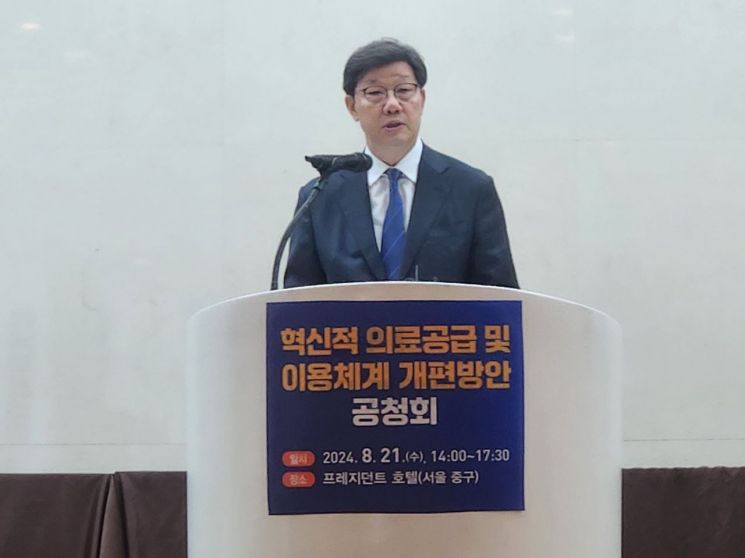 No Yeonhong, Chairman of the Medical Reform Special Committee, is delivering a greeting at the "Public Hearing on Innovative Medical Supply and Utilization System Reform Plan" held on the afternoon of the 21st at the President Hotel in Jung-gu, Seoul. Photo by Choi Taewon peaceful1@
On the afternoon of the 21st, the Ministry of Health and Welfare held a public hearing on the 'Innovative Medical Supply and Utilization System Reform Plan' at the President Hotel in Jung-gu, Seoul, where it announced the structural transformation plan for advanced general hospitals. In his opening remarks, Noh Yeon-hong, Chair of the Medical Reform Special Committee (Special Committee), said, "This will be a meaningful opportunity to transparently and thoroughly disclose the discussions held by the Special Committee and its advisory committee to the public and to gather diverse opinions," adding, "We will do our best to prepare a substantial medical reform implementation plan reflecting the various opinions presented at the public hearing."
At this event, the structural transformation of advanced general hospitals and the reform of the medical supply system were discussed first. Yoo Jeong-min, Director of the Medical System Innovation Division at the Ministry of Health and Welfare, stated, "We plan to start the structural transformation of advanced general hospitals over three years beginning in the second half of this year, ensuring no disruption to the severe and emergency care system, and to strengthen the role of advanced general hospitals as centers for severe and tertiary medical care," adding, "Along with establishing a vertical medical delivery system, we aim to establish a horizontal medical delivery system that covers prevention, acute care, subacute care, rehabilitation, and long-term care, so that the medical delivery system can be firmly established centered on the patient regardless of their situation."
He continued, "The structural transformation of advanced general hospitals is aimed at transforming five overall structures: treatment, treatment cooperation, beds, workforce, and resident training," and added, "We also plan to strengthen compensation evaluations for this. The criteria for patients considered severe will be broadened not only to include patients with specialized treatment disease groups but also those who can be practically regarded as severe, with the goal of increasing the proportion of severe patients to 60% within three years."
Regarding treatment cooperation, he said, "Currently, formal referrals are made based on the patient's preference rather than the physician's opinion, causing difficulties in medical utilization appropriate to the severity level, according to field feedback," and added, "We will introduce a 'fast track' system that specifies detailed physician opinions for specialist referrals based on medical judgment and allows priority reservations between cooperating hospitals."
He also announced a policy to reduce the proportion of general beds within advanced general hospitals to focus on intensive care. Director Yoo explained, "In Seoul, for hospitals with a total licensed bed count of 1,500 or more, we plan to reduce general beds by 15%, 10% for other hospitals, 10% for Gyeonggi and Incheon, and 5% for non-metropolitan areas," adding, "Rather than making this mandatory immediately, we will create a structure where hospitals with a higher proportion of intensive care beds receive greater performance rewards."
Regarding concerns from the medical community about the severity classification system, he said that revisions have begun. He stated, "There have been many requests from the medical community to improve the severity classification," and added, "Fundamentally, we are currently working on adjusting and revising the appropriate disease groups that advanced general hospitals and secondary hospitals should treat, aligning with the functions of medical institutions."
He further said, "We are also reforming compensation plans so that advanced general hospitals can focus on an environment that allows them to properly care for severe patients, rather than pursuing profits by increasing treatment volume as before," adding, "We are preparing an investment plan totaling around 3 trillion won, allocating 1.5 trillion won for intensive care units and hospitalization fee compensation, 500 billion won for severe surgery compensation, and 1 trillion won for post-care compensation."
Regarding rationalization of medical utilization, there was a call for strengthening the capabilities of medical consumers. Yoon Myung, Secretary-General of the Citizens' Coalition for Consumer Rights, said, "Medical consumers need to enhance their ability to acquire objective information rather than indiscriminate advertisements or baseless information," and added, "Recognizing the public good nature of healthcare, we need to improve the indiscriminate use of emergency rooms and the perception that large hospitals are always the best."
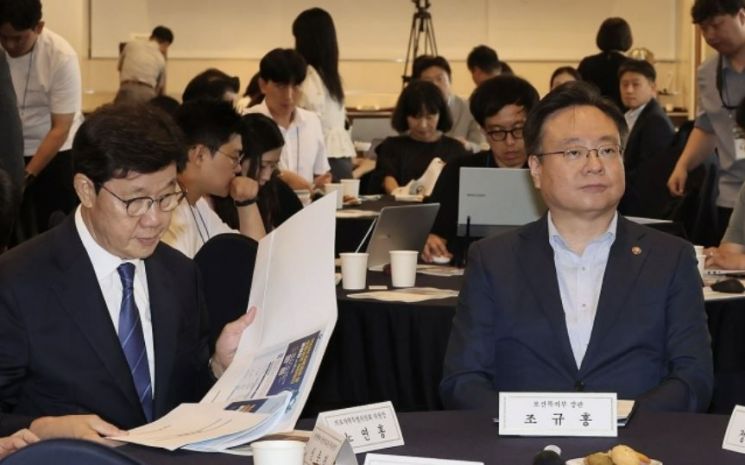 Minister of Health and Welfare Cho Kyu-hong (right) and Chairman of the Medical Reform Special Committee Noh Yeon-hong are attending a public hearing on innovative medical supply and utilization system reform measures held at the President Hotel in Jung-gu, Seoul, on the afternoon of the 21st.
 [Image source=Yonhap News]
At the public hearing, the establishment of a regionally complete medical system and compensation plans were also discussed. A regionally complete medical system refers to a system where all citizens can receive timely and quality medical services in their residential area. Shin Hyun-woong, Chair of the Delivery System and Regional Medical Expert Committee under the Special Committee, pointed out, "Due to issues like emergency room overcrowding, pediatric department 'open runs,' and childbirth refugees, gaps in the provision of universal essential medical care are becoming a reality," adding, "Ultimately, there are problems with the medical utilization and provision system, and the compensation system exacerbates these problems."
He argued that to establish a regionally complete medical system, improvements are needed in ▲medical system ▲compensation system ▲infrastructure. Shin said, "To improve the medical system, we will establish a regional medical control tower, reorganize regional medical institutions, and strengthen their capabilities to build and activate a regional medical network."
Regarding compensation system improvements, he explained, "It is necessary to establish an efficient and stable financial support system linked to the budget and health insurance," adding, "Considering the crisis in regional essential medical care, a focused increase in fees for surgeries, procedures, and basic essential medical services is needed in the short term." He further added, "In the future, continuous resolution of fee imbalances reflecting patient essentiality, severity, and regional vulnerability will be necessary."
To improve regional medical infrastructure, he emphasized the need for government support to expand and invest in regional and essential medical personnel. Shin said, "We need to review policy support tasks for securing regional and essential medical personnel at each stage, such as medical school admission, residency, and specialist training, and prioritize them," citing examples such as strengthening the regional talent quota for medical school admissions, establishing public medical schools, and increasing the regional quota for residents.
He also argued for expanding budget investments for regional and essential medical care using national and local government funds. Regarding funding methods, he explained, "We can create a special essential medical care account funded by general accounts and health-related tax increases on tobacco, alcohol, sugar, and carbon, and establish regional medical development funds using local taxes, local extinction funds, and special rural taxes."
© The Asia Business Daily(www.asiae.co.kr). All rights reserved.


















