576 Domestic and International Textile and Fashion Companies Participate... Record High
"As we enter the digital era, artificial intelligence (AI) technology has become important in the textile and fashion industries as well. At this event, we need to pay close attention to the AI capabilities of fashion companies."
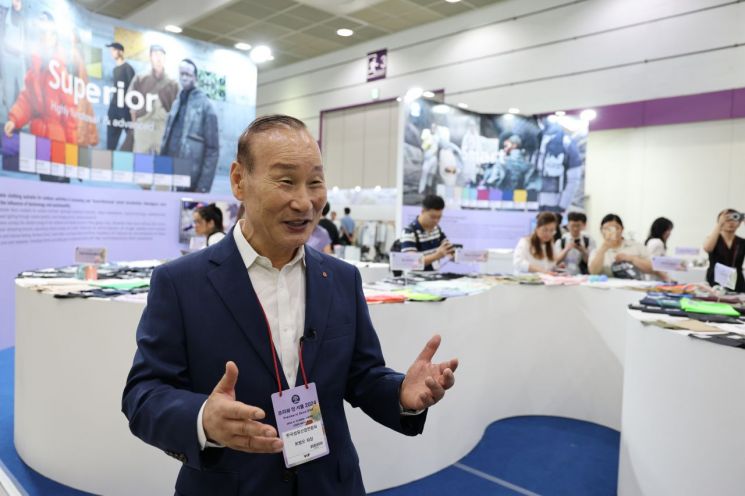 Chairman Choi Byung-oh of the Korea Federation of Textile Industries is posing. [Photo by Korea Federation of Textile Industries]
On the 21st, Choi Byung-oh, chairman of the Korea Federation of Textile Industries (Fashion Group Hyungji), made these remarks during a meeting with reporters at 'Preview in Seoul (PIS)' held at COEX in Seoul. With China encroaching on the global textile market and domestic textile industries facing stagnation due to global consumer market contraction, high inflation, and protectionist trends, this statement is interpreted as a determination to present a new direction for the textile and fashion industry through AI-based digital convergence technology. The export scale of domestic textile and fashion companies, including chemical fibers and knitted fabrics, amounts to $12.3 billion, ranking second in Asia after China.
PIS is an international textile and fashion exhibition where domestic and foreign companies related to the fashion apparel industry?such as textile yarns, fabrics, accessories, and raw materials?participate to showcase and promote their products. A total of 576 companies opened booths, including 275 domestic companies such as Hyosung TNC, Kolon FnC, and Fashion Group Hyungji, as well as 301 overseas companies headquartered in China, Japan, Taiwan, T?rkiye, India, Pakistan, and other countries.
This year’s PIS is the largest ever. Overseas buyers from brands like Burberry, Hugo Boss, Bottega Veneta, Ralph Lauren, and Lululemon attended, along with domestic fashion and distribution companies such as Hyundai Department Store, E-Land World, and LF, who plan to examine the technologies of domestic textile and fashion companies.
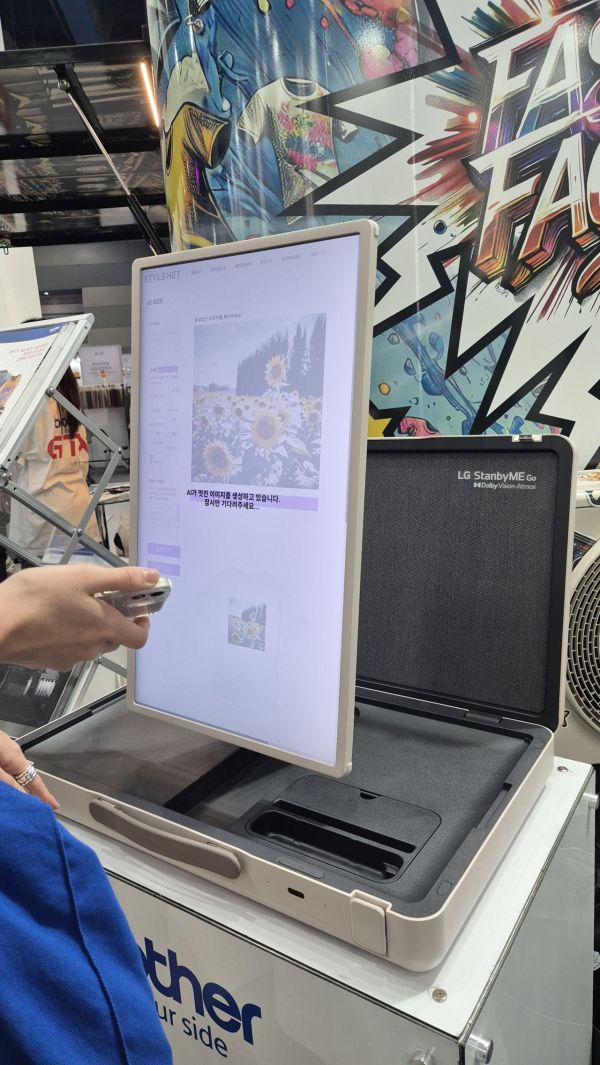
A total of 19 companies set up booths in the AI Fashion Tech Special Pavilion highlighted by Chairman Choi. This pavilion, where visitors could directly experience AI-based design and virtual clothing and model generation technologies, attracted the largest crowds during the exhibition. At the 'Hyunwoo International' booth, a long line formed as visitors were intrigued by the feature where AI generates graphics from input words and immediately prints them on T-shirts.
Additionally, companies and brands offering 3D clothing simulation through metaverse, AI, and virtual humans, as well as platform companies integrating AI technology to enable efficient inventory management, also opened booths. The Federation of Textile Industries has long emphasized the importance of AI and has been dedicated to talent development. Since 2021, through the 'AI Convergence Talent Development Education' program, over 800 graduates have been produced as of last year.
The fashion giant Kolon FnC was also present at the event. Kolon FnC’s cashmere brand 'Le Cashmere' partnered with dye manufacturer Cutis Bio to set up a booth. Le Cashmere is a brand that showcases cashmere products made from sustainable materials. Their main product features cashmere garments dyed in indigo blue. Hong Guk-ki, head of Cutis Bio, explained, "It is difficult to achieve indigo blue color on cashmere material, but we developed an eco-friendly Aqua Indigo dye." He added, "We collaborated with Le Cashmere to launch the product, which received a positive response in the U.S. market." Kolon plans to release this product in the fall/winter season next year.
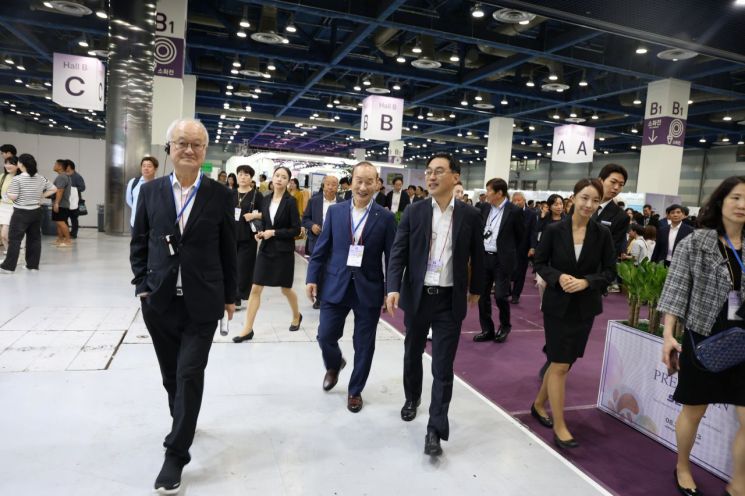 Chairman Choi Byung-oh (center) and former Chairman Sung Ki-hak (left) are touring the exhibition hall. [Photo by Korea Federation of Textile Industries]
Also attending the exhibition were former chairman of the Federation of Textile Industries, Sung Ki-hak, chairman of Youngone Corporation, and Sung Rae-eun, vice chairman of Youngone Corporation and president of the Korea Fashion Industry Association. Chairman Sung, whom we met at the exhibition, said, "Domestic textile and fashion companies have sufficient competitiveness in the global market," adding, "The ability to quickly produce products through listening to client feedback and collaboration puts us ahead of Chinese companies, which have strong price competitiveness."
© The Asia Business Daily(www.asiae.co.kr). All rights reserved.



















