US Security Firm "Increase in VPN Use Among North Korean Residents"
Efforts to Evade Government Censorship for 'Information Access'
Park Sugon "Need to Examine Impact on Information Inflow"
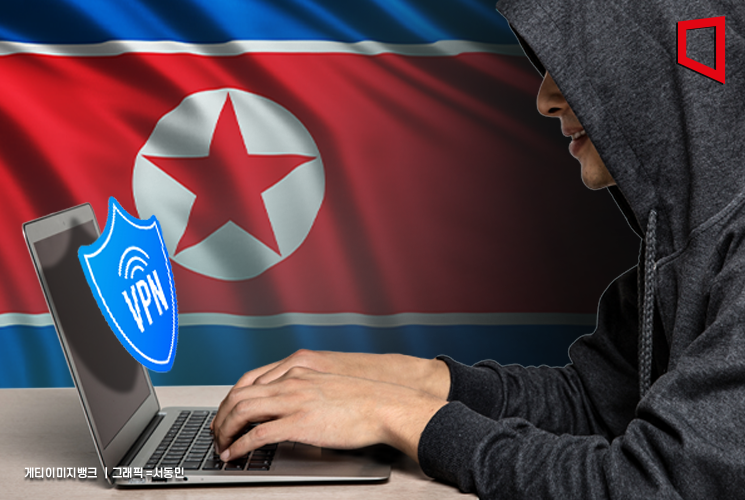
A survey has revealed that North Korean residents are actively using Virtual Private Networks (VPNs) to evade strict government censorship. This demonstrates the strong desire of the people to access information despite the Kim Jong-un regime's stringent control over the inflow of external information.
According to a report published on the 21st by global security firm Recorded Future, the Insikt Group (a threat analysis organization) observed communications between 31 unique North Korean IP addresses and 35 different VPN or proxy services from January 2023 to March of this year. Given that this period coincided with the pandemic-induced border closures when there were almost no foreigners inside North Korea, it is highly likely that these VPN connection traces were made by residents. While a 2020 investigation focused on VPN usage among North Korea’s privileged class, this time it was analyzed that ordinary residents used VPNs to evade domestic surveillance networks.
 A man is using a smartphone in front of portraits of Kim Il-sung and Kim Jong-il in Pyongyang, North Korea. [Image source=AP Yonhap News]
VPNs hide users’ IP addresses and reroute internet traffic through encrypted connections to VPN servers. They are used to protect personal information and maintain security online, but also to access specific internet networks where access is restricted. For example, in South Korea, accessing North Korean sites such as the Korean Central News Agency or Rodong Sinmun requires bypassing via VPN.
In North Korea, ordinary residents must use an intranet called "Kwangmyong" rather than the public internet, as in most countries. Nominally operated by the "Korea Computer Center Naenara Information Center," it is subject to strict censorship and supervision by the authorities. The increase in VPN use can be seen as an active effort by North Korean residents to evade government surveillance in order to access external information.
The VPN services most frequently used by North Korean residents in this investigation were Hotspot Shield (63.2%), ExpressVPN (16.1%), Private Internet Access (10.6%), and Psiphon 3 (5.1%). While the first three are widely used worldwide, Insikt Group explained that Psiphon 3 is a VPN designed specifically to circumvent internet censorship.
Insikt Group stated, "While we have continuously observed North Korean residents using VPNs or proxy services, this is the first time we have observed them using obfuscation services to evade domestic surveillance and censorship."

Experts advise closely monitoring these trends to develop effective strategies for information inflow into North Korea. Park Sugon, IT and system security officer at the Transition Justice Working Group (TJWG), evaluated, "The increase in VPN use to evade censorship inside North Korea also suggests a growing awareness of security among residents." He added, "The rise in VPN use indicates that access to external information is a high priority. It is necessary to carefully examine the impact on internal stability in North Korea and international information inflow."
Meanwhile, the investigation also observed records of North Korean residents using antivirus programs for security and overseas residents regularly visiting official news websites to obtain the latest information on incidents and policies occurring in North Korea. Notably, Insikt Group reported that North Korean residents continue to use foreign devices and technologies such as Apple, Samsung, Windows, and Huawei, stating, "Companies whose products may end up in North Korean hands should conduct appropriate due diligence on companies that can resell products to Russia and China."
© The Asia Business Daily(www.asiae.co.kr). All rights reserved.



















