'Major Countries' Responses and Implications to China's Supply Surplus' Report
China Provides Subsidies 3 to 9 Times Higher than OECD for EVs, Batteries, and Solar Power
Potential Spillover Benefits from Major Countries' Countermeasures
Supply Chain Risks May Rise Due to Expanding Trade Barriers
China's supply glut, which had occurred in traditional manufacturing industries such as steel, is expanding into new industries like electric vehicles, batteries, and solar energy. Amid strengthened import restriction measures by major countries including the US and the EU to address this issue, there are calls to closely monitor the impact on South Korea's exports.
According to the report "Major Countries' Responses to China's Supply Glut and Implications," published on the 21st by the Korea International Trade Association (KITA) Institute for International Trade and Commerce, the Chinese government has designated electric vehicles, batteries, and solar energy as three major new industries and is fostering these industries through massive industrial subsidies amounting to 3 to 9 times the OECD country average.
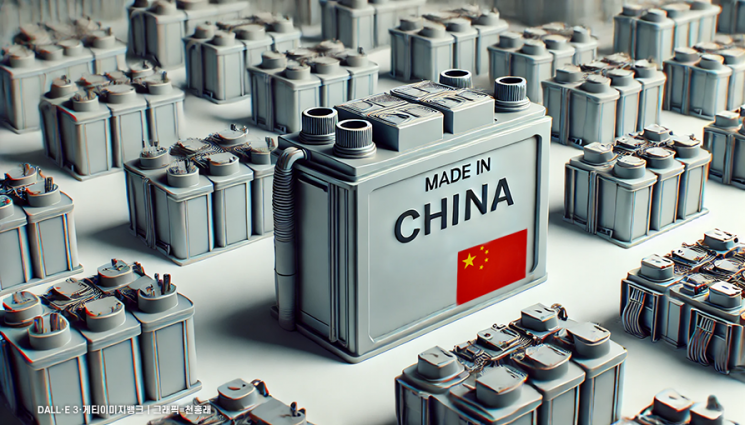
Chinese companies, supported by government aid, have gained competitiveness in technology and scale. However, due to a recent domestic market slump causing oversupply, they are exporting products at low prices, creating a global supply glut problem. Despite the global market already being unable to absorb the scale of China's oversupply, Chinese companies plan to maintain maximum production capacity not only in traditional industries such as steel and chemicals but also in new industries like electric vehicles, batteries, and solar energy, suggesting that the oversupply issue will worsen in the future.
In fact, last year China produced 9.54 million electric vehicles, but sales reached only 8.41 million, resulting in an oversupply of 1.13 million units. Consequently, China's electric vehicle exports surged from just 220,000 units in 2020 to 1.2 million units in 2023. With the Chinese government's electric vehicle subsidy policy ending in 2022, Chinese electric vehicle manufacturers are beginning to build factories in countries where subsidies remain and are attempting to resolve the domestic oversupply issue through exports.
The production scale of global battery manufacturers has already exceeded market demand, and last year, batteries produced in China alone were sufficient to meet global demand with enough left over for 1.56 million mid-sized electric vehicles. Oversupply in the solar energy market continues as well. In 2024, China's solar module production capacity is expected to reach 1,405 GW, but solar panel installations in China and globally are only 255 GW and 511 GW respectively, indicating ongoing oversupply.
Oversupply in traditional industries such as steel and chemicals remains a chronic problem with no signs of resolution. China is the world's largest steel producer, accounting for more than half of global production (54% as of 2022). Last year, China's net steel exports reached approximately $34.1 billion, nearing the peak of $34.3 billion in 2014, as it pushes surplus production into exports amid weakened domestic steel demand caused by a real estate market downturn.
Ethylene production capacity, a basic feedstock for chemical intermediate products, has been in oversupply since 2018, but with Chinese companies operating facilities at over 80% capacity, it is expected to take considerable time to resolve the oversupply.
In response, major countries such as the US and the EU are strengthening measures against China's oversupply. The US is expanding the application of traditional trade remedy measures such as anti-dumping, countervailing duties, and safeguards, as well as measures under Section 232 of the Trade Expansion Act and Section 301 of the Trade Act. The EU, which has mainly used anti-dumping measures targeting specific companies with relatively less political burden, is recently intensifying subsidy investigations. The EU has pointed to Chinese government subsidies as the cause of oversupply and has launched subsidy investigations into electric vehicles, solar energy, and wind turbines. Emerging countries such as India, Chile, Brazil, and Mexico have also announced import restriction measures one after another to respond to Chinese oversupply.
The report analyzed that China's oversupply and major countries' countermeasures will have direct and indirect effects on South Korea's exports. It suggested that some industries might gain a secondary benefit from the US and EU's tariff policies against China. In the US, market expansion opportunities are expected in the battery, solar energy, and petrochemical sectors, and if Chinese electric vehicle companies with high market shares in the EU shrink, domestic companies could benefit. However, the continued oversupply of low-priced Chinese products and trade barrier responses by major countries could increase risks across the supply chain, posing a burden to Korean companies. In fact, in the past, when the US implemented protectionist measures, major countries responded with global trade remedy measures, spreading trade barriers and affecting South Korea's exports.
Lee Jeong-ah, senior researcher at the Korea International Trade Association, said, "There is a precedent where the US invoked Section 232 and safeguard measures on imported steel to protect national security and domestic industries, so it cannot be ruled out that similar measures might be applied to new industries where China's supply glut is intensifying." She added, "If the US imposes additional import restrictions and other countries competitively adopt protective measures for their domestic industries, it could cause significant disruption to the global trade environment, so Korean companies need to be cautious."
© The Asia Business Daily(www.asiae.co.kr). All rights reserved.
![Clutching a Stolen Dior Bag, Saying "I Hate Being Poor but Real"... The Grotesque Con of a "Human Knockoff" [Slate]](https://cwcontent.asiae.co.kr/asiaresize/183/2026021902243444107_1771435474.jpg)
















