NYT Report... Top Secret Documents
China Expected to Possess 1,500 Nuclear Warheads by 2035
President Joe Biden approved a top-secret "nuclear operations directive" in March to prepare for China's rapid expansion of its nuclear arsenal, the New York Times (NYT) reported on the 20th (local time).
According to the NYT, the directive addresses the sharp increase in China's nuclear capabilities and diversity, which now rival those of the United States and Russia, and the need to respond to the combined threat posed by North Korea, China, and Russia. The directive is updated every four years and is treated as highly classified, distributed only in printed form to a very limited number of national security officials and Department of Defense commanders, with no electronic copies.
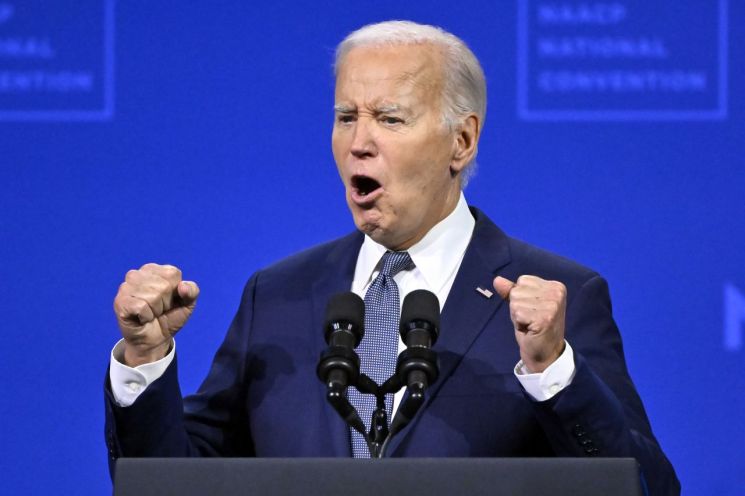
The White House has not publicly announced this. President Biden acknowledged in July that his administration adopted a policy seeking ways to broadly interfere with the China-Russia partnership but declined to discuss details publicly, saying he was "not ready to talk about specifics openly." However, the NYT reported that some senior government officials have recently hinted at limited changes in nuclear strategy.
Bipin Narang, an MIT professor who previously worked at the U.S. Department of Defense, stated earlier this month that "President Biden recently issued an updated nuclear operations directive considering multiple nuclear-armed adversaries," noting that it particularly took into account the significant increase in the size and diversity of China's nuclear weapons. In June, Pranay Vaddi, senior director at the National Security Council (NSC), also referenced the directive, emphasizing "the need to simultaneously deter North Korea, Russia, and China."
The NYT explained, "The new cooperative relationship between Russia and China and the phenomenon of North Korea and Iran supplying conventional weapons to Russia for the Ukraine war have fundamentally changed the U.S. government's mindset." It added that unlike previous directives which focused on Russia, this one centers on China, reflecting how rapidly China's nuclear capabilities are evolving.
The directive estimates that China's nuclear arsenal will reach 1,000 warheads by 2030 and 1,500 by 2035, matching the current nuclear stockpiles of the United States and Russia. This growth is occurring faster than U.S. intelligence agencies predicted two years ago.
Another concern regarding China is the breakdown of communication channels such as mutual warnings about nuclear launches and nuclear-related hotlines. Mallory Stewart, U.S. State Department Deputy Assistant Secretary for Arms Control, Verification, and Compliance, said, "The Chinese government is actively blocking dialogue on risks," adding, "It seems they have learned a lesson from Russia and have chosen not to engage in arms control, risk reduction, or nonproliferation talks until tensions and issues in bilateral relations are resolved."
There are also worries about possible cooperation among nuclear-armed adversaries. The NYT reported that Russia and China are already conducting joint military exercises. Former President Donald Trump, after meeting North Korean Supreme Leader Kim Jong-un three times during his tenure, was confident that North Korea would give up its nuclear weapons. However, North Korea's nuclear arsenal has doubled and is now estimated to exceed 60 warheads.
The NYT analyzed that while North Korea's limited arsenal in the past could be deterred through missile defense systems, its possession of nuclear weapons at the level of Pakistan or Israel theoretically enables it to cooperate with China and Russia to pose a threat to the United States.
Voices suggest that it is only a matter of time before the United States changes its war plans and strategies in response to the fundamentally altered nuclear environment. Professor Narang said, "The new challenge is the real possibility of cooperation and collusion among nuclear-armed adversaries."
Meanwhile, Colin Kahl, former U.S. Deputy Undersecretary of Defense for Policy, said regarding the NYT report, "I cannot comment on classified matters," but added, "However, the world is changing, and the cooperation among North Korea, China, Russia, and Iran is becoming closer."
© The Asia Business Daily(www.asiae.co.kr). All rights reserved.
![Clutching a Stolen Dior Bag, Saying "I Hate Being Poor but Real"... The Grotesque Con of a "Human Knockoff" [Slate]](https://cwcontent.asiae.co.kr/asiaresize/183/2026021902243444107_1771435474.jpg)
















