'Meeting to Strengthen the Global Competitiveness of the Korean Economy'
First Seminar After the Founding General Assembly at the Korea Chamber of Commerce and Industry
Brainstorming Support Measures for Advanced Industries
"The Key to Overcoming Peak Korea is Advanced Industries"
"Must Develop into a National Strategy Through Policy Cooperation"
Members of the National Assembly visited the Korea Chamber of Commerce and Industry (KCCI) in large numbers to discuss support measures for advanced industries with experts from the business community and academia-industry-research sectors.
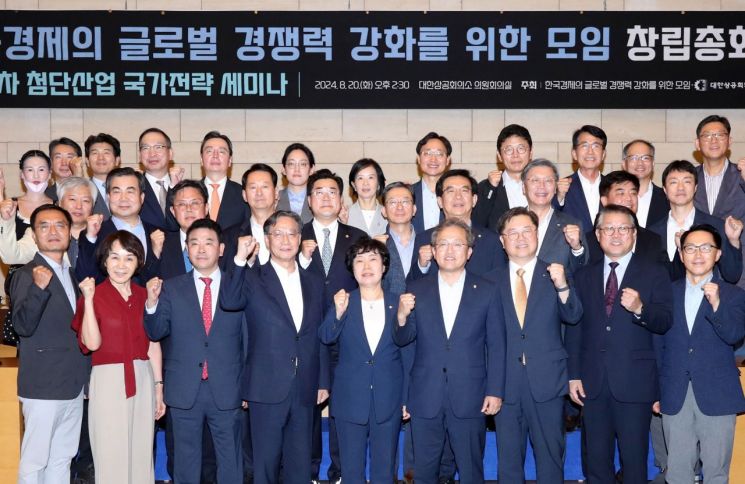 Members of the 'Association for Strengthening the Global Competitiveness of the Korean Economy' are shouting "Fighting" while taking a commemorative photo with experts from the business community and industry-academia-research sectors. Photo by Korea Chamber of Commerce and Industry
The group, named 'Meeting for Strengthening the Global Competitiveness of the Korean Economy,' composed of 15 lawmakers from both ruling and opposition parties, held its inaugural general meeting at the KCCI on the afternoon of the 20th and held the first activity, an 'Advanced Industry National Strategy Seminar' with the KCCI.
The seminar was attended by about 10 lawmakers from both ruling and opposition parties belonging to the research group, including four members from the People Power Party: Jo Bae-sook, Jo Ji-yeon, Choi Su-jin, and Choi Eun-seok; and seven members from the Democratic Party of Korea: An Do-gul, Yoo Dong-soo, Song Ki-heon, Lim Kwang-hyun, Park Jeong, Jeong Il-young, and Jeong Seong-ho. Also present were Park Chan-dae, floor leader of the Democratic Party, and Kim Byung-wook, advisory committee chairman and former lawmaker.
From the business sector, attendees included Park Il-jun, Executive Vice Chairman of the KCCI; Park Seung-hee, President of Samsung Electronics; Lee Hyung-hee, Chairman of SK Communications Committee; Kim Dong-wook, Vice President of Hyundai Motor Company; Park Joon-sung, Vice President of LG; Kim Kyung-han, Vice President of POSCO Holdings; Moon Ji-hoon, Vice President of Hanwha Aerospace; Lim Seong-bok, Executive Director of Lotte Holdings; Jeong Ki-ok, Chairman of LSC Food; Kim Chang-beom, Executive Vice Chairman of the Korea Economic Association; and Lee Ho-jun, Executive Vice Chairman of the Korea Federation of Medium-sized Enterprises.
Park Il-jun, Executive Vice Chairman of the KCCI, explained, "As major countries prioritize their own interests and mobilize all available resources to foster advanced industries, it is becoming increasingly difficult for domestic companies to secure global competitiveness. Although the National Assembly and government are making many efforts, we planned this seminar to build a consensus that advanced industries need to be handled more seriously and support measures prepared from a national strategy perspective."
Kim Tae-yoo, Professor Emeritus at Seoul National University, delivered the keynote speech emphasizing "the necessity of bipartisan cooperation on the national strategy for advanced industries." Professor Kim stated, "Korea's economic growth rate has steadily declined over the past 30 years, and in 2022, Goldman Sachs predicted Korea's long-term growth rate to be negative, raising concerns about 'Peak Korea' (the phenomenon of economic growth peaking and then declining). For Korea's advancement, it is essential to intensively nurture advanced industry technologies to create a super-gap and discover new growth engines in knowledge industries such as IT and services, so that industrialization and democratization can create a virtuous cycle."
He continued, "Above all, policy decisions are crucial. While political activities can be conducted separately by ruling and opposition parties, advanced industrial technologies are not politically or socially biased, so policy implementation must be cooperative in terms of national happiness and national interest." He especially emphasized, "Since advanced industries tend to have a first-mover advantage, it is necessary to consider advanced industry policies from a national strategy perspective and swiftly implement more bold and effective policy packages to avoid losing the market."
During the subsequent panel discussion, experts from academia, industry, and research sectors unanimously agreed that "a more proactive and innovative shift in thinking is needed to support advanced industries."
Lee Seong-yeop, Professor at Korea University Graduate School of Technology Management, said, "Korea must pursue leading-edge technology development in fields such as artificial intelligence, semiconductors, and biotechnology. Especially for semiconductors, since investment exceeding 20 trillion won per fab is required, it is necessary to consider government subsidies directly to companies, as major countries do."
Kim Woo-cheol, Professor at the University of Seoul, pointed out, "Under the current tax support system, advanced industry companies cannot receive investment tax credits when they incur losses or low profits. Therefore, it is necessary to introduce a refundable tax credit (Direct Pay) system that allows advanced industries like secondary batteries to receive cash refunds for unused tax credits regardless of operating profit or loss."
Hong Dae-sik, Professor at Sogang University, said, "Given the enormous capital required to build and operate production facilities in advanced industries, enhancing companies' investment capacity is crucial. The financial-industrial separation regulation unique to Korea acts as an obstacle to investment promotion. The negative effects of conglomerate expansion can be sufficiently addressed through ex-post regulations such as unfair support acts, so it is necessary to improve the financial-industrial separation regulation that blocks investment in advance and ease corporate investment in advanced industries."
Yoo Seung-hoon, Professor at Seoul National University of Science and Technology, emphasized, "If 16 semiconductor factories are newly established in the semiconductor cluster by 2047, an additional 16.6GW of power demand will arise, but power supply is far from meeting this. It is necessary to resolve power shortages by constructing additional LNG power plants in southern Gyeonggi, and supporting the expansion of transmission lines between the East Coast and the metropolitan area and between Honam and the metropolitan area."
Hong Sung-min, Center Director at the Science and Technology Policy Institute, said, "Globally, competition to secure talent in advanced industries is fierce, but Korea's visa system, living environment, and incentive system are insufficient, making it relatively less attractive. In strategic technology fields, it is necessary to establish a support system that promotes the growth and career development of young researchers rather than immediate incentives, and to prepare comprehensive measures at the academia-industry-research level to create a healthy ecosystem that attracts talent by improving corporate R&D and research environments."
© The Asia Business Daily(www.asiae.co.kr). All rights reserved.

















