Producer Price Index in July Rises 0.3% Month-on-Month
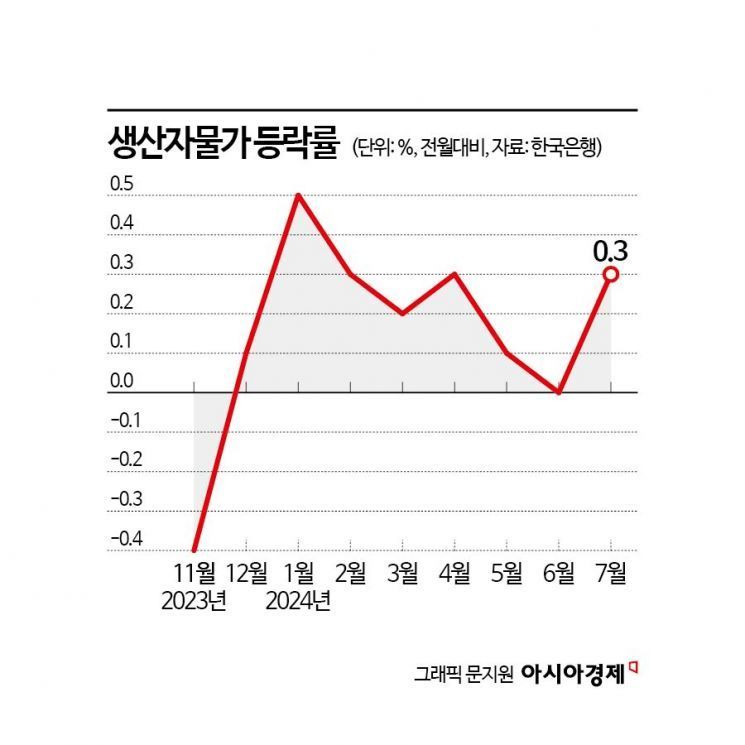
Last month, producer prices rose again after two months as heavy rains caused agricultural and marine product prices to increase. Producer prices affect consumer prices with a time lag.
According to the Bank of Korea on the 21st, the producer price index in July rose by 0.3% compared to the previous month. This is the highest increase in three months since April, which also recorded a 0.3% rise.
The producer price index had risen for six consecutive months from December last year to May but dipped once in June. However, with producer prices rising again in July, there are concerns that consumer prices may be stimulated in the future. Producer prices typically reflect on consumer prices with a lag of one to three months.
The rise in producer prices last month was due to the increase in agricultural and marine product prices caused by heavy rains, as well as the rise in petroleum prices which pushed up the manufactured goods index.
By item, among agricultural, forestry, and fishery products, agricultural products rose 1.5% and marine products increased 2.2% compared to the previous month. Among major detailed items, lettuce prices rose 171.4%, cucumber 98.8%, rockfish 8%, and flatfish 3.6%.
Among manufactured goods, coal and petroleum products rose 2.8%, and computers, electronics, and optical devices increased 0.9%. Among detailed items, diesel rose 5.1%, gasoline 4.5%, and DRAM jumped 6.1%.
Fresh foods rose 4.2%, food products 0.9%, and energy 0.6% compared to the previous month.
Lee Moon-hee, head of the Price Statistics Team at the Bank of Korea’s Economic Statistics Bureau, explained, "Last month, heavy rains caused prices of some agricultural and marine products to rise, impacting the increase in producer prices." He added, "There is uncertainty due to heatwaves or typhoons in August as well, so we need to monitor the trend."
The domestic supply price index, which measures price changes including imported goods, also rose 0.2% compared to the previous month. This was influenced by a decline in raw materials (-0.5%) but increases in intermediate goods (0.3%) and final goods (0.2%).
The total output price index, which measures price changes including domestic shipments and exports, rose 0.4% due to increases in agricultural, forestry, and fishery products (1.5%), manufactured goods (0.5%), and services (0.2%).
© The Asia Business Daily(www.asiae.co.kr). All rights reserved.

















