Annual Decline in Movie Theater Attendance and Revenue
Caused by OTT Competition and Ticket Price Burden
Expansion into Genres like Sports Games and Concerts
A movie theater in Gwanak-gu, Seoul, visited on a weekday afternoon. It was hard to find people passing by the concession stand and ticket counters. Although four movies were about to be screened, only about 10 seats for each were sold. An employee working here said, "On weekdays, there are so few people that I wonder if we should even operate," adding, "Unless it's a famous movie, almost no tickets are being sold."
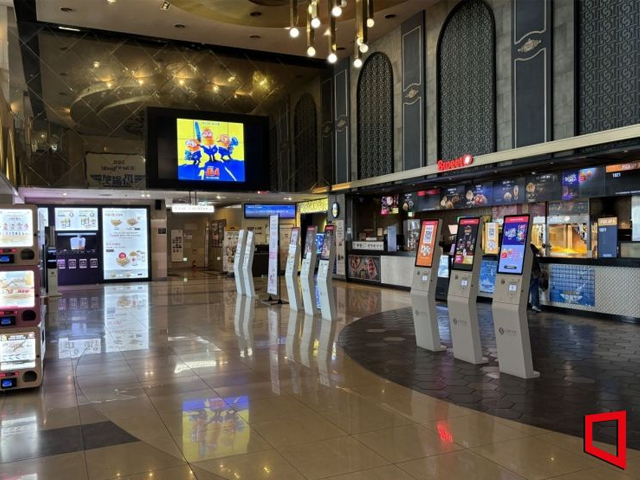 A movie theater in Gwanak-gu, Seoul. There are hardly any audience members or staff to be seen.
 Photo by Yeom Dayeon
As the film industry has not recovered its audience numbers even after COVID-19, the number of movie theaters closing down, especially in provincial areas, is increasing. Another movie theater in Yongsan-gu, Seoul, showed a similar scene. Despite being a large theater famous for its various screening rooms, it appeared somewhat quiet. Lee (23), who works there, said, "I've been working here for two years, and the number of staff has remained the same since COVID-19," adding, "Depending on the situation, we often take early leave upon request."
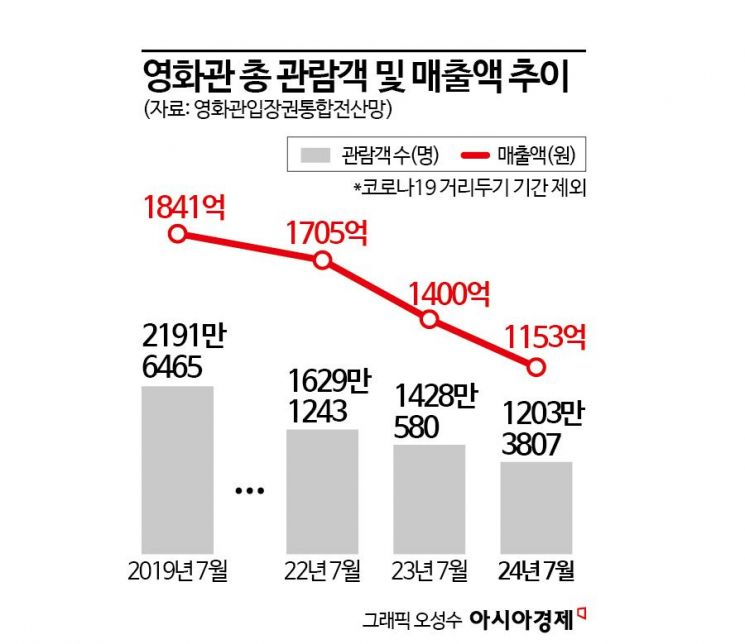
In fact, the number of movie theater visitors has been decreasing year by year. According to the Integrated Computer Network for Movie Theater Tickets, as of July, the total number of moviegoers was 12,033,807, which is almost half compared to 2019, just before the start of COVID-19. Despite the increase in movie ticket prices in 2022, total sales revenue has also decreased.
This stagnation in movie theaters is attributed to the aggressive competition from Over-The-Top (OTT) streaming services and the burdensome ticket prices. Popular culture critic Jung Deok-hyun explained, "Movie ticket prices have risen to a burdensome level, so the public inevitably feels the strain," adding, "OTT allows consumers to watch a lot of content for a monthly subscription fee, so this is a natural outcome."
Since 2022, after COVID-19, movie ticket prices have been 14,000 KRW on weekdays and 15,000 KRW on weekends including Fridays. The significant increase from 10,000 KRW in 2019 makes audiences feel burdened. Meanwhile, the number of domestic OTT users has steadily increased, surpassing 30 million.
No Hye-jin (25), who lives in Seongnam, Gyeonggi-do, said, "I used to visit movie theaters often, but after the price sharply increased, my expectations changed, so I stopped going," adding, "Unless people feel they must watch a movie in a theater, they watch movies on OTT." Actor Choi Min-sik (62) also sparked attention by saying on a talk show aired on the 17th, "I think audiences don't visit theaters because movie ticket prices are expensive."
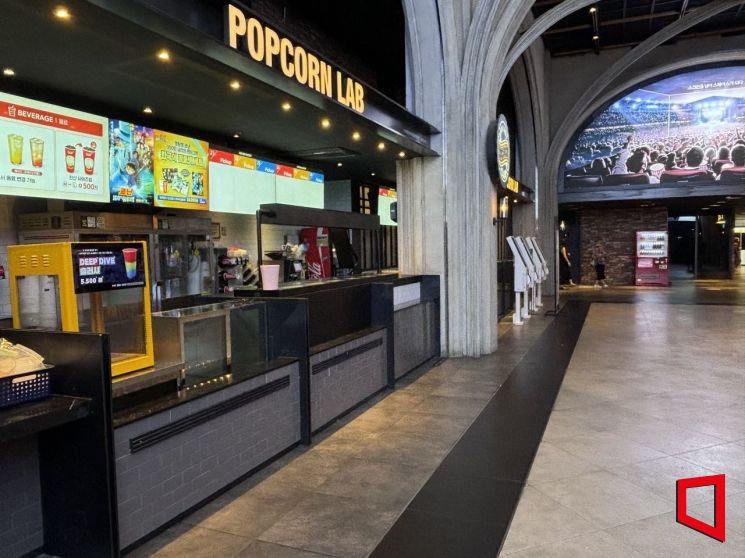 A movie theater in Yongsan-gu, Seoul. One of the two concession stands appears to be closed.
 Photo by Yeom Dayeon
In response, the film industry is striving to attract customers by expanding the genres screened in theaters. They offer services where groups can watch singer concerts, sports games, and dramas together. A recent group viewing event for the final episode of the popular drama 'Seonjae Eopgo Twieo' sold out 1,000 seats in five minutes, drawing explosive interest.
A CGV representative explained, "Concerts by artists and dramas have higher seat sales rates compared to movies, so they are called 'cash cow content,'" adding, "We are planning various contents so that people can feel joy in experiencing them together in theaters." They also stated, "We plan to expand special theaters with technology that allows special viewing of regular movies and premium screening rooms."
Experts emphasize that movie theaters need to expand their roles and functions as offline spaces. Critic Jung said, "The decrease in movie theater audiences was an inevitable result with the emergence of OTT, so new strategies are necessary," advising, "We must continue to discover and expand content that can only be experienced in theaters."
Professor Lee Eun-hee of Inha University's Department of Consumer Studies also said, "Seeing how people flock to various department stores and shopping malls, the public's desire for offline spaces remains strong," adding, "Theaters need to expand their spaces to provide various experiences beyond just movies."
© The Asia Business Daily(www.asiae.co.kr). All rights reserved.
![Clutching a Stolen Dior Bag, Saying "I Hate Being Poor but Real"... The Grotesque Con of a "Human Knockoff" [Slate]](https://cwcontent.asiae.co.kr/asiaresize/183/2026021902243444107_1771435474.jpg)


















