Challenges such as the Chaesangbyeong Special Prosecutor Act and the 250,000 Won Support Act
Possible Partial Agreement on Financial Investment Tax and Inheritance Tax Discussions
Lee Jae-myung, leader of the Democratic Party of Korea, and Han Dong-hoon, leader of the People Power Party, have reached a sudden agreement to hold a bilateral meeting on the 25th. However, there are expectations that negotiations between the two sides will not be easy due to political contentious issues. Both sides have expressed their intention to prioritize "livelihood" as the top agenda, but since livelihood and policy issues have been intricately intertwined for a long time, it is pointed out that finding common ground in a short period will inevitably be difficult.
According to political circles on the 20th, it is highly likely that Lee will bring up the "Chae Sang-byeong Special Prosecutor Act" as the first agenda item at the meeting. Earlier, Lee proposed a bipartisan meeting in his reappointment acceptance speech and directly mentioned that "frank discussions about the Chae Sang-byeong Special Prosecutor Act are necessary." The agreement on the Chae Sang-byeong Special Prosecutor Act is thus a prerequisite for bipartisan discussions on livelihood bills. A Democratic Party official said in a phone call, "More than one in two citizens said in surveys that a special prosecutor law is necessary to clarify the external pressure allegations in the Chae Sang-byeong case," adding, "Since both sides will sit at the discussion table frankly, the mainstream opinion within the party is that this (special prosecutor law) issue must be resolved first."
Additionally, the Livelihood Recovery Support Fund (a bill to provide 250,000 won to all citizens) is also likely to be on the agenda. This is because Lee himself proposed it and it is the Democratic Party’s first official party bill in the 22nd National Assembly, giving it symbolic significance. The bill provides all citizens with local love gift certificates and requires the state and local governments to provide administrative and financial support necessary for the payment of the Livelihood Recovery Support Fund. However, it is scheduled for a re-vote at the end of this month due to President Yoon Seok-yeol’s veto. The Democratic Party has left open the possibility of consultation with the opposition regarding the support fund bill. Lee Hae-sik, secretary to the Democratic Party leader, said, "Whether differential support or selective support, the leader has mentioned both. It is not a major issue." This suggests that the ruling and opposition parties can flexibly discuss matters such as the scope of the support fund payment.
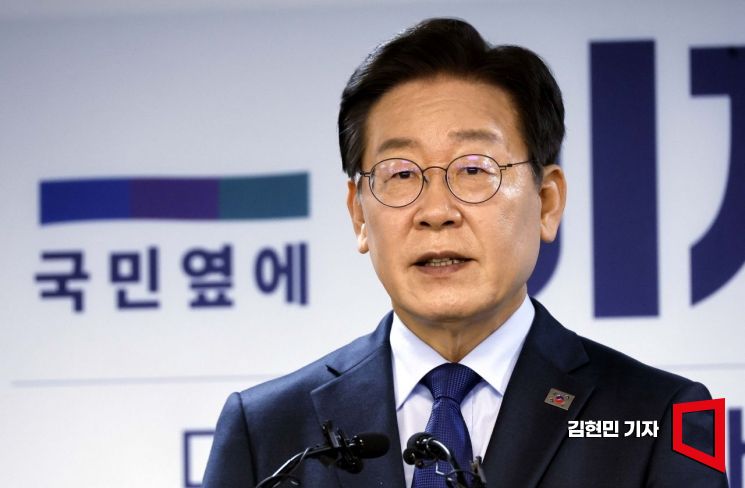 Lee Jae-myung, former leader of the Democratic Party of Korea, is declaring his candidacy for party leader at the party headquarters in Yeouido, Seoul, on the 10th. Photo by Hyunmin Kim kimhyun81@
The People Power Party plans to focus discussions on issues such as the abolition of the financial investment income tax (financial investment tax) and the reduction of inheritance tax rates. Notably, Lee also sympathizes with the suspension and easing of the financial investment tax during the party convention period, so the possibility of agreement is judged to be the highest. A People Power Party lawmaker said, "Since Lee said he prioritizes livelihood, is there any more appropriate agenda than discussing the abolition of the financial investment tax? It is time to show sincerity."
On the other hand, there is a strong negative sentiment regarding the possibility of discussing the Chae Sang-byeong Special Prosecutor Act, which is a prominent agenda for the Democratic Party. Until the day before, both sides clashed over the special prosecutor law. Park Chan-dae, floor leader of the Democratic Party, expressed willingness to accept Han’s "third-party recommended Chae Sang-byeong Special Prosecutor Act" and demanded, "Propose the third-party recommended Chae Sang-byeong Special Prosecutor Act within ten days." In response, Han made a de facto counterproposal, saying, "It is necessary to include the so-called whistleblower manipulation allegations recently revealed as part of the investigation." Han directly criticized the Democratic Party’s proposal, saying, "On one hand, they propose a law with much stronger unconstitutionality, and on the other hand, they say they will accept the Supreme Court Chief Justice (recommended) special prosecutor I proposed. People might have various thoughts about their true intentions."
The 250,000 won support bill could provoke opposition not only from the ruling party but also from the administration. With the national debt exceeding 1,000 trillion won, additional budget allocation is difficult. In particular, Choo Kyung-ho, floor leader and former Minister of Strategy and Finance, clearly expressed opposition by saying, "I firmly oppose it as a cash handout bill," leading to the judgment that negotiations themselves will be difficult.
Some express concern that due to significant conflicts over major contentious bills between the ruling and opposition parties, this meeting might end up as merely an event of "a meeting between two presidential candidates." To prevent this, opinions are emerging that both sides should actively discuss regular meetings and bipartisan government consultations.
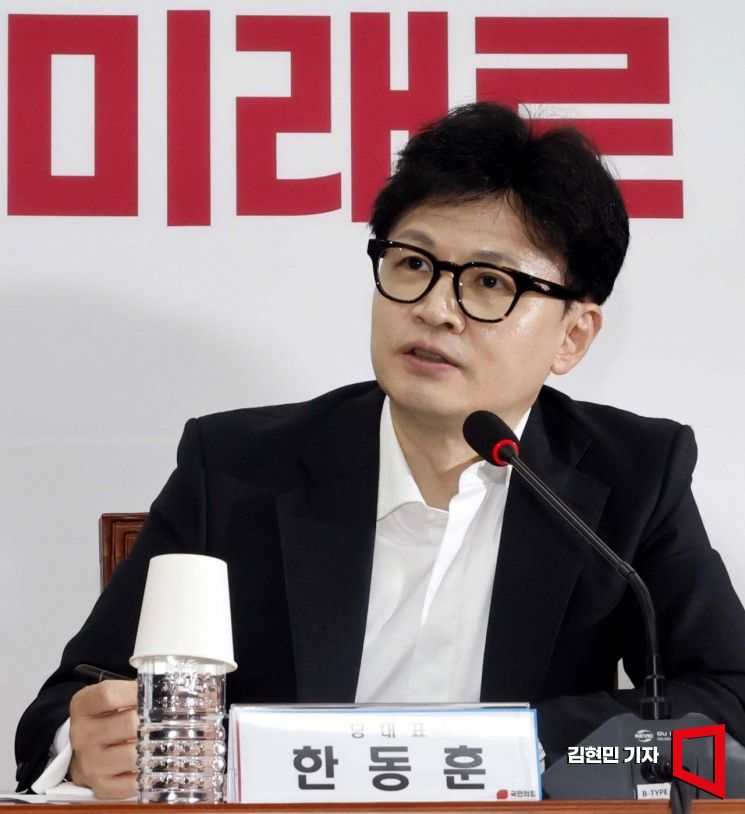 Handonghun, the leader of the People Power Party, is speaking at the Supreme Council meeting held at the National Assembly on the 29th. Photo by Hyunmin Kim kimhyun81@
© The Asia Business Daily(www.asiae.co.kr). All rights reserved.


















