Pilot Operation Starts from the 1st of Next Month
26.2 Billion Won Support for 17 Education Offices
Teacher-to-Young Child Ratio, Care Gaps, etc.
Focus on High-Demand Tasks
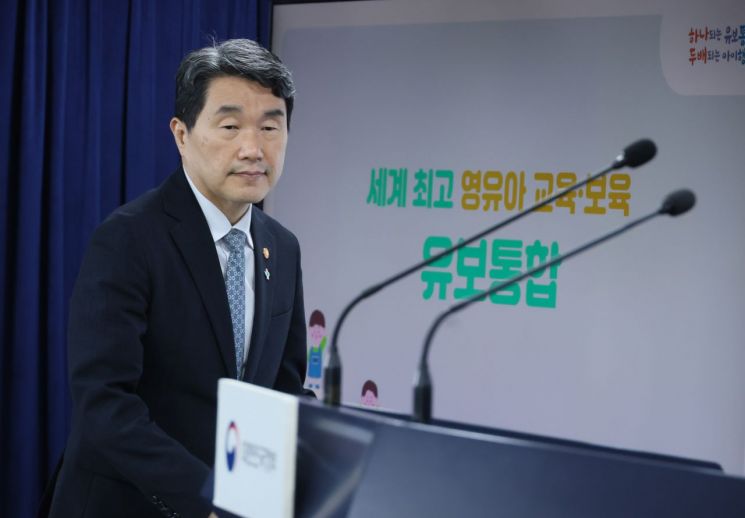
The Ministry of Education will operate pilot schools at kindergartens and daycare centers nationwide starting next month to develop a 'Preschool Integration' promotion model. The plan is to apply the pilot model for six months to address issues such as gaps in education and care, and the reduction of the number of young children per teacher.
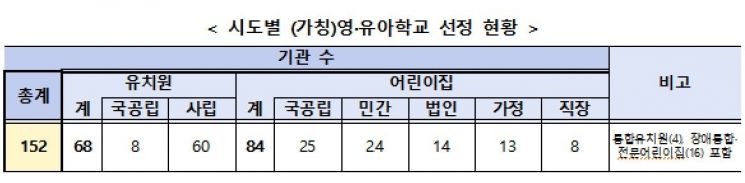
On the 20th, the Ministry of Education announced that 152 institutions were selected as pilot schools for the 'Infant and Toddler School (tentative name) Pilot Project.' The pilot schools will be finally selected after advisory and plan supplementation procedures by the education offices and will begin pilot operation from the 1st of next month.
The selected institutions include 68 kindergartens and 84 daycare centers. Among them are 4 kindergartens with special classes, 13 inclusive daycare centers for children with disabilities, and 3 specialized daycare centers for children with disabilities. Each metropolitan and provincial office of education will support at least 3 kindergartens and 3 daycare centers as a minimum standard.
The pilot project will be evaluated annually, and support for the following year will be decided based on the performance. Support can be provided for up to three years. The Ministry of Education will invest a total of 26.2 billion KRW in special grants, approximately 1.5 billion KRW per each of the 17 education offices. This support will be provided from next month until February of the following year.
Through this pilot project, the Ministry of Education plans to verify and supplement the integration model through research and performance evaluation. Each pilot school will focus on tasks such as ▲ensuring sufficient operating hours ▲optimizing the teacher-to-child ratio ▲strengthening demand-tailored education and care programs ▲enhancing teachers' professionalism and capabilities. Each education office will support and manage improvements by considering the type and conditions of each pilot school.
Each pilot school will guarantee a basic operating time of 8 hours plus 4 hours of morning and evening care (upon parental request) to eliminate gaps in education and care and create an environment where work and family life can coexist. Additionally, the number of young children per teacher will be reduced. Support will be provided to assign additional teachers if the teacher-to-child ratio exceeds 1:2 for age 0, 1:13 for age 3, 1:15 for age 4, and 1:18 for age 5.
The 17 metropolitan and provincial education offices will establish selection and management plans for pilot schools and build a support system by forming local advisory groups and principals' councils. They also plan to operate various distinctive projects to improve the overall quality of all infant and toddler education and care institutions in their jurisdictions.
For example, the Seoul, Sejong, Gwangju, Gyeonggi, Chungbuk, and Gyeongnam education offices will provide play and experience programs for young children by utilizing various cultural facilities in the region (museums, art galleries, public libraries, etc.). The Daegu, Gyeonggi, and Jeonbuk education offices plan to operate hub-type care institutions for young children who need care during commuting hours.
An official from the Ministry of Education explained, "Pilot schools will focus on tasks with high demand, and the education offices will provide support accordingly. We will identify areas that need improvement or additional support during actual operation and reflect them in the Preschool Integration implementation plan to be announced at the end of the year."
© The Asia Business Daily(www.asiae.co.kr). All rights reserved.


















