Rising Prices Increase Practical Shoppers Buying 'Only What They Need'
Orion's Domestic Strategy for Second Half: '1000-Won Snacks'
1000-Won Beer and Tofu Appear in Marts and Convenience Stores
"The party is over."
Recently, the American CNN announced the end of the YOLO generation. YOLO stands for You Only Live Once. Those who willingly open their wallets for immediate happiness and live a luxurious life were called the YOLO generation. YOLO became a consumption trend among the 2030 generation, synergizing with revenge spending after the COVID-19 endemic.
However, with prolonged inflation, the consumption party of the YOLO generation is coming to an end. Instead of YOLO, the YONO generation has rapidly emerged. YONO stands for You Only Need One. It refers to those who consume only the minimum necessary items. After the endemic, as their savings ran out and economic uncertainty increased, they are pursuing maximum utility with minimal spending.
The same applies to Korea. With high prices, high interest rates, and a shaky stock market, conspicuous consumption such as 'omakase' or 'hokangsu' is no longer considered 'hip.' Consumers with tightened budgets clearly show a tendency to prioritize practicality, and in the distribution industry, products that offer ‘happiness for 1,000 won’ are flooding the market.

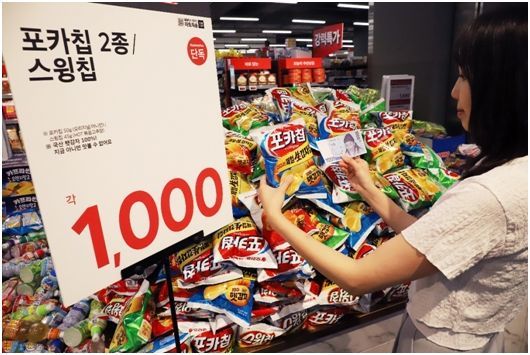
According to the distribution industry on the 20th, Orion recently identified '1,000 won snacks' as a strategy to expand domestic market sales in the second half of the year after announcing its Q2 performance. A 1,000 won snack is a product that reduces the volume of existing products and sells them for 1,000 won. Orion plans to produce and sell seven types of 1,000 won snacks, including its flagship products Poca Chip, Swing Chip, Kkobuk Chip, Oh! Potato, Sun, Nacho, and Nurungji. The price per gram is the same as the existing products. The 1,000 won snacks are already being sold at some Homeplus stores and local marts.
An Orion official explained, "As high prices continue, more consumers are trying to make rational purchases," adding, "Unlike shrinkflation, which reduces quantity at the same price, we are adjusting the quantity to fit 1,000 won to target the YONO generation who buy only what they really need."
Orion plans to gradually expand the 1,000 won snack brand based on market response.
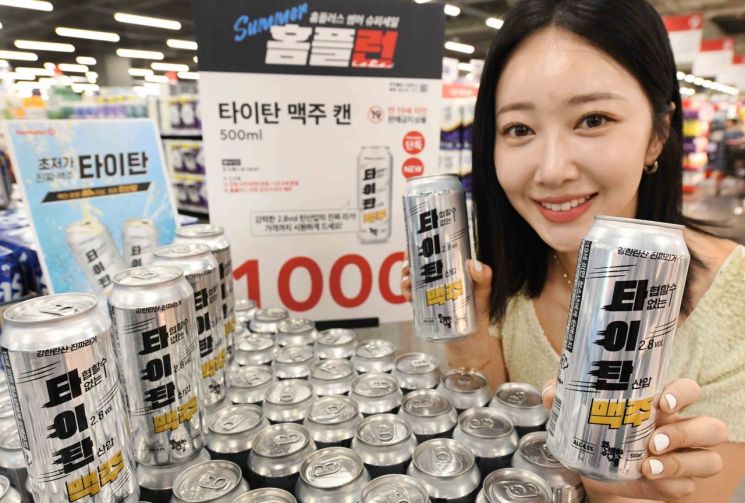
1,000 won beer has also appeared. Homeplus started the second sale of 1,000 won beer Titan 500ml on the 15th. Titan, launched earlier this month, sold out its initial 70,000 cans within three days. Titan is reasonably priced compared to other sparkling beers on the market, but it gained popularity due to containing over 80% malt and having a stronger carbonation pressure (2.8 vol) than competing products.
Seven Eleven is also re-releasing 1,000 won beers 'Virgin Mister 500ml' and 'Praga Fresh 500ml.' These products were first introduced in April and June, respectively, and sold out their initial stocks of 200,000 and 250,000 units within five days of release.
1,000 won tofu is also on sale. CU recently launched ‘HEYROO Tofu Deuktem.’ It is a 300g cooking tofu priced up to 45% cheaper than similar products sold at CU. To offer competitively priced, high-quality tofu, CU visited about 10 domestic small and medium-sized manufacturers with HACCP certification. By minimizing costs through a 100% direct transaction system without middle vendors, CU succeeded in selling 1,000 won tofu.
An industry insider said, "The YONO generation wants to eat a reasonable amount of snacks at a reasonable price," adding, "This is a phenomenon different from simply pursuing 'cost-effectiveness,' so as lifestyles change, the distribution industry will compete not only on price but also on packaging and other ideas."
© The Asia Business Daily(www.asiae.co.kr). All rights reserved.
![Clutching a Stolen Dior Bag, Saying "I Hate Being Poor but Real"... The Grotesque Con of a "Human Knockoff" [Slate]](https://cwcontent.asiae.co.kr/asiaresize/183/2026021902243444107_1771435474.jpg)


















