Jung-gu Launches Waste Reduction Project 'Infinite Practice Challenge'
Seongdong and Dongjak-gu Promote 'Plastic Waste Separation Activation' Initiative
Local governments continue their steady efforts to reduce waste such as household garbage.
Jung-gu, Seoul, will start the waste reduction project "Infinite Practice Challenge" with residents from the 19th and is recruiting participants. The challenge includes tasks that can be easily practiced in daily life, such as donating clothes you don't wear, separating and disposing of waste vinyl, practicing plogging (picking up trash), and removing labels from PET bottles and delivery boxes before recycling.
They will recruit 200 participants by the 30th of this month and conduct the challenge from the 9th of next month to October 4th. Participants will continue the challenge by uploading photos certifying task completion on the Naver Band during the activity period. Those who complete all four challenge tasks and certify them will receive Onnuri gift certificates, and 15 outstanding participants will be awarded the district mayor’s commendation.
Jung-gu planned this challenge to expand citizens' consensus on reducing household waste and protecting the environment through small daily practices. Jung-gu was also selected as the best district for four consecutive years since 2021 in the "Seoul Metropolitan Government District Household Waste Input Management Evaluation," which evaluates districts' performance in reducing waste input from the previous year.
Seongdong-gu is actively promoting the "Waste Vinyl Separation and Disposal Activation" project to reduce household waste. Although waste vinyl is recyclable, it is often mixed with general waste in volume-based waste bags and ends up being incinerated or landfilled.
In particular, the project targets 113 franchise headquarters and 10,000 businesses in Seongsu-dong, Geumho-dong, and Yongdap-dong, where waste vinyl generation is higher than in general households, expecting practical effects. From this month, they are distributing 30 dedicated bags per business and informational leaflets to encourage proper separation and disposal of waste vinyl.
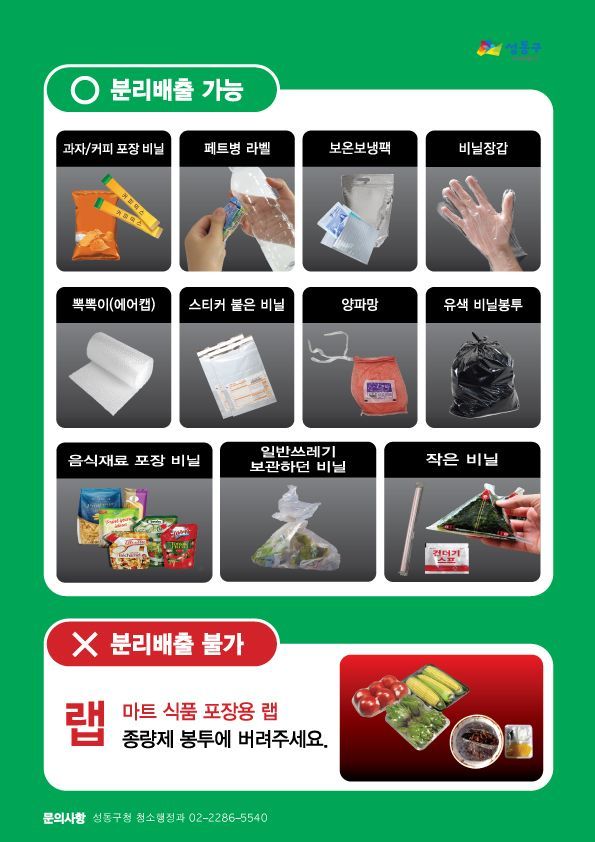
Besides waste vinyl, vinyl cushioning materials (air caps), snack and coffee packaging vinyl, and colored vinyl including black bags can be separated and disposed of. However, items such as strings, supermarket food wrapping wrap, and vinyl contaminated with solid substances like oil or grease are not subject to separation and disposal. Heavily contaminated waste vinyl with food waste should be rinsed with water to remove foreign substances before separation and disposal.
Dongjak-gu is also promoting the "Waste Vinyl Separation and Disposal Activation" project starting this month. They are focusing on the top 10 industries that generate large amounts of waste vinyl, including restaurants, bakeries, fast food outlets, pubs, coffee and beverage shops, chicken specialty stores, PC rooms, motels, marts and convenience stores, and fruit and vegetable shops.
A total of 64 personnel, including "Our Neighborhood Cleaning Agents" and "Illegal Dumping Inspectors," have been deployed in focused management areas to conduct publicity and on-site inspections.
© The Asia Business Daily(www.asiae.co.kr). All rights reserved.
![Clutching a Stolen Dior Bag, Saying "I Hate Being Poor but Real"... The Grotesque Con of a "Human Knockoff" [Slate]](https://cwcontent.asiae.co.kr/asiaresize/183/2026021902243444107_1771435474.jpg)
















