Virus Concentration in Sewage Doubles in One Week
1,359 Hospitalized Patients in the Second Week of August
As the resurgence of COVID-19 has become full-scale, the concentration of the COVID-19 virus in sewage nationwide has also been found to have rapidly intensified.
According to the National Sewage-based Infectious Disease Surveillance Project (KOWAS) website operated by the Korea Disease Control and Prevention Agency (KDCA) on the 18th, the concentration of the COVID-19 virus in sewage treatment plants nationwide during the 32nd week of this year (August 4?10) was 47,640 copies per 1 ml (unit of virus quantity). This is about twice the 24,602 copies recorded in the 31st week (July 28?August 3) one week earlier.
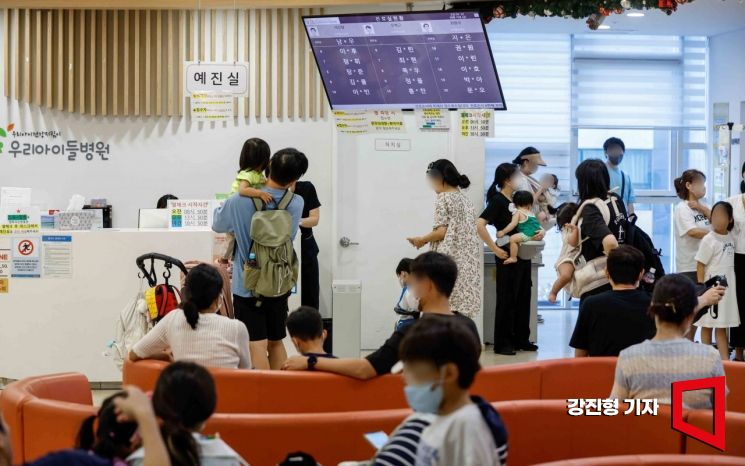 As COVID-19 resurges, the number of pediatric patients has nearly tripled in the past two weeks. On the 16th, Seoul Seongbuk-gu Seongbuk Woori Children's Hospital was crowded with patients waiting for treatment. Photo by Jinhyung Kang aymsdream@
The virus concentration in sewage had dropped below 10,000 copies per 1 ml from the 17th week (April 21?27) this year, but exceeded 10,000 copies again at 13,336 copies per 1 ml in the 30th week (July 21?27), then surged to 24,602 copies in the 31st week and 47,640 copies in the 32nd week, doubling within a week.
The concentration of the COVID-19 virus in sewage is an estimated value calculated by considering the population distribution by region based on measurements from 84 sewage treatment plants across 17 provinces nationwide. However, to avoid inaccuracies caused by various natural environmental factors such as heavy rain, the results are averaged over three weeks, so the latest figures may differ. Since April last year, the KDCA has been conducting the nationwide sewage-based infectious disease surveillance project to analyze the amount of virus mixed in domestic sewage to estimate the occurrence of COVID-19 patients in the community, not in medical institutions.
According to the weekly analysis report of the KDCA’s sewage-based infectious disease surveillance, as of the 32nd week, the concentration of the COVID-19 virus in sewage increased in 14 out of the 17 provinces nationwide, excluding Gyeongnam and Jeju. Concentration data for Jeonbuk was not analyzed due to lack of data and other reasons.

During the period when the concentration increased, the number of COVID-19 hospitalized patients also rose. The weekly new COVID-19 hospitalizations in the 30th week were 477, which is 2.1 times the 229 patients in the previous week. Furthermore, the number sharply increased to 878 in the 31st week and reached 1,359 new hospitalizations in the 32nd week. This accounts for 65.8% of the total 2,066 new viral hospitalizations that week. In particular, among viral hospitalizations of those aged 65 and older, COVID-19 patients were the most numerous. The cumulative number of hospitalized patients aged 65 and older due to COVID-19 this year is approximately 9,000.
© The Asia Business Daily(www.asiae.co.kr). All rights reserved.
![Clutching a Stolen Dior Bag, Saying "I Hate Being Poor but Real"... The Grotesque Con of a "Human Knockoff" [Slate]](https://cwcontent.asiae.co.kr/asiaresize/183/2026021902243444107_1771435474.jpg)

















