Life-or-Death Crossroads Amid Israel's Blockade and Indiscriminate Airstrikes
Since the outbreak of the war in Gaza, the number of Palestinian residents who have died is reported to have exceeded 40,000, but there are concerns that the actual death toll may be even higher.
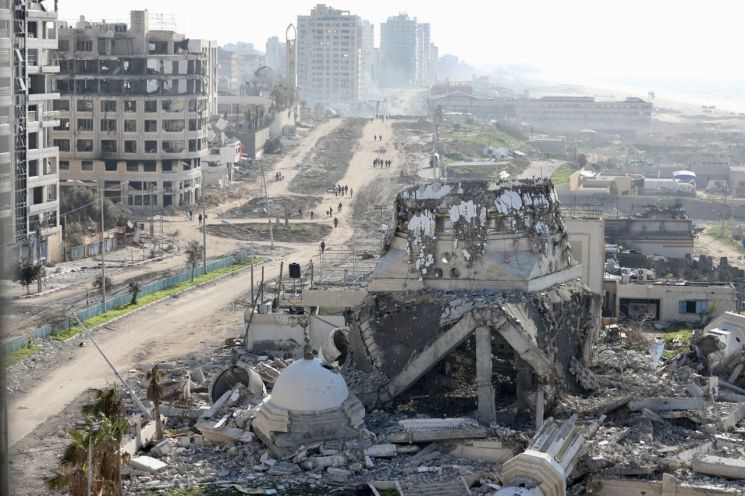
The Gaza Strip Ministry of Health, controlled by the Palestinian armed faction Hamas, announced on the 15th (local time) that approximately 40,000 residents have died due to Israeli attacks since the war began on October 7 last year. However, there is also a prevailing perception that this figure, based on Hamas's own count, cannot be fully trusted. Another limitation pointed out is that the Gaza Ministry of Health does not distinguish between civilians and combatants when counting the dead.
Nevertheless, experts have evaluated that the Gaza Ministry of Health's figures are relatively accurate. Although the death toll of 40,000 may be an underestimate, it is not considered an inflated number. According to the US daily Washington Post (WP), Michael Spagat, a professor at the University of London who studies conflict casualties, stated that the Gaza Ministry of Health has been tallying daily deaths based on the number of bodies in hospital morgues, and that this method was "highly reliable" in the early stages of the war.
Additionally, researchers such as Rasha Khatib from the US public health research organization Advocates Aurora Research Institute (AARI) stated in a paper published last month in the medical journal Lancet that "the reported death toll is likely underestimated." According to the research team, wars typically cause not only direct deaths from airstrikes and other attacks but also indirect deaths due to the destruction of medical infrastructure and shortages of food and water. Therefore, in recent global conflicts, indirect deaths have been estimated to be about 3 to 15 times the number of direct deaths. Based on this, the research team argues that the death toll in Gaza could be as high as 186,000. Considering Gaza's population of 2.2 million, this means about one in ten residents has died from the direct and indirect effects of the war.
The United Nations and local activists in Gaza report that most of the deceased are women and children. Pikru Shaltut, head of Gaza for the UK relief organization Medical Aid for Palestine, pointed out, "40,000 women, children, youth, adults, and elderly people no longer exist."
Volker T?rk, the UN High Commissioner for Human Rights, said in a statement on the 15th, "This unimaginable situation has occurred because the Israeli military did not comply with the rules of war," adding, "On average, about 130 people have lost their lives daily in Gaza over the past 10 months." He also criticized, "The scale of destruction caused by the Israeli military to homes, hospitals, schools, and places of worship is extremely shocking."
Israel began a retaliatory war targeting Hamas's stronghold, the Gaza Strip, after 1,200 people died in a surprise attack by Hamas in October last year. Israel, aiming for the complete dismantling of Hamas, blocked access routes to Gaza, cutting off the flow of essential goods and supplies before launching military operations.
The Israeli military, viewing Hamas as using civilian facilities such as schools and hospitals as shields, conducted intense ground battles even in these prohibited locations. Amid such indiscriminate offensives, civilians who should be protected in war?including women, children, and the elderly?have been massively attacked, leading to international criticism of Israel for war crimes.
© The Asia Business Daily(www.asiae.co.kr). All rights reserved.
![Clutching a Stolen Dior Bag, Saying "I Hate Being Poor but Real"... The Grotesque Con of a "Human Knockoff" [Slate]](https://cwcontent.asiae.co.kr/asiaresize/183/2026021902243444107_1771435474.jpg)
















