This summer, natural disasters have simultaneously occurred across the nation's seas, drawing evaluations that this is unusual.
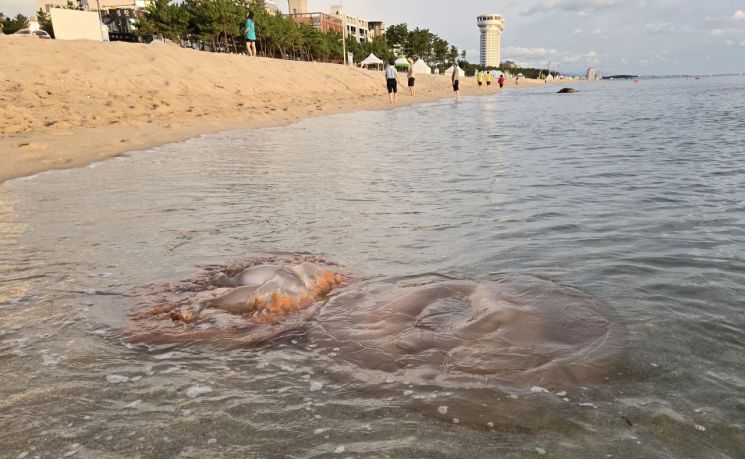
According to the National Institute of Fisheries Science on the 17th, natural disasters such as high water temperatures, jellyfish, red tides, cold water masses, and oxygen-deficient water masses are occurring simultaneously in various coastal areas nationwide. As of the 15th, Hampyeong Bay in the West Sea recorded the highest temperature at 31 degrees Celsius, with the West Sea coast at 30 degrees and Cheonsuman at 29.1 degrees.
Recently, the rise in sea water temperature has caused a rapid increase in jellyfish. The highly toxic Nomura's jellyfish have appeared along the entire coastline, prompting caution advisories last month in the waters of Busan, Ulsan, Gyeongbuk, Gangwon, and Jeonnam. This year, the number of Nomura's jellyfish that flowed into domestic coastal waters from China reached 108 per hectare (1 ha = 10,000㎡), the highest since observations began in 2015.
Additionally, in Cheonsuman on the West Coast, oxygen-deficient water masses were observed for the first time in six years due to a sharp rise in temperature. A cold water mass advisory, where the surface water temperature near the coast is about 8 degrees lower than surrounding waters, is currently in effect along the central East Sea coast. Red tide advisories are in place in Deukryang Bay and the eastern southern sea off Jeonnam, while red tide preliminary warnings are maintained in the western southern sea off Jeonnam, the western southern sea off Gyeongnam, and the central sea off Geoje.
An official from the National Institute of Fisheries Science stated, "As the North Pacific high pressure and Tibetan high pressure settle over the Korean Peninsula, the heat is prolonged, and concentrated heavy rains in China have affected the Korean Peninsula's waters." He added, "Further research is needed, but it is presumed that there is a link mediated by the impact of climate change among the successive natural disasters." He continued, "It is unusual for summer natural disasters to appear in this form. Because they occur simultaneously in many places, they are causing significant damage to aquaculture farms and others." He concluded, "Since the frequency and intensity of disasters may increase in the future, special caution is necessary."
© The Asia Business Daily(www.asiae.co.kr). All rights reserved.
![Clutching a Stolen Dior Bag, Saying "I Hate Being Poor but Real"... The Grotesque Con of a "Human Knockoff" [Slate]](https://cwcontent.asiae.co.kr/asiaresize/183/2026021902243444107_1771435474.jpg)
















