Morning hearing sparks controversy over transcript destruction
Government "Fears of escalating conflict" vs Opposition "Violation of law"
Afternoon hearing includes correction after reviewing National Assembly stenographic records
Ruling party points out medical service gaps and medical school education issues
Opposition criticizes "hasty decision without on-site verification"
On the 16th, the Ministry of Education revealed that it had destroyed the minutes of the Medical School Quota Allocation Review Committee, which played a role in allocating 2,000 medical school quotas to each university in March 2025, sparking controversy at one point. The Ministry argued that leaking the minutes could exacerbate conflicts, but opposition parties criticized it as a violation of the Public Records Management Act, leading to a heated dispute. However, as the government revised its statement from destroying the committee's minutes to destroying reference materials and issued an apology, the related controversy appears to be settling.
Moon Jung-bok, the opposition party's secretary of the Education Committee, stated at the joint hearing on medical school education conducted by the National Assembly's Education and Health and Welfare Committees that day, "At last week's plenary meeting, the ruling and opposition party secretaries agreed to submit materials that sufficiently reveal the contents of the Allocation Review Committee's meetings, excluding the name of the anonymous committee chair as a witness, and the ruling party secretary and the Ministry of Education promised this." He added, "However, on the 13th, the deadline for submitting materials, the Medical School Quota Allocation Committee refused to submit materials, claiming it is an ad hoc, non-statutory committee and thus not subject to the mandatory preparation of minutes as stipulated by the Public Records Management Decree."
He continued, "Later that day around 5 p.m., they submitted materials again, but upon review, they were very insufficient," and "Although we requested additional supplementation, the committee said it had destroyed the consultation contents. The opaque operation and poor procedures of the committee, which have been controversial, are undermining the purpose of medical innovation and amplifying public anxiety by refusing to submit materials."
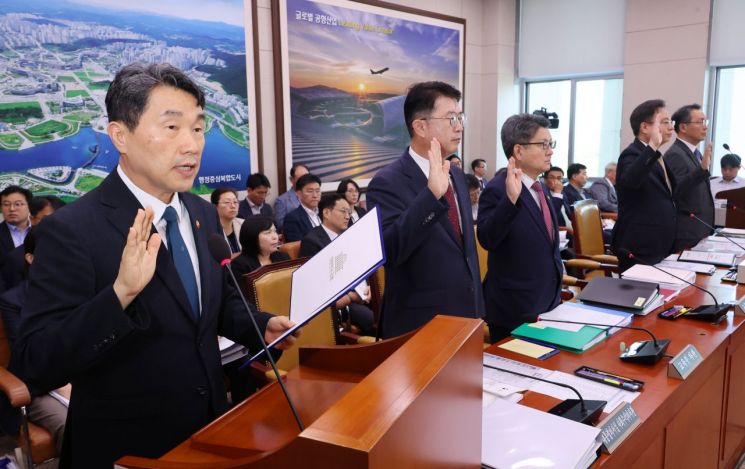 Lee Ju-ho, Deputy Prime Minister for Social Affairs and Minister of Education (far left in the photo), along with other witnesses, is taking an oath at the joint hearing on the inspection of medical school education held by the Education Committee and the Health and Welfare Committee at the National Assembly in Yeouido, Seoul, on the morning of the 16th. [Image source=Yonhap News]
Deputy Prime Minister: "It is customary for the Allocation Committee not to prepare minutes" vs Opposition: "Did not mention this when requested, mocking the National Assembly"
Lee Ju-ho, Deputy Prime Minister for Social Affairs and Minister of Education, explained, "The Allocation Committee is not a statutory body but an advisory body for the minister," and "It has been customary not to prepare minutes when operating the Allocation Committee, especially the Ministry of Education's Allocation Committee, not only for this committee but also for similar allocation committees."
He added, "Information about allocation committee members is handled by the Personal Information Protection Commission, and since allocation matters are very sensitive, we operate the committee with a promise to protect the personal information of members," and "Therefore, I ask for understanding that there were shortcomings in submitting materials based on the trust to protect personal information."
Kim Young-ho, chairman of the Education Committee from the Democratic Party of Korea, criticized, "The Allocation Committee was a very important meeting, and naturally, records should have been kept. If the contents were destroyed by agreement, when was it destroyed?" He added, "Not mentioning this when materials were requested is mocking and deceiving the National Assembly. If destroyed, they should have said there was no content. The ruling party secretary also agreed thinking materials existed. Do you think this makes sense?"
Park Joo-min, chairman of the Welfare Committee from the Democratic Party of Korea, also criticized, saying, "The government is making very important decisions, but it is impossible to verify what materials were used afterward," and "This causes a problem of declining trust."
Oh Seok-hwan, Vice Minister of Education, said, "I understand the destruction occurred during the period the committee was operating," and "I have explained that there are no minutes, and after much discussion, materials summarizing the meeting results were submitted at the request of the members. We do not have detailed materials from the meeting process." Regarding Kim's accusation of violating the Public Records Management Act and his question, "What were you afraid of to destroy them?" Oh replied, "We judged that minutes are not subject to recording under the Public Records Management Act, and we acknowledge that part."
Government: "Destroyed reference materials, not meeting minutes"… Controversy Settles
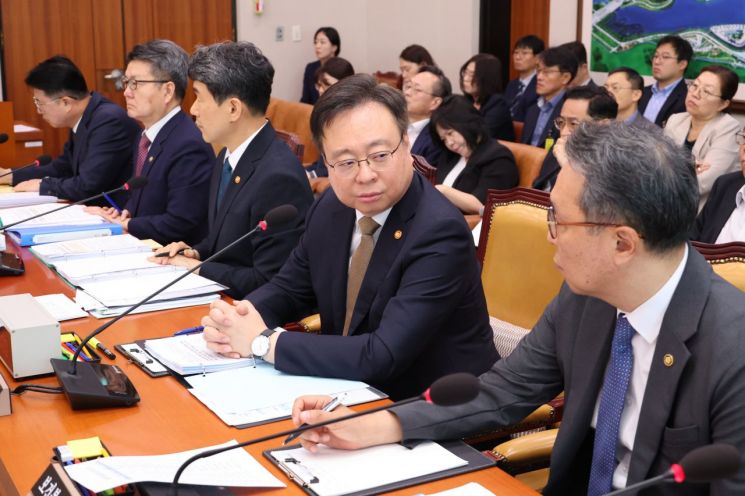
The government changed its statement from destroying meeting minutes to clarifying that no minutes were originally prepared and that reference materials for each meeting were destroyed. Vice Minister Oh explained the discrepancy between his morning and afternoon statements, saying, "We have consistently stated from the beginning that meeting minutes did not exist," and "The meeting results are summarized after the meeting and those results were submitted as materials to the court." He clarified that meeting minutes never existed and that the meeting result report submitted to the court was also submitted to the Education Committee.
Ruling and opposition lawmakers agreed to briefly recess and review the morning hearing transcript regarding the discrepancy in Vice Minister Oh's statements. After the meeting resumed, opposition lawmakers demanded an apology, claiming that Oh's statements could cause misunderstandings of perjury. In response, Chairman Kim asked Oh, "Do you acknowledge the difference between your morning and afternoon statements after reviewing the transcript?" Oh replied, "Yes."
Furthermore, Vice Minister Oh stated, "The Ministry of Education's official position is that 'minutes were not prepared, and materials summarizing the meeting results were submitted,'" and "I did not say that the meeting result report was shredded but mentioned that reference materials during the meeting process were shredded. I apologize for causing confusion." Although opposition lawmakers remained suspicious despite Oh's apology, Chairman Kim said, "Based on the transcript, it must be acknowledged that the statements were sufficiently questionable," thus concluding the 'minutes destruction' controversy.
Ruling and Opposition United: "Government Unprepared for Medical School Quota Increase"
At the hearing, both ruling and opposition parties criticized the government in unison for being unprepared, raising issues such as medical service gaps, medical education problems, and hasty quota increase decisions. Kim Dae-sik of the People Power Party pointed out to the Deputy Prime Minister, "Isn't the increase in medical school quotas to prevent gaps in essential and regional medical services?" He added, "However, due to the resignation of residents, medical service gaps on the ground are worsening."
Jeong Seong-guk, also from the People Power Party, welcomed the quota increase but criticized, "The biggest problem with increasing by 2,000 is the quality of education. No matter how much the quota increases, if professors at national university hospitals resign as they do now, what meaning does it have?"
Go Min-jung of the Democratic Party of Korea raised her voice, saying, "There is no such thing as hasty and sloppy as this. Making such a decision without field verification is almost like 'mind reading'."
Earlier, the Allocation Committee was criticized for hastiness after releasing results just five days after holding the review committee for quota allocation in March. Regarding this, Rep. Go criticized, "The Allocation Committee reportedly finished reviewing over 1,000 pages of application materials from each medical school in just one day, but the medical education inspection team's activity report clearly concluded there were limitations."
On the other hand, Vice Minister Oh responded, "Based on the demand applied by universities last November, the Ministry of Health and Welfare formed a medical inspection team to understand the field situation," and Minister Lee emphasized, "The medical school quota allocation process was conducted fairly and transparently without hiding anything."
© The Asia Business Daily(www.asiae.co.kr). All rights reserved.
![Clutching a Stolen Dior Bag, Saying "I Hate Being Poor but Real"... The Grotesque Con of a "Human Knockoff" [Slate]](https://cwcontent.asiae.co.kr/asiaresize/183/2026021902243444107_1771435474.jpg)
















