DAPA Adjusts Indonesia's Contribution to 600 Billion KRW
"Technology Transfer Will Also Decrease Proportionally to Reduced Contribution"
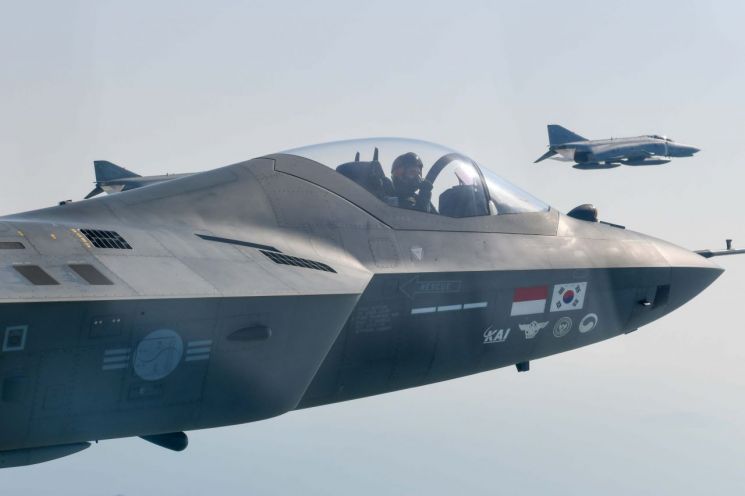
Indonesia's contribution to the Korean fighter jet KF-21 'Boramae', a joint development partner, has been reduced from the initial 1.6 trillion KRW to 600 billion KRW.
On the 16th, the Defense Acquisition Program Administration (DAPA) announced that at the 163rd Defense Acquisition Program Promotion Committee (DAPPC) meeting, the adjustment of the KF-21 joint development contribution ratio and the follow-up action plan were approved. Indonesia's system development contribution was adjusted to 600 billion KRW, and the committee reviewed and approved follow-up plans including value transfer adjustments and securing the shortfall in funding. DAPA stated that they comprehensively considered the bilateral cooperation relationship, including the mass production of the Indonesian-type fighter (IF-X), and the possibility of securing the shortfall in funding, and plan to conclude the contribution negotiations with Indonesia well to ensure the successful completion of the project.
The shortfall in funding is expected to be covered by the government and the system development companies' budgets. A DAPA official said, "The shortfall will be shared jointly by the companies and the government, with the government bearing a larger portion," adding, "Technology transfer was also approved to be conducted within the 600 billion KRW scope."
Regarding the KF-21 prototype that Indonesia was originally supposed to receive as compensation for joint development, the official said, "If Indonesia wants the prototype, we will negotiate, but if the total value of technology transfer including the prototype exceeds the contribution amount, they may have to pay more."
Excluding armaments, the development cost of the KF-21 is 8.1 trillion KRW. The contribution ratios of the Korean government, Korea Aerospace Industries (KAI), and Indonesia were set at 60%, 20%, and 20%, respectively. Indonesia agreed in January 2016 to bear 20% of the total KF-21 development cost, which was 1.7 trillion KRW (later reduced to 1.6 trillion KRW), until the completion of development in June 2026, and to receive corresponding technology transfers of equivalent value.
However, Indonesia changed its stance, citing financial difficulties, and stated it would only pay 600 billion KRW. The government decided to accept this proposal, judging that delays in contribution payments could affect the development schedule.
The KF-21 development cost was initially estimated at 8.1 trillion KRW, but cost reductions during development are expected to reduce it by about 500 billion KRW to 7.6 trillion KRW, according to DAPA. Therefore, even if Indonesia's contribution is cut from 1.6 trillion KRW to 600 billion KRW, the shortfall the government must cover is expected to be around 500 billion KRW, not 1 trillion KRW.
Meanwhile, at the same meeting, the DAPPC also approved the mass production plan for 155mm extended-range projectiles, the basic strategy for the ballistic correction fuze project, and the revised basic strategy for the medium tactical vehicle project. The 155mm extended-range projectile extends the range of the 155mm base bleed projectile used in self-propelled artillery by about 30%. System development was completed last year, and now a mass production plan has been established. The ballistic correction fuze adds guidance functions to improve the accuracy of the 155mm extended-range projectile. Research and development (R&D) will be promoted under the leadership of defense companies in the future, with a total project cost of 840 billion KRW from 2025 to 2033. The medium tactical vehicle is a vehicle for infantry unit mobility, and the goal was changed from R&D to domestic procurement. Approximately 382.5 billion KRW will be invested from 2026 to 2031.
© The Asia Business Daily(www.asiae.co.kr). All rights reserved.

















