Government, Economic Trends August Issue
No Major Change in Economic Perception Despite 'Moderate' Expression
Clear Temperature Difference with BOK and KDI
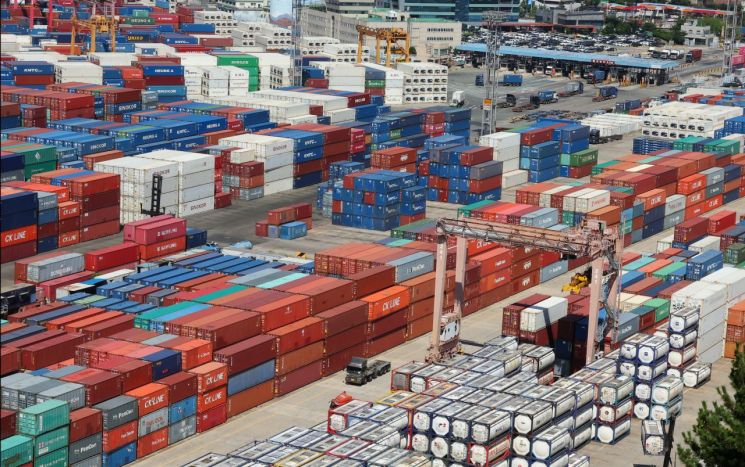
The government has maintained its assessment for four consecutive months that domestic demand is continuing to recover. Although indicators have emerged showing that the cause of the real GDP growth rate contraction in the second quarter of this year stems from sluggish private consumption and facility investment, raising concerns about economic instability, the government's economic outlook remains optimistic. This contrasts with the Korea Development Institute (KDI), a government-funded research institute, which has issued warnings about domestic demand slowdown due to prolonged high interest rates.
In the August issue of 'Recent Economic Trends' published by the Ministry of Economy and Finance on the 16th, it stated, "Our economy is showing signs of a gradual domestic demand recovery centered on facility investment amid an overall trend of price stability, supported by solid export and manufacturing performance, sustaining the economic recovery trend." Regarding prices, the phrase "overall price stability" was used, reflecting a more positive evaluation compared to the previous month, and although the phrase "gradual" was added to describe the signs of domestic demand recovery, the overall perception of a domestic demand recovery trend was not changed.
The government has maintained an optimistic view on domestic demand recovery from May through this month. While it had previously held the view that domestic demand was not keeping pace with export recovery, from May it changed the expression to "signs of domestic demand recovery are appearing." In June, it diagnosed that "signs of domestic demand recovery are strengthening, gradually expanding the economic recovery trend," and in July, it continued the assessment of "signs of domestic demand recovery" for the third consecutive month. In August, although the term "gradual" was added, the existing framework of judgment regarding signs of domestic demand recovery was maintained.
During the period when the government was optimistic about domestic demand, the real GDP growth rate in the second quarter contracted due to sluggish domestic demand indicators such as investment and consumption. On the 27th of last month, the Bank of Korea announced that the real GDP growth rate for the second quarter was -0.2%, indicating a contraction compared to the first quarter of this year. This is the first quarterly contraction in the Korean economy in one year and six months since the fourth quarter of 2022 (-0.5%). Notably, private consumption decreased by 0.2% compared to the first quarter. The strong export performance did not translate into a virtuous cycle of increased household income and stimulated consumption.
According to the National Statistical Portal (KOSIS) of Statistics Korea, retail sales in the second quarter decreased by 2.9% compared to the same quarter last year. This is the largest decline in 15 years since the first quarter of 2009 (-4.5%) during the financial crisis. Despite indicators showing that the cause of the second quarter GDP contraction lies in sluggish private consumption and facility investment, the government's diagnosis has not changed. The government cited increases in inbound tourists and two consecutive months of real wage growth as evidence of signs of domestic demand recovery. Kim Gwi-beom, head of the Economic Analysis Division at the Ministry of Economy and Finance, said, "Exports are strongly supporting the economy, and the second quarter GDP contraction is an adjustment within expected levels," adding, "In the case of retail sales, improvements in consumer sentiment and increases in inbound tourists are expected to act as positive factors."
However, in the short term, it is unlikely that the momentum for domestic demand recovery will strengthen significantly. For the labor market to recover, a virtuous cycle must occur where export growth leads to facility investment expansion, which in turn leads to job creation. However, facility investment in the second quarter sharply declined by 3.4% compared to a year earlier, confirming that the trickle-down effect from export growth is limited, and the prolonged slump in the construction sector is restricting investment recovery. Moreover, the prolonged high interest rates, due to the Bank of Korea missing the timing for rate cuts, have increased financial costs such as interest payments, acting as another factor limiting domestic demand recovery.
The coincident index of economic indicators in June fell by 0.1 points from the previous month to 98.7, marking a decline for four consecutive months. When this index falls below 100, it is interpreted as a sign that the current economic situation is unfavorable. The sluggish consumption market, unlike the rebound in the domestic leading index, manifested as a decline in the coincident index, warning that the domestic economic recovery may be weak.
Major global investment banks (IBs) have successively lowered their growth forecasts for the Korean economy this year. The average real GDP growth rate forecast for Korea by eight global IBs, including Goldman Sachs and JP Morgan Chase, was 2.5% as of the end of July, down 0.2 percentage points from a month earlier. Among the eight, Swiss investment bank UBS lowered its growth forecast the most, by 0.7 percentage points to 2.3%, while Goldman Sachs also revised its forecast down by 0.2 percentage points from 2.5% to 2.3%. Additionally, Citibank (2.4%), Barclays (2.6%), and JP Morgan Chase (2.7%) each lowered their forecasts by 0.1 percentage points within a month.
The government's optimism contrasts sharply with KDI's diagnosis of "domestic demand sluggishness." Earlier, on the 8th, KDI stated, "Exports are showing strong recovery, but prolonged high interest rates may slow economic recovery due to domestic demand sluggishness," lowering its economic growth forecast for this year by 0.1 percentage points from 2.6% to 2.5%. The main reason for lowering the growth forecast was domestic demand sluggishness.
© The Asia Business Daily(www.asiae.co.kr). All rights reserved.
![Clutching a Stolen Dior Bag, Saying "I Hate Being Poor but Real"... The Grotesque Con of a "Human Knockoff" [Slate]](https://cwcontent.asiae.co.kr/asiaresize/183/2026021902243444107_1771435474.jpg)
















