Longest Tropical Night 'Tie' in 118 Years
"Heatwave and Tropical Nights to Persist for a While"
As the heatwave continues day after day, Seoul's tropical nights have entered the longest period on record. The government is maintaining the highest heatwave crisis alert level, 'Severe,' for the second consecutive week, putting all efforts into response measures.
According to the Ministry of the Interior and Safety and the Korea Meteorological Administration on the 16th, tropical nights in Seoul have continued for 26 days as of the morning of that day, marking the longest tropical night period in 118 years. This ties with the tropical night period during the record-breaking heatwave in 2018 (July 21 to August 15). A tropical night is defined as a phenomenon where the temperature does not fall below 25 degrees Celsius from 6:01 PM until 9:00 AM the next day.
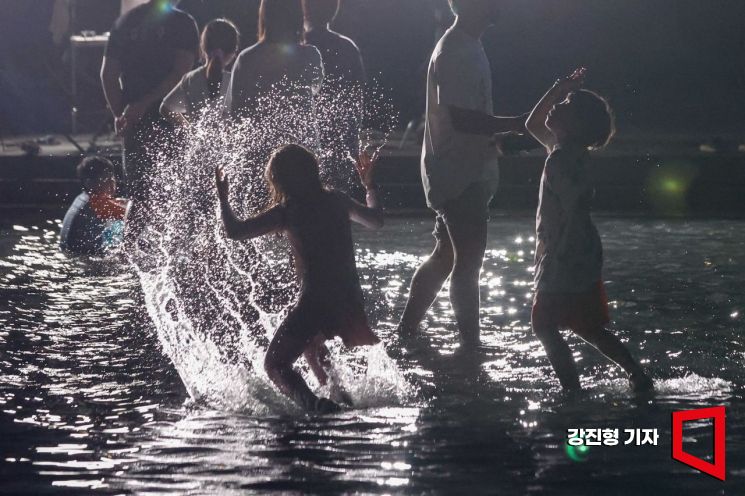 As the tropical nights in Seoul have continued for the 26th consecutive day, setting a record for the longest duration, citizens visiting Yeouido Hangang Park on the 15th are cooling off by playing in the water. Photo by Kang Jin-hyung aymsdream@
The heatwave crisis alert level 'Severe' has also been maintained for 16 days since the 31st of last month, making it the longest duration since the heatwave was legally recognized as a 'disaster' in September 2018. This is the third time the 'Severe' level has been issued, following 2019 and last year. However, in 2019 and last year, the 'Severe' level was maintained for only about 3 to 8 days before being downgraded to 'Warning.' The 'Severe' level, the highest among crisis alerts, is announced when it is expected that the daily maximum perceived temperature will be 35 degrees Celsius or higher for three or more consecutive days in 40% of the country’s regions.
However, this year, the Central Disaster and Safety Countermeasures Headquarters (CDSCH) has not yet escalated to Level 2. Level 2 is issued when it is expected that the daily maximum perceived temperature will be 35 degrees Celsius or higher for three or more consecutive days in 108 or more regions nationwide, or when the daily maximum perceived temperature will be 38 degrees Celsius or higher for three or more consecutive days in 72 or more regions nationwide. On August 4 last year, the CDSCH was elevated to Level 2 for the first time ever, and a special disaster safety grant of 3 billion KRW was urgently allocated to 17 metropolitan cities and provinces for heatwave countermeasures.
As the scorching heat continues, heat-related damages are increasing daily. As of 11 PM the previous day, the number of heat illness patients reached 2,570, surpassing 2,500. This is 294 more than the same period last year. The cumulative livestock deaths amount to 779,000, and aquaculture losses total 1,192,000.
While the midsummer heat usually eases around Liberation Day, this year it is expected to continue for some time. Kim Young-jun, a forecaster and analyst at the Korea Meteorological Administration, explained, "Rainfall is expected around the 20th, but after that, the North Pacific High will settle again, so warm and humid air will continue to flow into our country mainly from the southwest. Therefore, rather than the heatwave ending, it is expected to continue for a while, and tropical nights will also persist."
Minister of the Interior and Safety Lee Sang-min instructed local governments to fully respond to the remaining heatwave period. At the Central-Local Policy Council on the 14th, Minister Lee said, "Protecting the safety and lives of the people is the nation's top priority. Until the end of this summer, do not let your guard down and do your best to minimize casualties and property damage."
© The Asia Business Daily(www.asiae.co.kr). All rights reserved.
![A Woman Who Jumps Holding a Stolen Dior Bag... The Mind-Shaking, Bizarre Con of a "Human Knockoff" [Slate]](https://cwcontent.asiae.co.kr/asiaresize/183/2026021902243444107_1771435474.jpg)
















