Bank of Korea New York Office
"Applying Economic Theory Became Difficult During Pandemic Response"
The Bank of Korea evaluated that the 'Sham rule,' which sparked fears of a recession in the U.S., likely overestimated concerns about an economic downturn.
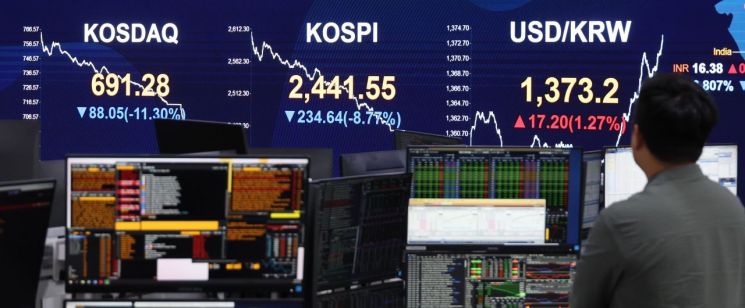
According to the trend analysis titled 'Activation of the Sham rule and market assessment of recession possibility' by the Bank of Korea's New York office on the 16th, the cause of the global stock market crash on the 5th was attributed to investors' fears of a recession. Among the triggers of these concerns, the Sham rule was analyzed to have likely overestimated the risk of a recession.
The Sham rule was devised in 2019 by Claudia Sham, former chief economist of the U.S. Federal Reserve (Fed) and current chief economist at New Century Advisors. It is a theory that forecasts future economic conditions based on the unemployment rate. If the difference between the average unemployment rate over the past three months and the lowest unemployment rate in the previous 12 months exceeds 0.5 percentage points, it is considered that the economy has entered a recession. The Sham rule is known to have relatively accurately detected recessions since 1970 and has not been triggered during non-recession periods. On average, it activates about three months after a recession begins and is recognized as an indicator that signals a recession earlier than the official declaration by the National Bureau of Economic Research (NBER).
On the 2nd (local time), the U.S. Department of Labor's employment report met the conditions of the Sham rule, heightening recession fears. The report showed that new jobs in the U.S. for July increased by 114,000, a reduced growth rate, while the unemployment rate surged to 4.3%. The three-month average unemployment rate was 4.13%, and the lowest three-month average unemployment rate in the previous 12 months was 3.6%, making the difference 0.53 percentage points, exceeding the Sham rule's activation threshold of 0.5 percentage points. Following the employment report, Goldman Sachs raised the probability of a U.S. recession from 10% to 25%.
However, Claudia Sham, the economist who devised the indicator, stated in a foreign media interview on the 7th that the increase in labor supply, including immigration, mainly influenced the activation of the Sham rule, making it difficult to conclude that the U.S. economy is currently in a recession. Typically, in the early stages of a recession, the unemployment rate gradually rises, leading to reduced household income and spending, decreased labor demand by companies, and further increases in unemployment, deepening the recession. But currently, new entrants to the labor market account for half of the unemployment rate increase, showing a different pattern from past recessions.
Fed officials have also expressed negative views on the possibility of a recession due to worsening employment data. Fed Chair Jerome Powell defined the Sham rule as a statistical regularity rather than a causal economic law during the FOMC press conference on the 31st. Austan Goolsbee, President of the Federal Reserve Bank of Chicago, and Mary Daly, President of the San Francisco Fed, also expressed negative views on the likelihood of a recession.
Many major global investment banks (IBs) consider the possibility of a recession caused by short-term employment deterioration to be low. Institutions such as JP Morgan and Goldman Sachs, which deny a recession, evaluated that the recent rise in unemployment was more influenced by increased labor supply and temporary adverse weather conditions like hurricanes rather than a reduction in labor demand. They argued that since final demand and corporate earnings remain strong, companies have little reason to significantly cut jobs.
Some IBs interpret the rise in unemployment as an indicator of a recession. Citi and others supporting the recession view assessed that the recent unemployment increase mainly stems from a slowdown in labor demand regardless of weather conditions. They argued that the sharp rise in temporary layoffs could lead to permanent layoffs, causing further unemployment increases and potentially leading to a recession.
A Bank of Korea official stated, "As the labor market imbalance is being adjusted and the number of job seekers increases, the rise in unemployment may cause the Sham rule indicator to overestimate recession risks." The official added, "Especially as the economic structure has significantly changed during the pandemic response and consumption and investment supported by large-scale fiscal spending have weakened the effect of interest rate hikes, there are increasing cases where economic theories and statistical regularities are difficult to apply."
He continued, "However, signs of labor market slowdown are clearly emerging, so it is necessary to identify trends through additional statistics. As the economy slows, the psychology of vulnerable economic agents can be shaken by small shocks, greatly contracting economic activity. Therefore, the need for immediate policy responses has become more important when economic and financial market instability intensifies."
© The Asia Business Daily(www.asiae.co.kr). All rights reserved.

















