Jikjang Gapjil 119 Survey of 1,000 People
20 Dispatched Temporary Workers in Arisel Fire with '23 Deaths'
A survey revealed that three out of four workers in South Korea are unaware that dispatching workers to direct production processes in the manufacturing industry is illegal.
On the 15th, the civic group Workplace Bullying 119 announced the results of a survey on 'manufacturing industry dispatched labor' conducted by the polling agency Global Research from the 1st to the 9th of this month. The survey targeted 1,000 workers nationwide aged 19 and older. According to the results, 75.2% of respondents answered that they 'did not know dispatch labor was illegal,' while only 24.8% said they were aware. The current Dispatch Act prohibits the use of dispatched workers in direct production processes in manufacturing. The Arisel factory in Hwaseong, Gyeonggi Province, where a major fire occurred in June killing 23 people, is suspected of illegally dispatching foreign workers to direct production processes in manufacturing. Among the 23 victims of the fire, 20 were dispatched workers from subcontractors.
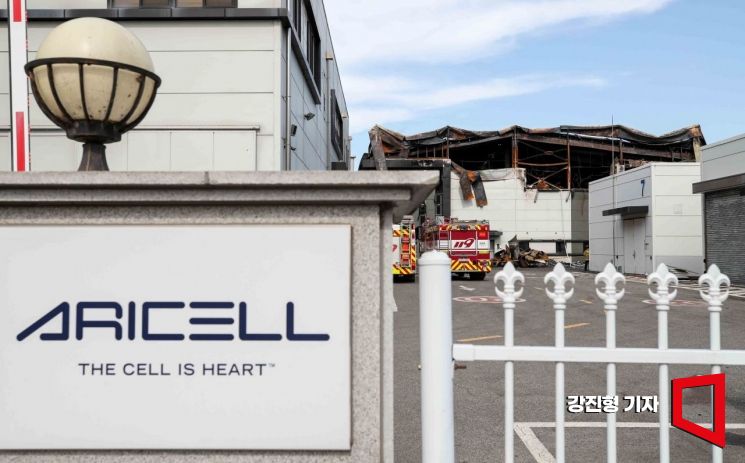 On June 25, firefighters were busily working at the scene of a fire at a primary battery manufacturing factory in Hwaseong-si, Gyeonggi Province. Photo by Jinhyung Kang aymsdream@
Furthermore, 84.1% of respondents said that 'the government does not properly crack down on illegal dispatch in manufacturing.' Additionally, 83.3% agreed that a full-scale investigation into illegal dispatch in manufacturing should be conducted to prevent accidents like the Arisel fire from recurring.
Regarding the Dispatch Act, 50.1% of respondents said 'the current law should be maintained but illegal dispatch should be strictly punished,' exceeding half. Next, 27.5% responded that 'the current Dispatch Act should be abolished and employers should directly hire workers,' and 9.2% said 'the scope and duration of permitted dispatch under the current law should be expanded.'
Regarding the survey results, Kwon Doo-seop, a lawyer at Workplace Bullying 119, pointed out, "When media reports cover serious accident cases, the victims are always workers belonging to partner companies, service companies, or subcontractors, but in reality, illegal dispatch cases are frequent." He added, "Risky tasks are outsourced, and the primary contractor shifts the responsibility for industrial safety and health measures to subcontractors. The National Assembly should amend laws to strengthen the employer responsibility of primary contractors, and the Ministry of Employment and Labor should conduct a full-scale investigation into illegal dispatch in manufacturing."
The Ministry of Employment and Labor announced that a special inspection of the Hwaseong Arisel workplace last month uncovered 65 violations across 28 clauses. These included improper installation such as emergency exits placed incorrectly (2 cases), failure to install gas detection and alarm devices in areas with flammable liquid vapors (2 cases), and failure to designate explosion hazard areas (1 case), which will lead to legal action.
A total of 82 violations subject to fines were also found. Problems included failure to conduct worker safety and health education and health checkups, and not keeping material safety data sheets at the workplace. The government plans to finalize the subjects and amounts of fines later, as the investigation is linked to violations of the Dispatch Act. Investigations are ongoing regarding violations of the Industrial Safety and Health Act, Serious Accident Punishment Act, and Dispatch Act at Arisel.
© The Asia Business Daily(www.asiae.co.kr). All rights reserved.
![User Who Sold Erroneously Deposited Bitcoins to Repay Debt and Fund Entertainment... What Did the Supreme Court Decide in 2021? [Legal Issue Check]](https://cwcontent.asiae.co.kr/asiaresize/183/2026020910431234020_1770601391.png)