The Ministry of Land, Infrastructure and Transport announced the 'Aircraft Turbulence Accident Prevention Measures' to prevent damage caused by turbulence.
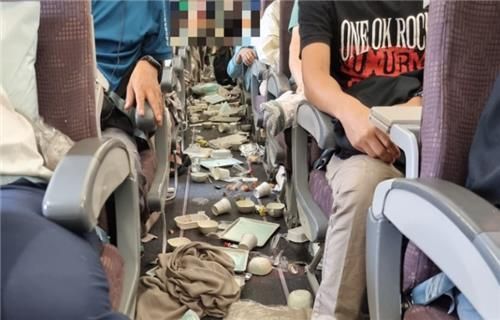 In-flight meals and other items spilled due to turbulence on flight KE197
Photo by Kim Gat's Travel Archiving, Naver Blog, Yonhap News
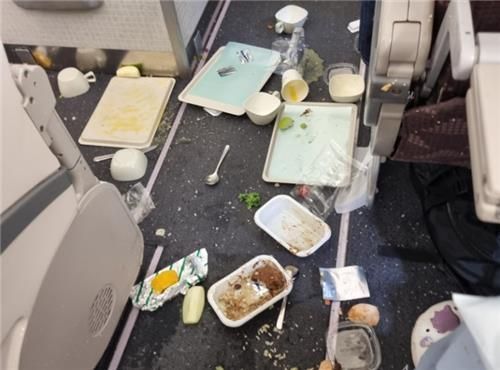 In-flight meal dropped on the floor due to turbulence
Photo by Naver Blog 'Kimgat's Travel Archiving', Yonhap News
On the 15th, the Ministry prepared measures to ▲strengthen passenger safety ▲enhance turbulence response capabilities of aviation personnel ▲expand information sharing. The Ministry collaborated with academia, industry, and research institutes to develop these turbulence accident prevention measures.
Turbulence is a phenomenon where the flow of air moves unpredictably and unstably, causing an aircraft to shake or suddenly descend when encountered. Academia reports that climate warming is increasing the frequency and intensity of turbulence occurrences.
First, a standard procedure will be established to immediately suspend in-flight services such as meal and duty-free sales upon encountering turbulence.
Considering that turbulence frequently occurs during the landing process, it is recommended that in-flight services end 40 minutes before landing on medium- and long-haul routes, and 15 minutes before landing on short-haul routes. This advances the service termination time by up to 20 minutes compared to before.
Korean Air and Asiana Airlines have already applied this policy, and low-cost carriers (LCCs) have expressed a positive stance toward the government's recommendation, according to the Ministry.
Additionally, airlines are advised to review the risks associated with serving hot liquids such as soup and tea onboard. Korean Air has suspended cup noodle service in economy class starting from this day to prevent burn accidents caused by turbulence.
Furthermore, in-flight announcements will be strengthened to encourage passengers to always wear seat belts during flights, and promotional activities will be conducted through social media platforms.
 An accident involving Singapore Airlines flight SQ321 making an emergency landing at Suvarnabhumi International Airport in Bangkok, Thailand due to turbulence. The photo is for illustrative purposes and is not directly related. [Image source=Sky News]
The turbulence understanding and response capabilities of aviation personnel will also be enhanced.
To this end, starting next month, a 'Turbulence' subject will be added to the regular training courses for pilots and flight dispatchers, and turbulence scenario response training for cabin crew will be intensified.
Expansion of turbulence information sharing among airlines and between domestic and international authorities will also be promoted.
The Ministry plans to support all 11 domestic airlines to use the private paid turbulence forecasting services, which are currently used by only some national airlines.
Currently, Korean Air and Jin Air use the International Air Transport Association (IATA)'s 'Turbulence Aware Platform' (ITA), while Asiana Airlines and T'way Air use another alert system called 'WSI-TTA'.
According to the Ministry, these services utilize actual turbulence measurement data obtained from airlines worldwide, making them more accurate than forecasts from the Korea Meteorological Administration.
Therefore, the Ministry plans to provide incentives in safety scores during the allocation review of traffic rights (operating rights allocated by the government to airlines) if the other seven domestic airlines use these services.
Furthermore, the Ministry aims to have all 11 domestic airlines participate in the Ministry's 'Hazardous Weather Information Sharing System,' currently involving only Korean Air and Jin Air, by next month to improve turbulence prediction accuracy.
This system provides analysis information on turbulence occurrence trends by route, location, and time based on airline turbulence reports. Based on this, the Ministry will also promote the establishment of a real-time turbulence information sharing system among airlines.
Additionally, by the end of 2026, the Ministry plans to develop a plan to share weather characteristics and analysis results by air route with the Korea Meteorological Administration to enhance turbulence response capabilities.
The Ministry will also establish a 'Turbulence Response Cooperation System' beyond individual countries through the International Civil Aviation Organization (ICAO). To this end, it plans to propose the establishment of a data collection and sharing mechanism at the ICAO World Air Navigation Conference at the end of this month.
Moreover, in the second half of this year, the Ministry plans to propose to aircraft manufacturers such as Boeing and Airbus improvements to cabin structures for safety, including remote seat belt fastening verification devices, auxiliary handrails inside galleys, and fixed rails for food and beverage carts.
© The Asia Business Daily(www.asiae.co.kr). All rights reserved.
![Clutching a Stolen Dior Bag, Saying "I Hate Being Poor but Real"... The Grotesque Con of a "Human Knockoff" [Slate]](https://cwcontent.asiae.co.kr/asiaresize/183/2026021902243444107_1771435474.jpg)


















