Samyang Foods Achieves Record Quarterly Results Amid Buldak Syndrome
HiteJinro Sees Sharp Operating Profit Increase Due to Marketing Cost Offset
Nongshim Operating Profit Declines Due to Cost Burden, Ottogi and Binggrae Advertising Expenses Impact
Domestic food companies overcame adverse conditions such as high inflation and economic recession to deliver relatively strong business performance in the second quarter of this year. Among the so-called '3 trillion won club' with annual sales exceeding 3 trillion won, some manufacturers offset sluggish domestic demand with overseas markets, achieving record-high results.
According to the Financial Supervisory Service's electronic disclosure system on the 14th, major food companies that announced their results for April to June generally continued an upward trend in operating profit compared to the same period last year. Samyang Foods showed remarkable growth. The popularity of its flagship product, Buldak Bokkeum Myun, expanded beyond Asia to the United States and Europe, resulting in a consolidated second-quarter operating profit of 89.4 billion won, a 103.2% increase from the same period last year. Sales during the same period rose 48.7% to 424.4 billion won. Both quarterly sales and operating profit were the highest ever recorded. Notably, overseas sales in the second quarter alone reached 322.1 billion won, surpassing 300 billion won for the first time. The proportion of overseas sales in total company sales expanded to 78%. First-half sales and operating profit were 810.1 billion won and 169.5 billion won, respectively, up 52.6% and 149.6% from the same period last year. These first-half sales and operating profits were also record highs. The company surpassed last year's annual operating profit of 147.5 billion won, which exceeded 100 billion won for the first time in its history, within just the first half of the year.
In the confectionery and bakery industry, Orion's performance stood out. Thanks to strong sales from overseas subsidiaries in China, Vietnam, and other countries, second-quarter operating profit increased 8.47% year-on-year to 121.7 billion won, and sales rose 4.38% to 745.2 billion won. On a consolidated basis for the first half, operating profit and sales also reached record highs at 246.8 billion won and 1.4677 trillion won, up 16.8% and 6.5% respectively from the same period last year. An Orion representative stated, "We will focus on securing future growth engines such as expanding the food business based on solid cash flow generated through overseas operations."
Lotte Wellfood also recorded a 30.3% increase in second-quarter operating profit to 63.3 billion won, driven by strong global business including India and the peak summer ice cream season, while sales remained steady at 1.0442 trillion won, similar to the same period last year. SPC Samlip's second-quarter sales decreased 1.4% year-on-year to 849.4 billion won, but operating profit rose 1.89% to 27 billion won through cost efficiency improvements. Binggrae saw a 4.84% increase in second-quarter sales to 407.5 billion won, driven by strong overseas product sales centered on the United States, but operating profit slightly decreased by 2.81% to 44.9 billion won due to increased marketing expenses for products like Together and Banana Flavored Milk, which celebrated their 50th anniversary this year.
Food industry leader CJ CheilJedang achieved three consecutive quarters of operating profit growth since the fourth quarter of last year, thanks to increased overseas sales of K-food items such as dumplings and gimbap, and the advancement of its bio business, a future growth engine. CJ CheilJedang's consolidated operating profit, including its subsidiary CJ Logistics, reached 383.6 billion won in the second quarter, up 11.3% year-on-year, while sales rose 0.3% to 7.2387 trillion won during the same period.
In particular, the overseas food business performed well in Europe, North America, and Oceania, generating sales of 1.3244 trillion won and leading growth. Attention is focused on whether the company will succeed in rebounding its domestic food business, which had been sluggish, by resuming transactions with Coupang after a year and eight months of conflict over supply prices.
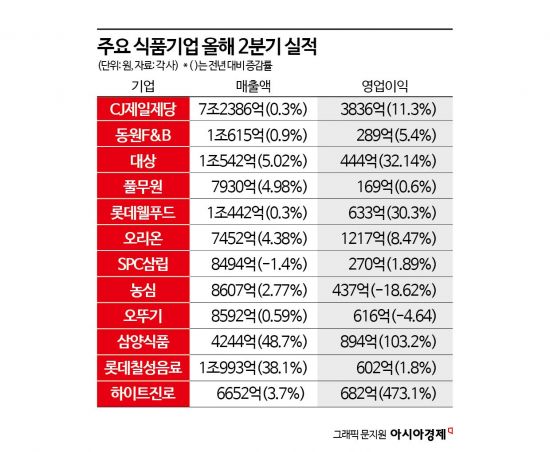
Daesang also saw a 32.14% increase in second-quarter operating profit to 44.4 billion won, driven by increased exports of kimchi and other food products, growth in online channel sales, and an improved bio industry outlook. Sales during the same period rose 5.02% to 1.0542 trillion won. Additionally, Dongwon F&B recorded a 5.4% increase in second-quarter operating profit to 28.9 billion won, supported by stable growth in strategic items such as tuna sauce, instant rice, and pet food following prior facility investments, while sales slightly increased by 0.9% to 1.0615 trillion won. Pulmuone's food service distribution business led sales growth, and improved profitability of overseas subsidiaries in the United States and China helped achieve a second-quarter operating profit of 16.9 billion won, a 0.6% increase from the same period last year. Sales rose 4.98% to 793 billion won. Pulmuone's cumulative first-half sales and operating profit also reached record highs at 1.5623 trillion won and 32.5 billion won, respectively.
In the alcoholic beverage industry, Hite Jinro posted a second-quarter operating profit of 68.2 billion won, a remarkable 473.1% increase from the same period last year. After launching the new beer product 'Kelly' in April last year and incurring marketing expenses that reduced operating profit, the company achieved a significant rebound this year due to a base effect. Sales also increased 3.7% to 665.2 billion won. Lotte Chilsung Beverage's second-quarter operating profit rose 1.8% year-on-year to 60.2 billion won, driven by increased soju exports and growth through the acquisition of Philippine Pepsi last year, while sales surpassed 1 trillion won for the first time on a quarterly basis, reaching 1.0992 trillion won.
Among the three major ramen companies, Nongshim and Ottogi reported somewhat disappointing results. Nongshim's second-quarter sales increased 2.8% year-on-year to 860.7 billion won, but operating profit fell 18.6% to 43.7 billion won. The company explained that this was due to increased costs of sales and management expenses, as well as price reductions for key products such as Shin Ramyun and Shrimp Crackers last year. However, first-half export volume rose 33.6% year-on-year. A Nongshim representative said, "Despite the challenging business environment, we reduced the decline in operating profit through internal efforts such as increasing exports and cutting selling and administrative expenses." Ottogi's second-quarter sales rose 0.59% year-on-year to 859.2 billion won, but operating profit decreased 4.6% to 61.6 billion won. An Ottogi representative stated, "Operating profit margin slightly declined due to increased advertising expenses and commissions in the second quarter."
© The Asia Business Daily(www.asiae.co.kr). All rights reserved.


















