- Burden of Rising Seoul Housing Prices, Continued 탈서울화
- Bucheon Goean District, Adjacent to Seoul Hangdong District with Walkable Seoul Living Area
As the exodus from Seoul accelerates among demanders, the real estate market in areas adjacent to Seoul is gaining momentum. It is interpreted that demanders, burdened by the high housing prices in Seoul, are turning their attention to regions where the burden of 'owning a home' is relatively lighter.
According to Statistics Korea's 'Domestic Population Movement Statistics,' the net outflow of population from Seoul in the first half of this year was 16,151 people. This is the highest among the 17 metropolitan cities and provinces nationwide and represents a sharp increase of 41.86% compared to the same period last year (11,385 people). In contrast, Gyeonggi-do, adjacent to Seoul, showed a net inflow of 31,622 people during this period, a 12% increase compared to the same period last year, presenting a stark contrast to Seoul.
Apartment purchase sentiment among Seoul residents in the Gyeonggi area is also spreading. According to data from the Korea Real Estate Board, a total of 7,838 Seoul residents purchased apartments in Gyeonggi-do in the first half of this year, an increase of 14.6% compared to the same period last year. Demand influx was particularly concentrated in areas adjacent to Seoul, such as Anyang City with a 94.79% increase (211 cases → 411 cases), Gwacheon City 86.49% (37 cases → 69 cases), Gwangmyeong City 48.99% (298 cases → 444 cases), Guri 22.31% (130 cases → 159 cases), and Bucheon 22.16% (352 cases → 430 cases), which also influenced the overall increase.
The background to this ongoing 'escape from Seoul' is attributed to the expensive housing prices in Seoul. It is analyzed that demanders burdened by rapidly soaring housing prices are flocking en masse to areas adjacent to Seoul.
According to real estate R114 data, as of the end of July this year, the average apartment sale price and jeonse (long-term deposit lease) price in Seoul were 1,316.17 million KRW and 626.99 million KRW, respectively. This amount far exceeds the apartment sale price in Gyeonggi-do (597.35 million KRW), meaning that one could purchase an apartment in Gyeonggi-do with the jeonse price of a Seoul apartment.
A real estate expert said, "As Seoul housing prices continue their high-flying trend, more demanders are turning their attention to Gyeonggi-do, where they can realize home ownership through jeonse prices. In particular, demand is concentrated in areas within Gyeonggi-do that are adjacent to Seoul and effectively classified as part of the Seoul living area."
Given this situation, areas adjacent to Seoul are recording high rates of price increases. According to real estate R114 data, the apartment sale price increase rate in Gwacheon City was 0.74% from January to July this year, significantly higher than the Gyeonggi-do average of 0.11%. Other areas such as Seongnam (0.59%) and Gwangmyeong (0.23%) also showed price increase rates exceeding the Gyeonggi-do average.
Moreover, in the subscription market, new apartment complexes near Seoul are showing strong presence. According to subscription home data, 'Goyang Janghang Atera,' which held a subscription in August, attracted a total of 9,398 applicants for 306 households (excluding special supply), recording an average competition rate of 30.7 to 1 for the first priority. The complex's location in Goyang, adjacent to Seoul, and the application of the price ceiling system contributed to its price competitiveness and subscription success.
Similarly, 'Sanseong Station Heriston,' supplied in Seongnam, Gyeonggi-do in July, also completed its subscription with an average first priority competition rate of 30.57 to 1, highlighting its proximity to Seoul's Gangnam and Songpa areas.
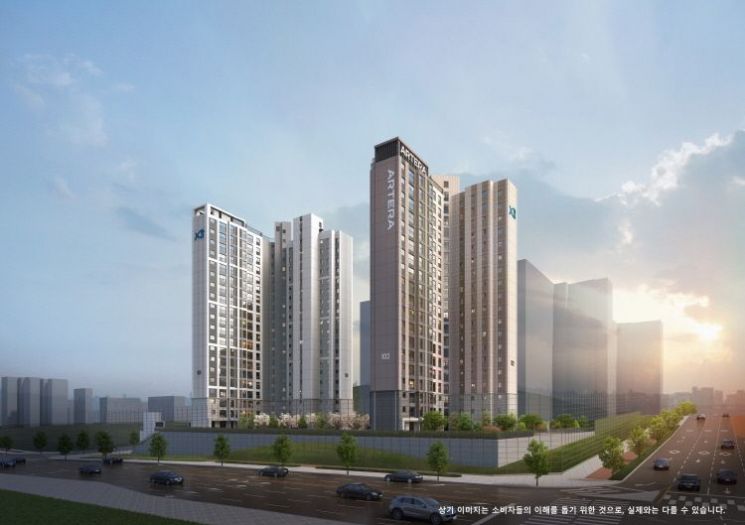
Meanwhile, interest is also growing in 'Bucheon Atera Xi,' a new complex sharing the Seoul living area. The GS Construction consortium will launch 'Bucheon Atera Xi (total 200 households with exclusive areas of 50 and 59㎡)' in September in Goean-dong, Sosa-gu, Bucheon City, Gyeonggi-do. It is considered a complex where residents can enjoy the Seoul living area on foot.
Opposite the complex is the Hang-dong District of Seoul, spanning approximately 660,000㎡, providing a double living area between Bucheon and Seoul. Especially, the Goean District (about 140,000㎡) is adjacent to the Hang-dong District of Seoul, leading the industry to refer to this area as the 'Goehang District' (Goean District + Hang-dong District).
Bucheon Atera Xi is located right across from Yangji Elementary School, enabling safe commuting for children, and is close to the academy districts of Hang-dong and Ok-gil, offering an excellent educational environment. Additionally, parks such as the Blue Arboretum, Seoul's first public arboretum covering about 200,000㎡, and Goean Sports Park are within walking distance. Nearby are also Cheonwang Mountain, Cheonwang Mountain Family Camping Site, and Geonji Mountain, allowing residents to enjoy an eco-friendly urban life.
Regarding transportation, the complex is near Yeokgok Station on Line 1, providing easy access to major Seoul business districts such as Jongno, G-Valley (Seoul Digital Industrial Complex), Yeouido, and Gangnam. It is also connected to road networks such as Bukwang-ro and Sosadong-ro, facilitating smooth vehicle access. Furthermore, it is close to major arterial roads like Gyeongin-ro and the Metropolitan Area 1st Circular Expressway, enabling easy travel to Seoul's main business districts and neighboring areas.
Currently, a promotional center is operating in Yeokgok-dong, Wonmi-gu, Bucheon City, Gyeonggi-do (within the Yeokgok E-Class High-End complex commercial area), and the model house is scheduled to open in September in Sang-dong, Bucheon City, Gyeonggi-do (within the Bucheon Video Culture Complex).
© The Asia Business Daily(www.asiae.co.kr). All rights reserved.

















