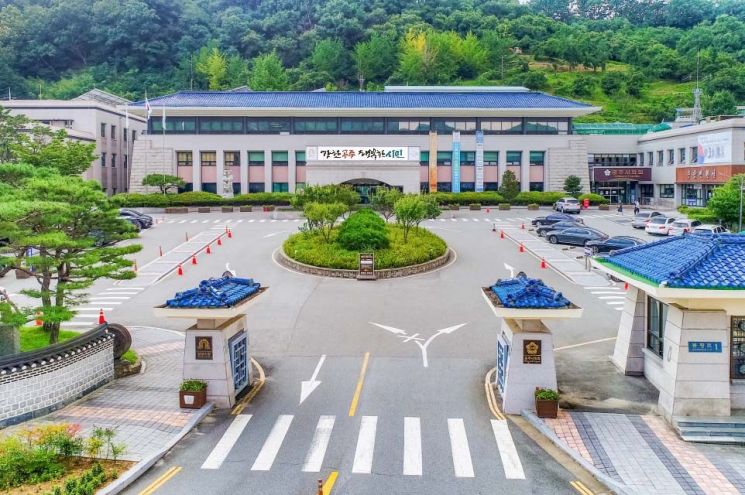
The average resident population of Gongju City, Chungnam, which has been classified as a depopulation area, was found to be the highest in Chungnam Province in the first quarter of this year.
Gongju City announced on the 14th that the average resident population for the first quarter was calculated at 555,376 people.
This figure is based on the Ministry of the Interior and Safety and Statistics Korea's recent calculation of the first quarter 2024 resident population for 89 depopulation areas nationwide.
The resident population, which refers not only to local residents but also to people who actually engage in economic activities in the area, is calculated by adding the ‘registered foreign population’ and the ‘staying population’ (those who stay at least once a month for more than three hours) to the ‘resident registration population’.
This clearly reveals the vitality of the region, which could not be identified by the existing registered population standard, through the concept of resident population. It is evaluated as showing the possibility that Gongju City can overcome the crisis of regional extinction and secure new growth engines.
The city reported that the average monthly resident registration population for the first quarter was 101,939 people, with 2,377 foreigners, but the staying population was 451,060 people, more than four times the resident registration population.
In particular, the staying population steadily increased, with 401,651 in January, 473,322 in February, and 478,208 in March.
This result is analyzed as evidence that the city’s strategic population policies and the creation of four-season stay-type tourist destinations are starting to bear fruit.
This year, the city is investing 6.4 billion won from the Local Extinction Response Fund to promote projects such as: nighttime tourism linked to historical culture ‘Gongju-Ya, Let’s Play’; Gongju Gourmet School; the ‘Jeong Anjigyo Project’ to save rural schools at risk of extinction; and the Gongjuyeo-U stay-type small farm project.
In particular, since the 8th popularly elected administration, the ‘New 5 Provinces 2 Villages Project’ population policy, which is being actively promoted to attract the 4 million people living in nearby areas such as Daejeon, Sejong, Cheonan, and Cheongju to become part of Gongju’s resident population, is being evaluated as a model for regional development.
In addition, the city is working to prevent the outflow of the youth population by discovering various job opportunities, supporting youth monthly rent, and creating youth-customized shared housing projects.
Based on the results of this resident population calculation, the city plans to introduce policies tailored to the age and gender of the resident population, strengthen the New 5 Provinces 2 Villages policy, and operate various tourism programs such as festivals, workations, and accommodation experiences to secure a stable resident population.
Mayor Choi Woncheol said, “The resident population is an important indicator for gauging the vitality and future of the region,” adding, “We will continue to support customized population policies centered on the resident population in line with the government’s policy direction.”
© The Asia Business Daily(www.asiae.co.kr). All rights reserved.
![Clutching a Stolen Dior Bag, Saying "I Hate Being Poor but Real"... The Grotesque Con of a "Human Knockoff" [Slate]](https://cwcontent.asiae.co.kr/asiaresize/183/2026021902243444107_1771435474.jpg)
















