After attending K-Display 2024 on the 14th, met with reporters
"Having a lot of capacity doesn't mean it's all good"
"Differentiating IT OLED through collaboration with Qualcomm, Intel, etc."
"Price is key for micro displays"
"In terms of sales revenue, Korea still leads China in organic light-emitting diode (OLED) technology."
On the morning of the 14th, Choi Ju-seon, President of Samsung Display, told reporters at the '2024 Korea Display Industry Exhibition (K-Display 2024)' held at COEX in Seoul that this is the case regarding recent Chinese display companies surpassing Korea in the global OLED panel market.
According to market research firm Omdia, in the first quarter of this year, Chinese display companies accounted for a 49.7% share of the entire OLED market (by shipment volume), including small and medium-sized OLEDs. Korea, which had held the top spot until now, dropped to second place with a 49% share. In the first quarter of last year, Korea and China had shares of 62.3% and 36.6%, respectively, showing a large gap, but in just one year, China closed the gap by more than 20 percentage points and overtook Korea.
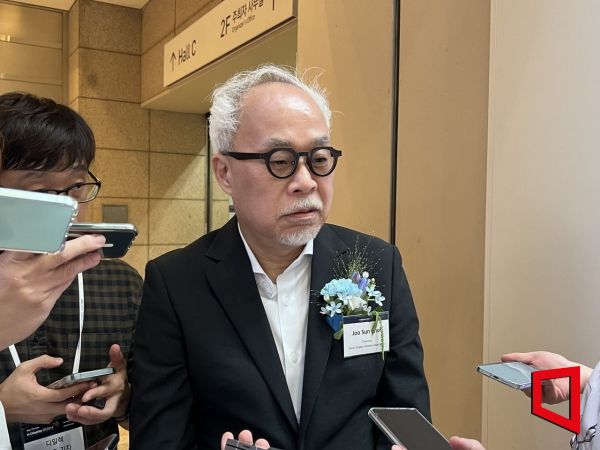 Choi Juseon, President of Samsung Display, is meeting with reporters for a Q&A session at the '2024 Korea Display Industry Exhibition (K-Display 2024)' held at COEX, Seoul, on the morning of the 14th.
 [Photo by Han Yeju]
President Choi said, "In fact, the same was true for LCDs, but having a large capacity (production capability) does not necessarily mean everything is good," and diagnosed, "There is not much that can be differentiated in LCDs."
He added, "In the case of self-emissive OLEDs, factors such as form factor, ultra-low power consumption, performance, and quality are important, and various changes and differentiations can be made," emphasizing, "Our future strategy is to maintain at least the capacity and keep the transition point while surpassing China with premium products."
Regarding securing IT OLED customers, he said, "We are communicating with many customers," and added, "Recently, combined with on-device AI, we expect a lot of synergy."
President Choi also said, "We will invest in large-area 8.6G and start production soon, but compared to the previous 6G, the business scale is different, and there are many aspects to study, such as whether it is oxide or the existing LTPS (low-temperature polycrystalline silicon) in terms of performance," adding, "We will strive to provide good solutions through collaboration not only with customers but also with various system partners such as Intel and Qualcomm, enabling differentiation of mobile OLEDs to extend to IT."
Regarding strengthening microdisplay competitiveness, he said, "The key to microdisplays is how to provide solutions to customers at a low cost," and expressed confidence, "Since it is ultimately a B2C product, we can prepare steadily over time."
He also explained, "Since various effects and synergies are emerging from Imagine, which we acquired, I believe we will be able to do well when commercialization occurs." Samsung Display acquired the U.S. microdisplay specialist Imagine last year for about 290 billion KRW.
When asked about the performance outlook for the second half of the year, he answered conservatively. President Choi said, "There are many concerns about the second half," and added, "We will work hard and do well."
Meanwhile, at the exhibition, Samsung Display surprised attendees by unveiling a new OLEDoS technology, a core technology for extended reality (XR) headsets. Unlike the previously disclosed RGB (Red, Green, Blue) method, this uses a white (W-OLED) method and succeeded in achieving an ultra-high brightness of 12,000 nits in an industry-first 1.3-inch ultra-small size.
For the first time in Korea, OLED concept products were publicly displayed, including a smart key and smart headphones equipped with 1.5-inch circular OLEDs, a smart watch cling band with a 6.2-inch flexible OLED, and a smart speaker with a 7.6-inch flexible OLED.
When asked about the focus of Samsung Display at this exhibition, President Choi answered "Gamseong (emotion)." He said, "Since displays ultimately need to contact B2C, we proceeded with a concept that approaches the emotions of younger people more closely."
He added, "Compared to the semiconductor industry, we are a downstream industry," and said, "Since the display industry contributes a lot to Korea, I hope the government, industry, and academia will take a lot of interest."
© The Asia Business Daily(www.asiae.co.kr). All rights reserved.
![Clutching a Stolen Dior Bag, Saying "I Hate Being Poor but Real"... The Grotesque Con of a "Human Knockoff" [Slate]](https://cwcontent.asiae.co.kr/asiaresize/183/2026021902243444107_1771435474.jpg)
















