Sanitary Pads, Skincare, and Infertility Clinics Appear as Sponsors
Targeting Female Customers... "Growing Interest Recently"
Global Women's Sports Industry Expected to Reach 1.8 Trillion Won This Year
At the 2024 Paris Olympics, female national athletes from various countries showed remarkable performances, and the expansion of the women's sports industry is expected to accelerate further. Companies such as sanitary pad and makeup manufacturers, which previously showed little interest in the sports market, have begun to emerge as sponsors in the sports industry to capture the attention of female customers.
The Wall Street Journal (WSJ) recently reported, "The rise of women's sports has led to the entry of unexpected sponsors," adding, "Unknown startups, companies focused on female customers, and brands that previously had no interest in sports have started to become official sponsors of women's sports leagues or teams." This change appears to be happening most rapidly in the United States, where the women's sports industry is the largest.
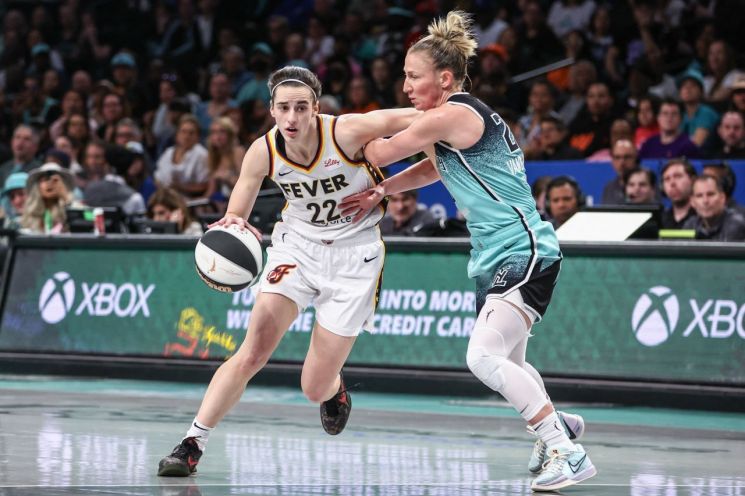 During the game between the New York Liberty and the Indiana Fever, women's professional basketball teams in the United States
 [Image source=Reuters Yonhap News]
Sequall, a startup that manufactures and sells sanitary pads and tampons, signed a contract this month to become the official tampon supplier for the US professional league USL Super League, in support of the women's professional soccer league starting this month. The Kansas City Current, a U.S. women's professional soccer team, signed a contract last December to display the name of the American jewelry brand Helzberg Diamond at the stadium entrance.
The New York Liberty, a basketball team active in the Women's National Basketball Association (WNBA), recently signed partnership agreements with skincare company Hero, women's clothing brand M.M.LaFleur, and New York's infertility center RMA, alongside existing sponsors such as investment bank Barclays and global hotel chain Marriott. Kia Clark, CEO of Liberty, explained that there was a time when they were not interested in beauty and fashion companies, but now the situation has changed.
This shift in atmosphere appears to be caused by the expansion of the women's sports market. Female athletes are standing out in various sports such as soccer and basketball, and the number of women interested in recreational sports is also increasing. Additionally, female sports stars like U.S. national gymnast Simone Biles, who received significant attention at the recent 2024 Paris Olympics, are also influencing this trend.
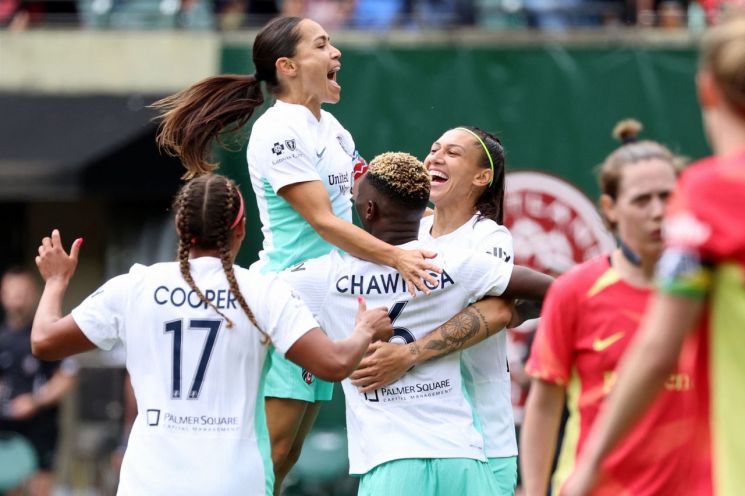 In June, players of the Kansas City Current, a U.S. women's professional soccer team, are celebrating after scoring a goal in a match.
 [Image source=Reuters Yonhap News]
According to consulting firm Deloitte, the women's sports market is expected to generate $1.3 billion (approximately 1.8 trillion KRW) in revenue worldwide this year. This is a rapidly expanding scale from $692 million in 2022 and $981 million last year. Of this, 55% comes from commercial transactions, including sponsorships. Although the sponsorship scale is still smaller than that of men, the growth rate is fast. Women's sports are also gradually increasing in areas previously neglected, such as TV broadcasting.
Erin Kane, Vice President of marketing agency Excel Sports Management, conveyed the atmosphere, saying, "New brands that previously had no entry into the sports industry because they were deemed unsuitable for men's sports are showing interest." David King, Senior Vice President of Corporate Partnerships for the Minnesota Lynx, a U.S. women's basketball team, also stated, "Compared to a few years ago, more companies are reaching out."
When sponsorship contracts are signed, corporate brand-related campaigns or prize-giving events are often held at the stadium on game days. Odell, a haircare company sponsoring the Lynx, reportedly provided product samples and coupons as prizes during games. Additionally, RMA, a sponsor of the Liberty, ran the "Let's Go Baby" campaign last June at the Brooklyn stadium, delivering the message not to give up on pregnancy, childbirth, and parenting through work-life balance.
Although corporate sponsorship for women's sports is increasing, the scale itself is still smaller than that of men's sports. It is reported that teams seeking corporate sponsorship strongly emphasize that, although they lag behind men's teams in terms of viewership and number of games, the current situation where women's teams receive significant attention is highly valuable.
© The Asia Business Daily(www.asiae.co.kr). All rights reserved.


















