PPI Increase Rate Falls Below Expectations
Goldman Sachs Raises Recession Probability
April 27% → Recently 41%
Bloomberg: "Market Still Sees Recession Risk"
The Producer Price Index (PPI), a leading indicator of U.S. consumer prices, slowed more than expected, providing some relief to financial markets. However, a soft landing for the U.S. economy is not guaranteed by just one or two indicators. Although recession fears triggered by the early-month employment shock have subsided, Wall Street points out that the market still shows a higher probability of recession than before, so it is too early to be complacent.
Despite PPI Relief... Wall Street Says Recession Probability Remains High
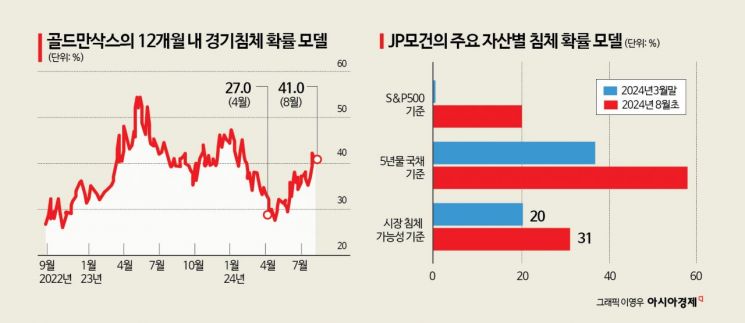
Bloomberg reported on the 13th (local time), when the July PPI increase rate came in below market expectations, analyzing financial market models from Goldman Sachs and JP Morgan, stating that "the market still views the likelihood of a recession as elevated." According to Goldman Sachs, the recession probability assigned by the stock and bond markets (within 12 months) was 41% as of the 12th. This is significantly higher compared to April (27%), when the probability was at its lowest this year.
JP Morgan's analysis by asset type shows a similar trend. The recession probability, which was around 20% at the end of March, recently rose to 31%. In particular, the recession probabilities reflected in the metals market and the 5-year Treasury market were relatively high at 67% and 58%, respectively. Bloomberg noted, "Goldman Sachs and JP Morgan's models suggest that the signals from the U.S. Treasury market and the earnings of stocks highly sensitive to economic cycles indicate that the market-implied recession risk has materially increased."
Relief from Market-Friendly Indicators for Now
The shockwave that pulled down global stock markets last week has calmed as a series of market-friendly indicators have been released recently. Following the previous day’s report showing the mid-term inflation expectations of U.S. consumers at an all-time low, the July PPI increase rate released on this day rose only 0.1% month-over-month, falling short of market forecasts.
This immediately became a positive catalyst for the New York stock market. Investors engaged in chase buying, pushing the three major New York indices up sharply by 1-2%. The so-called 'Magnificent 7 (M7)' stocks such as Nvidia (6.53%), Tesla (5.24%), and Meta Platforms (2.44%) all rose. Bitcoin also surged about 3% from the previous session, breaking above the $60,000 level. These figures indicate that market fears of recession have significantly eased.
Bloomberg noted, “With economic indicators such as weekly jobless claims, small business optimism index, and mortgage rates consecutively meeting market expectations, economists believe the risk of recession is not at a level of serious concern.”
Next Indicators Critical... Likely to Influence September Rate Decision
The key will be major economic indicators scheduled for release this week, including the Consumer Price Index (CPI). If the CPI increase rate announced the following day falls below market expectations, recession fears could ease further and the soft landing outlook could strengthen. Conversely, if the persistently high inflation trend is reconfirmed, recession concerns are expected to resurface. With signs of consumer spending slowing in the U.S., the July retail sales data released on the 15th will also serve as an important gauge of recession risk.
This will also be a major factor influencing the Federal Reserve’s decision, which has signaled a rate cut in September. Raphael Bostic, President of the Federal Reserve Bank of Atlanta and considered a hawk (favoring monetary tightening), said at an African American financial professionals conference that “more economic data is needed to be confident before cutting rates,” advocating caution. This is because prematurely cutting rates due to recession fears and then having to raise them again could cause greater damage to the economy.
Overreaction to Single Economic Indicators Likely to Continue for Now
Experts point out that with recession fears not fully dissipated, the market’s tendency to overreact to single economic indicators may continue for some time.
Marco Kolanovic, former Chief Global Market Strategist at JP Morgan and a leading Wall Street bear, warned on X (formerly Twitter) that "the market faces various issues including the U.S. presidential election, geopolitical problems, Murphy’s Law, and the potential rise in bankruptcies due to credit card delinquencies." Mike Wilson, Chief Investment Officer (CIO) at Morgan Stanley, said that “growth prospects are uncertain,” but “there will not be a larger-scale stock market downturn.” He is known for having predicted on the 9th of last month, before the U.S. stock market crash at the end of that month, that “the U.S. stock market could soon experience a correction of around 10%.”
© The Asia Business Daily(www.asiae.co.kr). All rights reserved.

















