13th Display Business Forum
Sally Chan, CEO of Chino, Presentation
"China Surpasses Korea in Panel Area"
A Chinese market research firm announced that China has surpassed South Korea in OLED panel area. It also predicted that China could become the world's largest country in smartphone OLED.
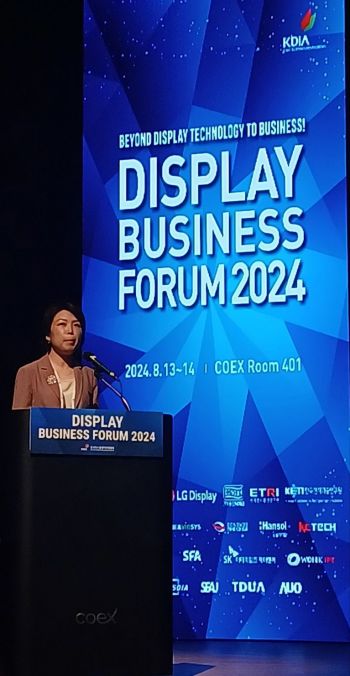 Sally Chen, CEO of Chinese market research firm Chinoresearch, is speaking at the 'Display Business Forum 2024' hosted by the Korea Display Industry Association at COEX in Samseong-dong, Gangnam-gu, Seoul on the 13th.
 [Photo by Moon Chaeseok]
On the 13th, at the 'Display Business Forum 2024' held by the Korea Display Industry Association at COEX, Samseong-dong, Gangnam-gu, Seoul, Sally Chen, CEO of Chinoresearch, gave a presentation titled "The Chinese Display Market Has Entered a New Era," revealing these insights. Chinoresearch is a Chinese market research firm.
CEO Chen announced, "Chinese display panel companies are number one in the world by area." When asked, "You said China is number one in the world in OLED (panel) area, but when will it become number one in sales?" she drew a line, saying, "I think we will have to answer this question again in five years."
According to CEO Chen, China's display market share by product category is the highest in the world. TV share is 69%, IT 57%, smartphone 69%, and automotive 47%. Sales also showed an increasing trend. In 2018, it was $24.7 billion (about 33.85 trillion KRW), accounting for 23% of the global $107.5 billion (about 147.329 trillion KRW), but last year it expanded to $51.2 billion (about 70.2 trillion KRW), 45.5% of the global $112.6 billion (about 154.3 trillion KRW). China's share doubled in five years.
Regarding smartphone panel shipments, it was 45% last year and 51% in the first quarter of this year. CEO Chen said, "China is expected to become the world's largest OLED smartphone panel country this year," adding, "BOE and others are investing in large OLEDs, and Tianma and China Star (CSOT) are also considering new large OLED panel fab (factory) investments."
David Xie, Senior Director at Omdia, also said China's influence in the OLED market is growing. As Chinese smartphone manufacturers began mass production of foldable phones, Samsung Display's foldable OLED market share for smartphones fell from 84% in 2022 to 59% this year, a 25 percentage point drop. During the same period, the combined market share of Chinese display manufacturers BOE, CSOT, and Visionox rose from 16% to 41%, a 25 percentage point increase.
It is expected that China's dominance in the LCD market will strengthen further with LG Display's sale of its Guangzhou LCD factory in China. LG Display decided to sell its 8.5-generation Guangzhou LCD factory to CSOT. CSOT's market share this year is 19.7%. With the acquisition of LG Display's Guangzhou factory, LCD panel market share is expected to increase to 23.9% in 2026. Combined with BOE's 27%, the total market share will be 50.9%, exceeding half.
Director Xie said, "Samsung Electronics' Visual Display (VD) division has signed a long-term transportation agreement (LTA) with CSOT and others," adding, "After LG Display's sale of the Guangzhou LCD fab, CSOT will become the most important supplier to Samsung Electronics' VD division."
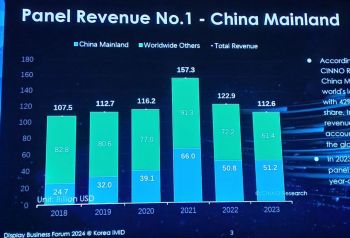 Sales figures for Chinese and global panels presented by Sally Chen, CEO of Chino, at the 'Display Business Forum 2024' held on the 13th.
 [Photo by Moon Chae-seok]
LG Display said that 'software-defined vehicles (SDV)' will bring trends such as larger displays, low power consumption, and deformability. Ki-hwan Son, Executive Director in charge of Auto Marketing Product Planning at LG Display, said that ultra-large displays of 40 to 50 inches will be installed in vehicles in the future. The average size of vehicle displays is expected to grow from 10 inches in 2020 to 12 inches this year and 15 inches by 2030.
Director Son said that to keep up with the trend of larger sizes, the form factor (device shape) must be freely changeable. Rollable and slidable displays should be adopted so that the display can be exposed in the desired size only when in use. He also predicted that electric vehicle power consumption will be twice that of internal combustion engine vehicles, making the development of low-power displays increasingly important.
Samsung Display predicted the arrival of the 'on-display AI' era. Jae-wan Kim, Executive Director of the AI Team at Samsung Display's Production Technology Research Institute, said that the 'on-device AI' craze that occurred in the home appliance and smartphone markets is expected to continue in the display industry.
Until now, the roles related to image quality optimization were divided between set (finished product) companies like Samsung Electronics and LG Electronics and panel manufacturers like Samsung Display and LG Display. Often, optimization was done according to the set company's graphics processing unit (GPU). In the future, to optimize image quality at high speed and low power, panel companies will need to optimize image quality directly, and 'AI T-con' technology is expected to emerge in this process.
Director Kim said, "An era will come when panel companies' AI T-con technology optimizes the screen according to content or applications (apps), enhancing product competitiveness," adding, "A new business model will emerge where panel company products perform roles previously done by set companies' GPUs."
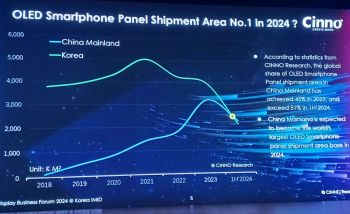 Current status of Chinese organic light-emitting diode (OLED) panel shipments presented by Sally Chen, CEO of Chino, at the 'Display Business Forum 2024' held on the 13th.
 [Photo by Moon Chae-seok]
Samsung and LG Display are accelerating the advancement of low-power, low-heat display technologies for AI. Chang-hee Lee, Vice President and Head of Samsung Display's Display Research Institute, said in a keynote speech, "For on-device AI display components, low power consumption and reduced heat emission are important," adding, "Innovative designs suitable for new form factors are needed to reduce power consumption and heat emission."
Yoon Soo-young, Chief Technology Officer (CTO) and Vice President of LG Display, said, "When supporting AI functions, it is important to save more power in the display field," explaining, "Because about 30-40% of power consumption occurs in the display."
© The Asia Business Daily(www.asiae.co.kr). All rights reserved.



















