Discover and Process Numerous Livelihood Bills by the 28th
Differences Over President's Attendance at Ruling, Opposition, and Government Consultative Body
The ruling and opposition parties have agreed to hold a plenary session on the 28th to pass bills without contentious issues. While further discussion is needed on the specific bills to be passed, they decided to take time and hold the plenary session at the end of the month to process as many livelihood-related bills as possible.
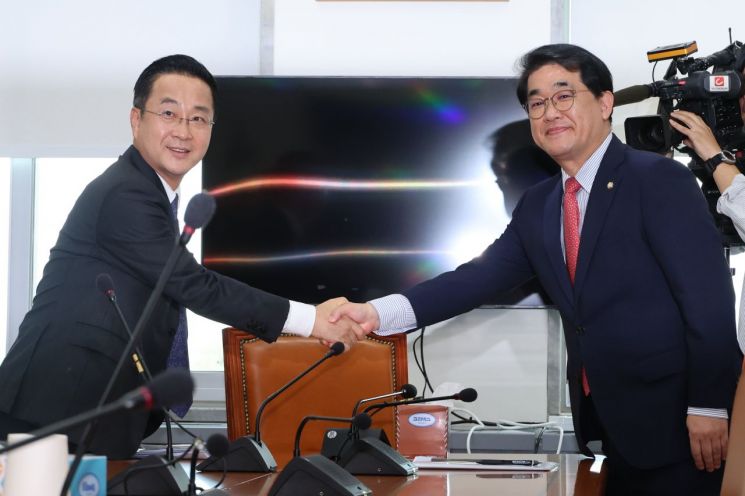
On the 13th, Park Seong-jun, the senior deputy floor leader of the Democratic Party of Korea, met with Bae Jun-young, the senior deputy floor leader of the People Power Party, at the National Assembly. After the meeting, Park told reporters, "We agreed to hold a plenary session at 2 p.m. on the 28th. Before the plenary session, each standing committee will convene and quickly pass non-contentious bipartisan agreed bills through subcommittees and then submit them to the plenary session." He added, "On the day before the 28th plenary session, we tentatively agreed to hold an operations committee meeting to receive work reports and current issue inquiries from the National Assembly Secretariat, the Human Rights Commission, and the Presidential Office."
Regarding the bipartisan-government livelihood consultative body, no final agreement was reached due to the president's attendance. Senior Deputy Floor Leader Bae said, "Our proposal is still valid," adding, "The senior deputy floor leaders and policy chiefs of both parties can meet, and if necessary, the head of the Office for Government Policy Coordination can be a fixed member to handle bills, budgets, and other matters that the people of both parties want." Park said, "By meeting with Senior Deputy Floor Leader Bae, practical consultations are taking place, and the floor leaders have lunch with the Speaker of the National Assembly every Monday to discuss parliamentary operations." He explained, "Ultimately, to improve the quality of life for the people and strengthen accountability, a bipartisan-government consultative body involving the floor leaders and the president is necessary to achieve substantial results, whereas the consultative body advocated by the People Power Party is more of a working-level group."
When asked whether the Nursing Act, the Ku Hara Act (Civil Code amendment), and the Special Act on Jeonse Fraud would be prioritized for passage, Senior Deputy Floor Leader Bae said, "Those laws were examples mentioned by the senior deputies of both parties last time, and there is a reason we set the plenary session for the 28th." He emphasized, "We will make efforts to discover and pass more livelihood-related bills by sufficiently discussing and reaching agreements on non-contentious livelihood bills in standing committees and subcommittees."
Additionally, when asked whether contentious bills between the ruling and opposition parties would not be submitted at the plenary session on the 28th, Senior Deputy Floor Leader Bae said, "We hope so," but added, "We need to wait and see." Park responded, "The ruling and opposition parties may have different policy directions, and there are bills with and without contentious issues. We should consider this as a two-track approach." He continued, "If there is a policy direction we think of, we pursue it, and if there are bills that can be swiftly promoted through bipartisan agreement, we pursue those together. We cannot say in advance which will pass and which will not."
© The Asia Business Daily(www.asiae.co.kr). All rights reserved.
![Clutching a Stolen Dior Bag, Saying "I Hate Being Poor but Real"... The Grotesque Con of a "Human Knockoff" [Slate]](https://cwcontent.asiae.co.kr/asiaresize/183/2026021902243444107_1771435474.jpg)











