Keynote Speech at Display Business Forum on 13th
'Nobel Laureate' Professor Shuji Attends
"MicroLED Efficiency↑ with Tunnel Junction Technology"
China and Taiwan Show Tech Confidence Ahead of Korea
AUO CEO: "Korea, Don't Give Up on MicroLED"
Samsung Display stated at the country's largest display forum that securing low-power and low-heat technologies in the artificial intelligence (AI) era is the most important. They emphasized that Samsung's high-brightness OLEDoS technology can support the development of high-resolution extended reality (XR) devices.
LG Display stressed that this year is a crucial year in which the share of organic light-emitting diode (OLED) displays in the small- and medium-sized information technology (IT) device market, such as mobile phones and tablets, will increase more than threefold.
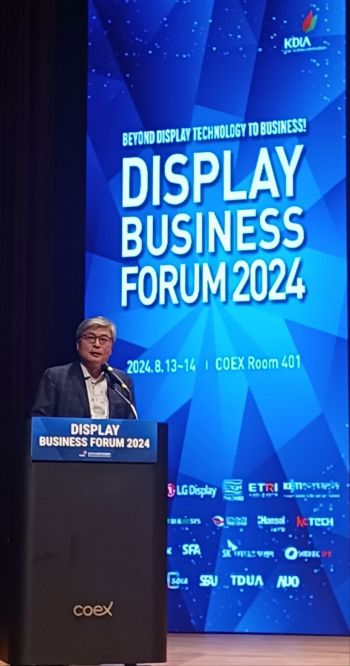 Lee Chang-hee, Vice President and Head of Display Research Center at Samsung Display, is delivering the keynote speech on "Display Technology for the Artificial Intelligence (AI) Era" at the "Display Business Forum 2024" held on the 13th at COEX in Gangnam-gu, Seoul.
 [Photo by Moon Chae-seok]
On the 13th, Lee Chang-hee, Vice President and Head of the Display Research Center at Samsung Display, delivered a keynote speech titled "Display Technology for the AI Era" at the 'Display Business Forum 2024' held at COEX in Gangnam-gu, Seoul, stating that Samsung can stand out in the on-device AI era.
Considering that AI devices consume a lot of power for high-computation tasks, Lee said there will be growing interest in display technologies that can effectively reduce power consumption.
He said, "Display components for on-device AI need to consume less power and reduce heat emission," adding, "Innovative design suitable for new form factors is also necessary to reduce power consumption and heat emission."
He continued, "As finished product companies try to make wearable, virtual reality (VR), and augmented reality (AR) devices thinner and lighter, we are also developing OLEDoS," and added, "To enhance the performance of multi-modal AI devices, it is necessary to incorporate various sensors."
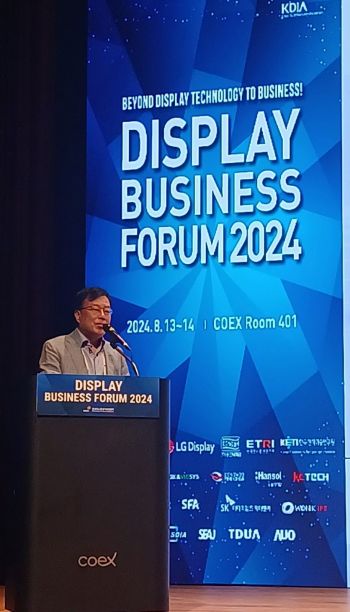 Yoon Soo-young, Chief Technology Officer (CTO) and Vice President of LG Display, is delivering a keynote speech on the theme "New Opportunities in the Display Industry" at the "Display Business Forum 2024" held on the 13th at COEX in Gangnam-gu, Seoul.
 [Photo by Moon Chae-seok]
Yoon Soo-young, Vice President and Chief Technology Officer (CTO) of LG Display, emphasized this year as a year of rebound for the small- and medium-sized IT OLED market in his keynote speech titled "New Opportunities in the Display Industry."
Yoon cited data from market research firm Omdia, stating that the share of OLED in the overall IT display market will expand about threefold from 5% last year to 16% this year. The market size is expected to grow from $1.442 billion (approximately 2 trillion KRW) to $5.468 billion (approximately 7.5 trillion KRW).
He said, "This year will effectively be the year when the small- and medium-sized IT market adopts OLED technology," citing Apple's first adoption of OLED technology in the iPad as an example. He added, "By 2028, OLED is expected to account for about 34% of the entire IT display market."
Nobel Physics laureate Shuji Nakamura, professor at the University of California, Santa Barbara, pointed out several issues with micro light-emitting diode (LED) technology, such as red color implementation and high power consumption. He noted that as the size of display components shrinks from 100 micrometers (μm; one-millionth of a meter) to 20 μm, the chips (semiconductors) are also getting smaller.
Professor Nakamura said that applying tunnel junction technology to gallium nitride devices can improve microLED efficiency. He expects microLEDs to be widely used in data centers in the future. He stated, "We confirmed that gallium nitride tunnel junctions improve current spreading without loss (defects)," adding, "As microLED technology becomes more active, its application in data centers will increase, which will reduce costs and improve speed."
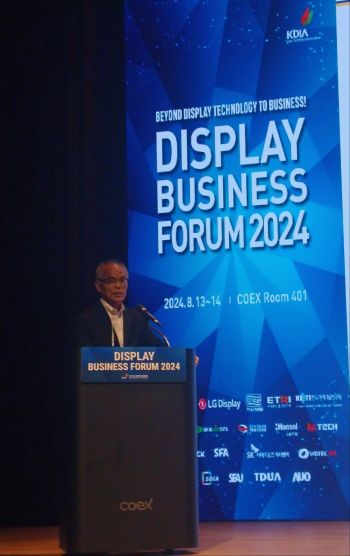 Professor Shuji Nakamura, the 2014 awardee who developed the blue LED, is delivering a keynote speech on the topic of "Recent Advances in Nitride Technology for High Efficiency of Micro LED Devices for Display and Artificial Intelligence (AI) Communication" on the 13th at COEX in Gangnam-gu, Seoul.
 [Photo by Chaeseok Moon]
Key figures from competing countries such as China and Taiwan showed confidence in their technologies at the forum.
Yang Xinqing, Vice Chairman of the China Optical Optoelectronic Industry Association (CODA), expressed gratitude to Korea in his congratulatory speech, saying, "Thanks to Korea, China has succeeded in localization of mass-produced displays and has grown into a major member of the global electronic information industry."
He also said that China is shifting from "quantity to quality." Yang said, "The Chinese display industry is striving to break away from the traditional approach of expanding production and aims to achieve a leap forward through technological innovation and high-quality development."
Frank Ko, CEO of Taiwanese display company AUO, explained that his company is the world's first developer of microLED and has the technology to produce components at the 8-micrometer scale. According to him, AUO created the world's first 8-inch full-color microLED display in 2018. Samsung Electronics is a major customer. He said they realized the world's first commercial microLED TV together with Samsung.
Ko said they have secured the technology to produce microLED products sized 8 to 10 μm and are currently evaluating economic feasibility. He mentioned that although microLED consumes more power than OLED, the difference can be overcome through technological development such as optimizing LED package design.
In response to a request for advice on the "poor" state of the Korean microLED industry infrastructure ecosystem, Ko said, "Don't give up and keep going," adding, "AUO is ready to cooperate with other companies."
© The Asia Business Daily(www.asiae.co.kr). All rights reserved.
![Clutching a Stolen Dior Bag, Saying "I Hate Being Poor but Real"... The Grotesque Con of a "Human Knockoff" [Slate]](https://cwcontent.asiae.co.kr/asiaresize/183/2026021902243444107_1771435474.jpg)


















