If Early, Detailed Sale Plan to Be Submitted to City Council Next Month
Multiple Sale Attempts... No Bidders and Frequent Lawsuits with Consignment Company
All Lawsuits with Last Consignment Company Withdrawn... Remaining Issue Is Hull Sale
Construction Cost 11.2 Billion KRW, Price Halved... Impact of Facility Aging and Others
The sale process of the Han River cruise ship Araho, which operated between Yeouido Hangang Park and the southern end of Seogang Bridge in Seoul, is set to resume. After several failed attempts due to price and contract conditions, its value has now dropped to about half of the construction cost. Administrative procedures related to the operation of Araho are also in the final stages. Recently, it was confirmed that the Seoul Metropolitan Government withdrew all lawsuits filed against the consignment companies to wrap up the project.
According to the Seoul Metropolitan Government on the 13th, the city plans to submit a detailed implementation plan for the sale of Araho to the Seoul Metropolitan Council as early as next month. Since it involves the sale of Seoul city property, approval from the council is required. Previously, the city also went through the process of changing the shared property management plan for the sale of Araho.
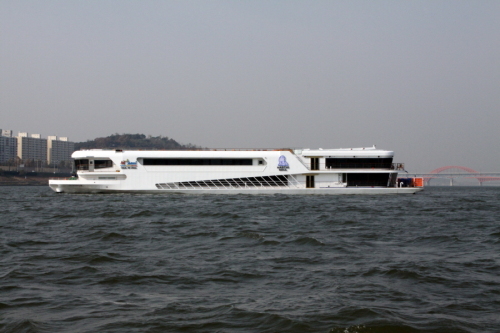
Araho was the first performance-specialized cruise ship on the Han River, constructed in 2010 with an investment of 11.2 billion KRW. It was built to accommodate 310 passengers and equipped with a stage and variable seating. However, from the moment it set sail, issues regarding fare setting and business feasibility were raised, and it was dubbed a "money pit," leading to efforts to sell it starting in 2012.
There were no bidders. Despite adjusting the price and attempting to sell it five times in total, no owner was found, and the ship was repeatedly operated under consignment. Starting with LetsGoKorea in 2017, followed by E-Land Cruise, a subsidiary of the E-Land Group, and Inderline25, the business rights were transferred, but there were limits to restoring profitability.
Lawsuits were frequent as well. With the first consignment company, LetsGoKorea, conflicts arose during the lease contract process over the timing and price conditions of the ship purchase. E-Land Cruise began operations only after a year-long legal battle with the previous consignment company. The last consignment company, Inderline25, was involved in litigation with the Seoul Metropolitan Government over contract periods and other issues.
However, the Seoul Metropolitan Government recently withdrew all three lawsuits against Inderline25 (eviction lawsuit, injunction to prohibit prior occupancy, and administrative injunction). Measures and agreements regarding rent and compensation were completed, and the pier demolition work was also finalized.
What remains is the sale of the hull. The Seoul Metropolitan Government recently conducted an appraisal for the sale, confirming that the value has dropped to nearly half compared to the construction cost (11.2 billion KRW). According to a city official, the value had already fallen to 9 billion KRW during the sale attempt 10 years ago, and depreciation has increased further due to aging facilities.
The exact sale price and implementation plan will be disclosed as early as next month. Currently, the city is preparing administrative procedures to obtain council approval for the sale. The demolished pier is being relocated and remodeled to be used as a pier for other public vessels.
However, the industry views that even if the ship is acquired, its utilization will be low due to aging facilities, increased maintenance costs, and concerns about overlap with the River Bus (Hangang Bus) service that Seoul is extensively preparing. Therefore, the sale is expected to be difficult. Lowering the price would increase competitiveness, but since it is city property, excessively adjusting the price below market value could also be problematic. A Seoul city official stated, "It is now insufficient for Seoul to operate it in various ways," adding, "We will smoothly prepare and proceed with the remaining processes such as the sale to transfer it entirely to the private sector so they can operate it."
© The Asia Business Daily(www.asiae.co.kr). All rights reserved.
















