Opposition Proposes Bills Expanding Directors' Duty of Loyalty
Concerns from Business Circles and Conflicts Escalate to National Assembly
Ongoing Worries About Impact on Directors' Business Judgment
US Focuses on Duty of Loyalty for Controlling Shareholders
"Diverse and In-Depth Discussions Needed"
The business community is growing increasingly tense as bills to expand the scope of directors' duty of loyalty are being proposed one after another. The business sector has long clashed with financial authorities over their intention to 'value up,' and now the front line appears to be expanding to the National Assembly as well.
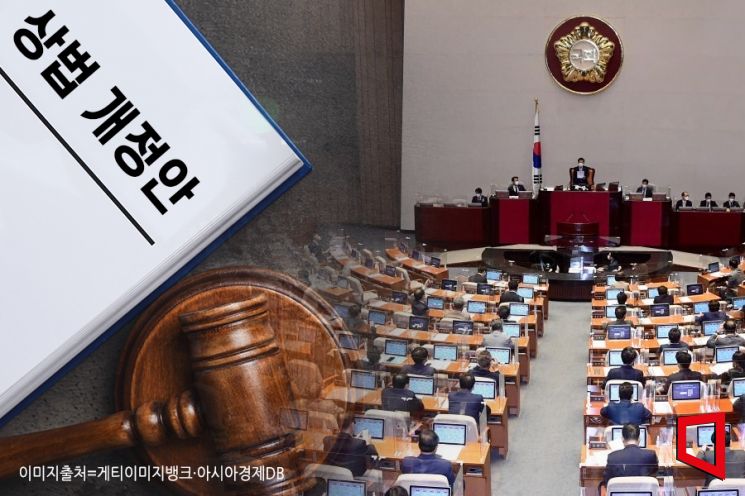
According to the business community and political circles on the 13th, multiple bills have been proposed in the National Assembly to amend Article 382-3 of our Commercial Act, which currently defines the 'scope of directors' duty of loyalty,' expanding it from the existing 'company' to 'company and shareholders.'
The amendment bills are led by members of the Democratic Party of Korea. The lawmakers claim that these bills correct defects and contradictions found in the government's proposed Commercial Act amendment with the same intent. The wording and content vary widely. Democratic Party member Kim Hyunjung added a 'duty of fairness' in addition to the directors' duty of loyalty. Without changing the existing legal text in the Commercial Act, she added a second paragraph stating, "A director has the duty to treat shareholders fairly in the performance of their duties." Earlier, fellow party member Kang Hunsik proposed changing the scope of directors' duty of loyalty from the company to 'the interests of the company and shareholders,' Park Jumin suggested 'company and majority shareholders,' and Jeong Junho proposed revising it to 'proportional interests of shareholders and the company.'
There is also a bill proposing not to amend the Commercial Act but to create a separate special law. Kim Namgeun, along with about 30 opposition lawmakers, is preparing to propose a bill to expand the scope of directors' duty of loyalty from the company to shareholders and the company only for listed large corporations with assets exceeding 2 trillion won. Relatedly, Kim held a 'Discussion on the Enactment of the Small Investor Protection Act' the day before to help build momentum.
Concerns in the Business Community Remain Over Impairment of Directors' Management Judgment
Although the lawmakers claim to have supplemented the government's legislation, the burden on the business community remains significant. One official said, "In terms of the expanded scope of legal responsibilities imposed on directors, it is not fundamentally different." They are particularly concerned that directors' free and swift management decisions could be hindered. Previously, directors could make final decisions considering only the impact on the company's interests when making management judgments, but if the Commercial Act is amended, they will have to consider whether shareholders' interests are infringed from multiple angles. Moreover, management decisions may become ambiguous depending on individual shareholders' interests, and directors could sometimes face lawsuits from individual shareholders.

"Duty of Loyalty Needed Not Only for Directors but Also for Controlling Shareholders"
The legal and business communities point out that the direction of the Commercial Act amendment is problematic in that it focuses only on touching the directors' duty of loyalty. They argue that various perspectives should be considered and other measures explored.
Recently, in the business community, a piece titled "Issues in Introducing the Duty of Loyalty System of Directors to Shareholders," published in June by Han Mansoo, an advisor lawyer at Kim & Chang Law Office, on the Korea Institute for Future Strategies website, has attracted attention. Han argued, "U.S. corporate law precedents and theories can serve as a milestone in discussions on whether to introduce a system imposing a duty of loyalty on company executives not only to the company but also to shareholders in Korea, and if introduced, to what extent."
He particularly pointed out that in the U.S., controlling shareholders, not directors, are also burdened with a duty of loyalty toward minority shareholders. While maintaining the basic legal principle that shareholders have self-determination rights over their privately owned shares, it may be more practical to prevent controlling shareholders from making decisions that harm other shareholders' interests. He also noted that this duty of loyalty is not unlimited but restrictively prohibits only fraud and betrayal.
Currently, our Commercial Act does not include provisions imposing a duty of loyalty on controlling shareholders such as majority shareholders. Experts emphasize that without examining such provisions and focusing solely on expanding directors' duty of loyalty, it will be difficult to derive reasonable measures.
© The Asia Business Daily(www.asiae.co.kr). All rights reserved.


















