'Red Light' on Deficit Resolution Policy
Collapsed Manuals Such as Two-Person Teamwork
Recently, fatal accidents involving workers conducting subway inspections and maintenance have occurred consecutively, bringing the issue of 'outsourcing of risk' back into the spotlight. It is pointed out that workforce reductions and outsourcing, implemented as part of public sector management efficiency measures, have failed to guarantee a safe working environment.
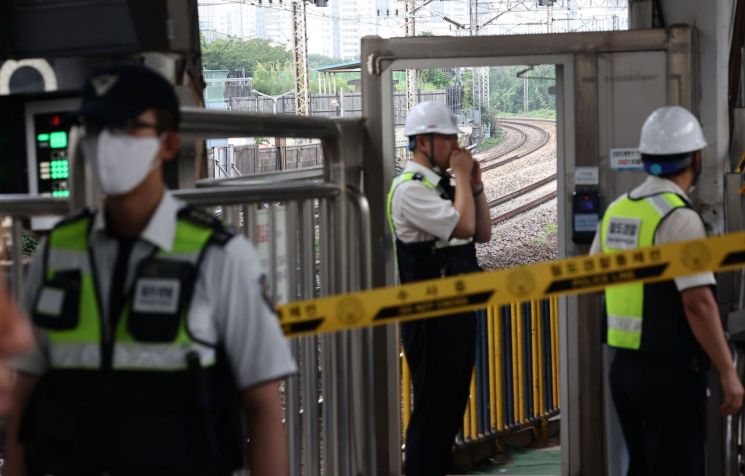
According to the Railway Safety Information Integrated Management System on the 13th, the number of casualties in railway accidents was 16 in 2021, 12 in 2022, 10 in 2023, and 9 so far in 2024. In the early hours of the 9th, a work vehicle performing overhead line work at Guro Station on Seoul Subway Line 1 collided with another work vehicle, resulting in the deaths of two employees and injuries to one. On the 17th of last month, a worker installing guide lights on the ceiling of Yangjae Station in Seocho-gu, Seoul, died. On the same day, a worker performing lighting wiring work at Samgakji Station in Yongsan-gu, Seoul, was electrocuted and died.
Behind these repeated accidents lies a structural problem. The Seoul Metropolitan Government and the corporation are pushing for a reduction of about 2,200 personnel and expansion of outsourcing by 2026, citing deficit resolution as the reason. Korea Railroad Corporation reduced 3.8% of its total workforce in 2022, including safety and essential personnel. As a result, basic principles that must be observed for safety, such as working in pairs, are being undermined.
According to the Seoul Metro Labor Union, during the electrocution accident at Yeonsinnae Station in Eunpyeong-gu, Seoul, last June, three personnel performed regular inspections and special checks within three hours by working at different locations individually.
A representative of the Seoul Metro Labor Union explained, “The principle of working in pairs is to check safety conditions next to the worker and confirm with each other to work safely, but to handle many tasks in a short time, there is no room to watch the work beside them.” A representative of the National Railway Labor Union pointed out, “There is a manual that requires train watchers to be placed in front and behind during fieldwork, but when workers move by vehicle, there is no such mandatory provision. If there had been more watchers, at least the risk could have been detected.”
Experts unanimously agree that sufficient personnel are necessary to ensure workers' safety. Lee Byung-hoon, emeritus professor of sociology at Chung-Ang University, said, “When there is a shortage of personnel, the probability of safety issues increases,” and advised, “The state must respond strictly so that employers take responsibility and prevent accidents.”
Professor Ha Jong-kang of the Labor Academy at Sungkonghoe University also said, “Even directly employed workers, when understaffed, try to handle many tasks in a short time, which sometimes leads to simultaneous execution of tasks that should not be done concurrently,” and added, “To strictly comply with safety manuals, the accompanying personnel must be guaranteed.”
© The Asia Business Daily(www.asiae.co.kr). All rights reserved.

















