Statistics Korea, Regional Economic Trends for Q2
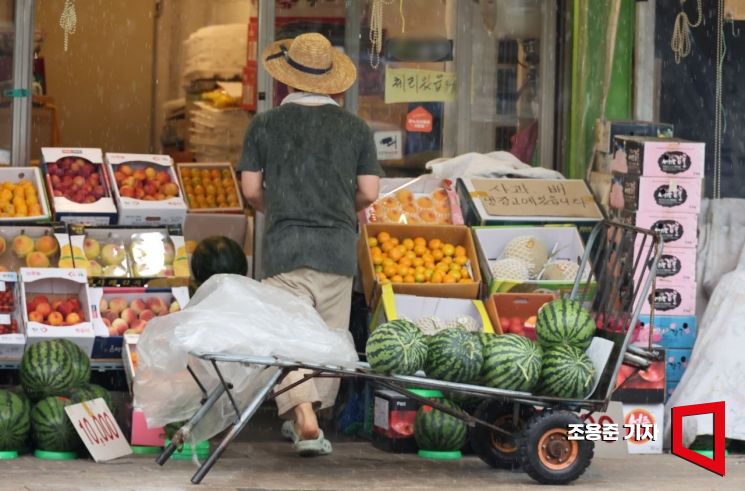 On the 2nd, as the consumer price inflation rate remained in the 2% range for three consecutive months and fruit prices such as apples continued to rise, a vendor was displaying fruits at the fruit and vegetable market in Yeongdeungpo-gu, Seoul. Photo by Jo Yongjun jun21@
In the second quarter of this year, retail sales decreased in 15 out of 17 metropolitan cities and provinces nationwide compared to the same period last year. Consumer prices rose in all metropolitan cities and provinces compared to the same period last year.
According to the regional economic trends report for the second quarter released by Statistics Korea on the 12th, nationwide retail sales in the second quarter of this year fell by 2.9% compared to the same period last year. Retail sales have been declining for nine consecutive quarters since the second quarter of 2022.
By region, retail sales decreased in 15 out of 17 metropolitan cities and provinces, except for Chungnam (4.0%) and Chungbuk (0.7%). Ulsan (-7.9%), Incheon (-7.2%), and Seoul (-6.8%) showed particularly large declines, influenced by reduced sales at passenger car and fuel retail stores, as well as specialty retail stores.
Exports (based on customs clearance) increased in nine metropolitan cities and provinces including Gyeonggi (35.5%) and Chungnam (16.9%). This was due to increased exports of memory semiconductors, processors/controllers, and computer peripherals. Conversely, Daegu (-22.3%), Jeonbuk (-13.1%), and Gwangju (-6.7%) saw declines as exports of other organic/inorganic compounds, general machinery, and processors/controllers decreased.
Consumer prices rose in all metropolitan cities and provinces due to increases in agricultural products and personal services excluding dining out. Incheon (3.1%), Gwangju (3.1%), and Jeonnam (3.0%) experienced higher-than-average increases nationwide, driven by rises in agricultural products and personal services excluding dining out, while Jeju (2.3%), Chungnam (2.3%), and Daegu (2.4%) saw increases below the national average.
The employment rate rose in eight metropolitan cities and provinces including Gwangju (1.2%p), Jeonbuk (1.1%p), and Chungbuk (0.8%p), but declined in Daegu (-2.5%p), Jeonnam (-1.5%p), and Daejeon (-0.6%p).
The unemployment rate increased in 11 metropolitan cities and provinces including Chungnam, Seoul, and Jeonnam. The unemployment rates in Chungnam (0.8%p), Seoul (0.7%p), and Jeonnam (0.7%p) rose, while those in Sejong (-0.6%p), Gyeongnam (-0.4%p), and Jeonbuk (-0.3%p) decreased.
© The Asia Business Daily(www.asiae.co.kr). All rights reserved.

















