"South Korea Also Needs to Review Various Seismic Performance Measures"
After a magnitude 7.1 earthquake struck Miyazaki Prefecture, Japan on the 8th, earthquakes with magnitudes over 5 occurred for three consecutive days, prompting the Japan Meteorological Agency to issue a 'Major Earthquake Advisory' for the first time in history. Amid growing concerns that South Korea might also be affected, Professor Hong Taekyung of Yonsei University's Department of Earth System Sciences warned, "The southern coast of our country cannot just stand by and watch a super-large earthquake happen across the sea."

On the 12th, Professor Hong explained on CBS Radio's 'Kim Hyun-jung's News Show,' "When the magnitude 7.1 earthquake occurred in Japan, there were quite a few reports that seismic tremors were felt along the southern coast of South Korea as well," adding, "For sensitive individuals, it was a situation where they could feel buildings shaking about 1 cm."
The Nankai Trough earthquake refers to earthquakes that occur at intervals of 100 to 150 years along the oceanic trench extending from the sea off Shizuoka Prefecture, west of the Tokyo metropolitan area, to the southern part of Shikoku and the eastern part of Kyushu. According to investigations conducted by the Japanese government after the Great East Japan Earthquake, earthquakes with magnitudes in the low 8 range have occurred alternately in three regions: Tokai, Tonankai, and Nankai. The problem arises when earthquakes in these three regions occur sequentially. The magnitude of such an earthquake can reach up to 9.0, comparable to the Great East Japan Earthquake. It has been analyzed that if an earthquake with a magnitude between 8 and 9 occurs in the Nankai Trough, more than 230,000 people could die or go missing, and approximately 2.09 million buildings could be damaged.
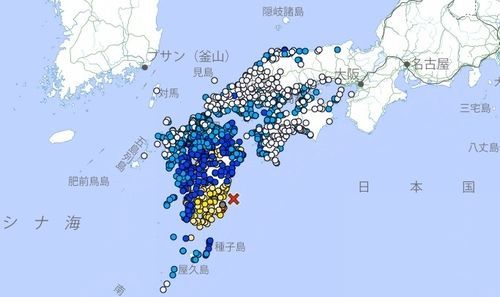
An earthquake of about magnitude 9.0 is roughly 1,000 times stronger than a magnitude 7.1 earthquake. The seismic tremors are expected to be about 30 times greater. Professor Hong said, "If the shaking along the southern coast was about 1 cm during the 7.1 earthquake, it means it would shake about 30 cm during a 9.0 earthquake," expressing concern that "the southern coast cannot just watch a super-large earthquake happen across the sea."
Moreover, since South Korea's seismic resistance standards are lower than those applied in Japan, there is a high possibility that buildings could suffer significant damage, according to Professor Hong. He assessed, "In the event of a super-large earthquake like the Great East Japan Earthquake occurring in the Nankai Trough, South Korea must also review various seismic resistance standards."
© The Asia Business Daily(www.asiae.co.kr). All rights reserved.
![From Bar Hostess to Organ Seller to High Society... The Grotesque Con of a "Human Counterfeit" [Slate]](https://cwcontent.asiae.co.kr/asiaresize/183/2026021902243444107_1771435474.jpg)

















