Medical AI company VUNO announced on the 12th that it has obtained medical device approval from the Ministry of Food and Drug Safety for its AI-based heart failure screening software, VUNO Med-DeepECG LVSD.
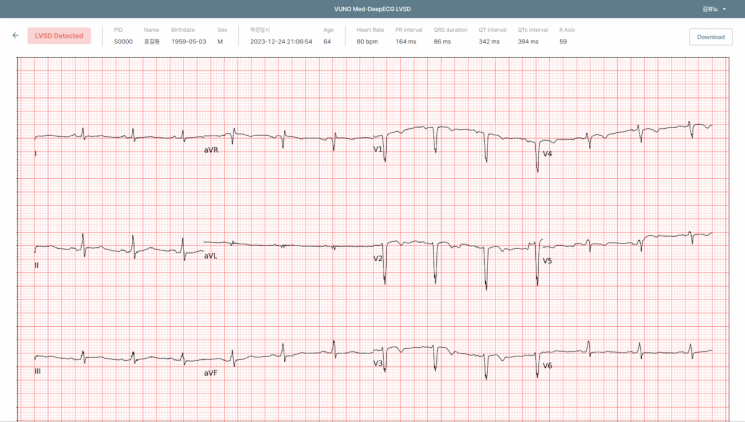 Operating screen of Vuno's AI-based heart failure screening software 'VunoMed DeepECG LVSD'
 [Photo by Vuno]
This product is a software-type medical device that analyzes electrocardiogram (ECG) data based on AI to screen for left ventricular systolic dysfunction (LVSD), a major type of heart failure. It is VUNO's second AI-based ECG analysis software product, following VUNO Med-DeepECG AMI, a software approved by the Ministry of Food and Drug Safety in May for detecting acute myocardial infarction.
LVSD refers to a condition where the left ventricular ejection fraction, the percentage of blood ejected from the left ventricle with each contraction, falls below 40%. Due to reduced contraction function of the left ventricle, blood is not effectively pumped, resulting in insufficient blood supply to various parts of the body, which can lead to diseases such as coronary artery disease, myocardial infarction, and multiple organ failure. Although it is known to have a high rate of readmission after diagnosis, low survival rate, and poor prognosis, it often occurs asymptomatically, making early detection important.
VUNO Med-DeepECG LVSD demonstrated excellent performance in clinical trials involving LVSD patients. In terms of AUROC, a performance indicator representing predictive accuracy, it recorded 0.9634 for the standard 12-lead ECG measured in hospitals, 0.9428 for limb lead ECG, and 0.9263 for single-lead ECG.
VUNO plans to integrate the home-use ECG measuring medical device, Hartiv P30, with VUNO Med-DeepECG LVSD in the future. This will allow patients to easily measure and check their ECGs in daily life and receive appropriate medical care in advance. Additionally, compared to echocardiography examinations performed in clinical settings for diagnosis, it offers the advantages of simplicity and reduced examination time, aiming to be utilized for early screening of emergency patients by medical staff and improving patient prognosis.
Lee Ye-ha, CEO of VUNO, said, “With this approval, we can introduce AI medical devices that allow individuals to easily detect major cardiovascular diseases in daily life and receive timely treatment.” He added, “ECG data holds great potential as clues for various diseases beyond acute myocardial infarction and heart failure, such as atrial fibrillation, hyperkalemia, and chronic kidney disease. We will continue to expand the utilization of Hartiv P30 through ongoing research and development.”
© The Asia Business Daily(www.asiae.co.kr). All rights reserved.

















