High Electricity Cost Burden in Addition to Prices and Labor Costs
Yeo Mo (30), who runs a private cafe in a residential area of Dongjak-gu, Seoul, usually paid around 300,000 won for electricity bills, but last month she paid 570,000 won, nearly double.
On the 10th, Yonhap News reported the sighs of self-employed people burdened by high electricity bills in addition to rising prices and labor costs.
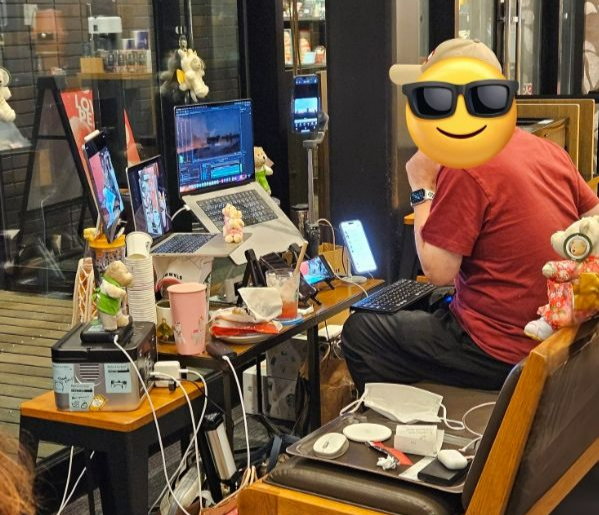 A customer at a Starbucks in Japan working with multiple laptops and mobile phones set up on the table. (This photo is not directly related to the article.) [Photo by X Capture]
Kim Mo (48), who runs a two-story cafe in Yangcheon-gu, had an electricity bill of over 1 million won last month. This means about a quarter of his net profit of 4 million won after expenses disappeared. To increase the cafe’s net income, he operates two hours longer than nearby cafes.
Kim told Yonhap News, "I’m already worried about how much the electricity bill will be this month," adding, "The cafe has to run the air conditioner so cold that customers come, and if the temperature is raised even slightly, complaints come in quickly." Although the government operates a program to support electricity bills for small business owners with annual VAT-reported sales under 60 million won, the maximum support of about 200,000 won per year is not much consolation.
They all agree that the influx of middle and high school students and college students flocking to cool cafes during summer vacation does not significantly help sales. On top of that, the presence of ‘Kagongjok’ (students who study in cafes) causes severe losses.
Since fast turnover directly affects sales, customers who stay for long periods and even charge their phones and laptops cause a slight increase in electricity costs that cannot be ignored. Some stores have blocked power outlets because of this, but it is not a perfect solution.
According to a 2019 survey by the Korea Foodservice Industry Research Institute, the break-even time for a cafe on a 4,100 won cup of coffee is 1 hour and 42 minutes. If one person orders one drink and stays longer than 1 hour and 42 minutes, the owner actually incurs a loss. It is also common to see cases where customers leave their belongings at the table during meal times, go eat, and then return to continue studying.
Kim Mo (22), a part-time worker at a cafe, told Yonhap News, "It is common for one person to use a four-person table, spread out their belongings, and study, and group customers often just come in, glance around, and leave."
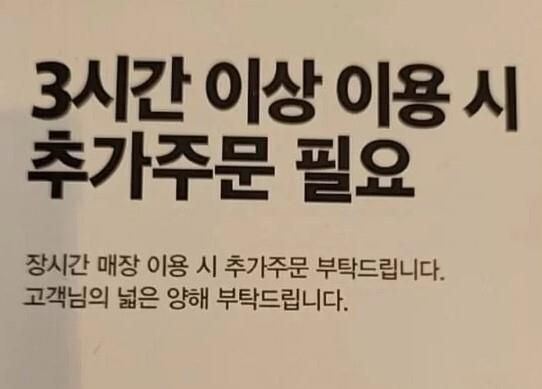
Moreover, private cafes that mostly serve regulars and local residents find it difficult to speak frankly to customers for fear of being rumored as unfriendly. Some cafes have posted notices asking customers to order additional items if they stay longer than three hours, but they cannot kick customers out if they do not comply.
Meanwhile, the government operates a program to support electricity bills for small business owners with annual VAT-reported sales under 60 million won, but this is known to be about 200,000 won per year at most. Also, with international energy prices soaring since last year, electricity bills have increased by more than 40%, and if more than 1,000 kWh of electricity is used this summer, the amount to be paid will be higher than last year.
© The Asia Business Daily(www.asiae.co.kr). All rights reserved.


















