Dow up 0.13% · S&P 500 up 0.47% · Nasdaq up 0.51%
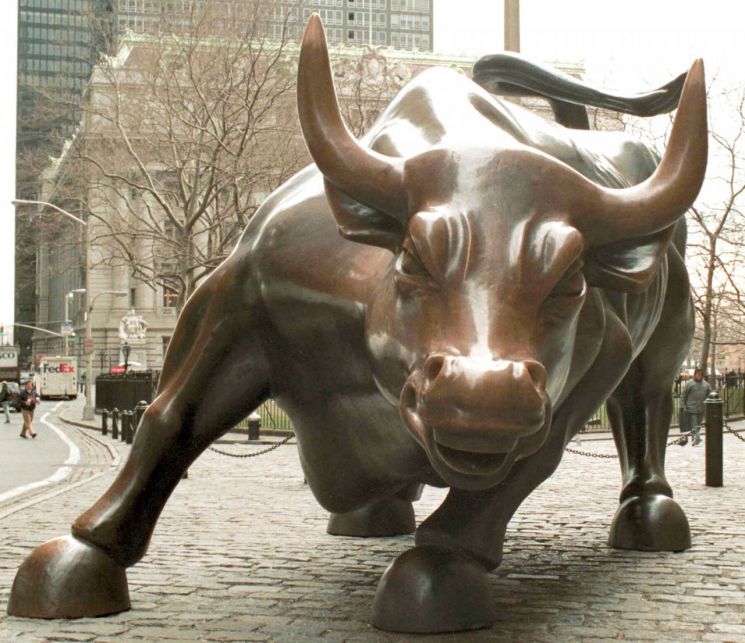
The New York stock market showed gains for the second consecutive day, recovering most of the weekly losses.
On the 9th (local time) at the New York Stock Exchange (NYSE), the Dow Jones Industrial Average closed at 39,497.54, up 51.05 points (0.13%) from the previous session. The Standard & Poor's (S&P) 500 index rose 24.85 points (0.47%) to 5,344.16, and the Nasdaq Composite Index closed at 16,745.30, up 85.28 points (0.51%) from the previous session.
Major stock indices started the week with a sharp decline, but as recession concerns eased, steady bargain buying offset the losses.
The S&P 500 index had a weekly decline of -4.25%, but ended the week at -0.04%. The Nasdaq index also narrowed its weekly loss from -6.36% to -0.18% by the end of the week.
Worsening U.S. employment data for July, concerns over the Federal Reserve's (Fed) potential delay in rate cuts, and aggressive unwinding of the yen carry trade shook the market. However, the improvement in new unemployment claims announced this week, along with continued expansion in the service sector and employment, somewhat eased these concerns.
The "Magnificent 7," referring to seven major tech stocks, all rose except for Nvidia. Nvidia fell 0.21%, recording a weekly decline of over 2%.
Large pharmaceutical company Eli Lilly surged more than 5% following nearly a 10% jump the previous day, driven by news of a sharp increase in sales of its obesity treatment drugs. As a result, its market capitalization reached $803.3 billion, closely trailing Meta Platforms' $1.113 trillion.
Eli Lilly's Maounjaro and Zepbound, originally developed as diabetes treatments, have attracted attention as obesity treatments, leading to a surge in demand. Supported by this, second-quarter sales rose 35.98% year-over-year to $11.328 billion, and adjusted earnings per share (EPS) surged 85.78% year-over-year to $3.92.
There was also news of a sharp increase in sales from TSMC (Taiwan Semiconductor Manufacturing Company), the world's largest semiconductor foundry. TSMC announced that due to sustained demand for artificial intelligence (AI), its July sales rose 24% month-over-month and 45% year-over-year to $7.94 billion. However, TSMC's stock price only rose about 1%.
The Philadelphia Semiconductor Index was nearly flat following a more than 6% surge the previous day. Major AI and semiconductor-related stocks such as AMD and Qualcomm also showed weakness. Although most sectors showed gains, none rose more than 1%. Materials was the only sector to decline, falling 0.1%.
The Chicago Board Options Exchange (CBOE) Volatility Index (VIX) fell 3.42 points (14.38%) from the previous session to 20.37.
© The Asia Business Daily(www.asiae.co.kr). All rights reserved.
![Clutching a Stolen Dior Bag, Saying "I Hate Being Poor but Real"... The Grotesque Con of a "Human Knockoff" [Slate]](https://cwcontent.asiae.co.kr/asiaresize/183/2026021902243444107_1771435474.jpg)











