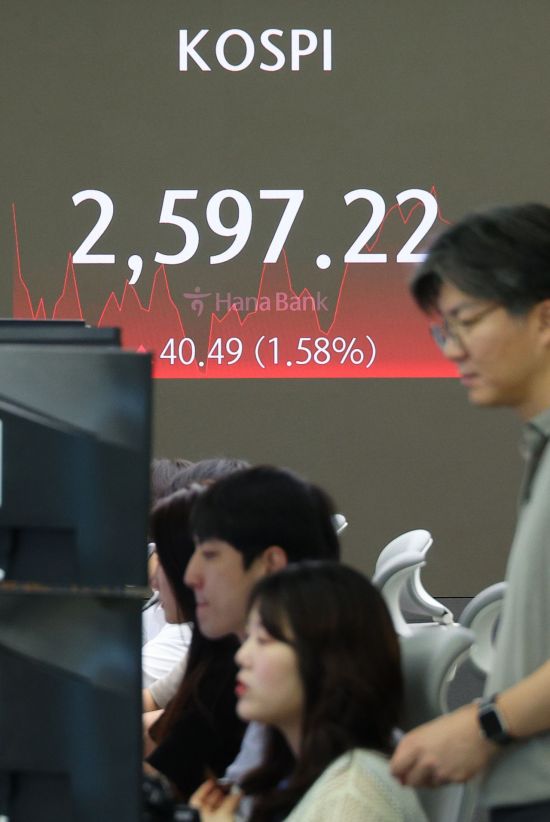
The KOSPI showed an upward trend on the 9th, led by semiconductor and earnings-related stocks, but the index failed to reclaim the 2600 level as the intraday yen strength limited the gains.
The KOSPI index closed at 2,588.43, up 31.70 points (1.24%) from the previous session on the 9th. The index started the day higher at 2,603.08 but gave up some of the gains amid significant intraday fluctuations.
By investor type, institutions were the sole buyers with purchases worth 34.3 billion KRW, while individuals and foreigners sold 28.3 billion KRW and 8.8 billion KRW respectively. Program trading recorded a net sell of 65 billion KRW, combining both arbitrage and non-arbitrage trades.
By sector, the largest gains were seen in electrical and electronics (2.18%), chemicals (2.16%), non-metallic minerals (1.87%), distribution (1.70%), manufacturing (1.63%), steel and metals (1.50%), machinery (1.32%), paper and wood (1.31%), and construction (1.30%).
Most of the large-cap stocks also rose. Samsung Electronics (1.77%), SK Hynix (4.96%), LG Energy Solution (0.31%), Hyundai Motor (2.75%), Samsung Electronics Preferred (0.85%), Celltrion (0.15%), and Kia (0.30%) all increased. On the other hand, Samsung Biologics (-1.44%) and KB Financial Group (-0.36%) declined.
Among individual stocks, earnings-driven gains stood out. Korea Tire & Technology (7.73%), Hanwha General Insurance (11.05%), Mirae Asset Securities (3.47%), and Hyundai GTF Holdings (2.38%) rose after reporting strong second-quarter results. However, Netmarble (-10.81%) plunged sharply right after the opening despite good Q2 earnings, as profit-taking selling pressure surged.
Ji-won Kim, a researcher at KB Securities, said, "The U.S. initial jobless claims were released lower than expected, easing recession concerns. As a result, the three major U.S. stock indices rose together, with the semiconductor index surging nearly 7%, showing strength in tech stocks."
He added, "Domestically, leading semiconductor stocks recovered most of the previous day's losses and foreign investors significantly reduced their net selling of cash and futures, but the index closed without recovering the gap-down level from last Monday."
Regarding the significant intraday volatility, he explained, "Concerns over the massive Nankai earthquake led to a renewed yen strength, causing the Nikkei index and the domestic index to lose momentum during the session, continuing the yen-linked trend." Indeed, the Nikkei 225 index also reversed to a decline in the afternoon like the KOSPI, before rebounding later.
Meanwhile, the KOSDAQ index closed at 764.43, up 19.15 points (2.57%) from the previous trading day. The index started higher but, like the KOSPI, experienced a sharp intraday decline before reversing to gains.
Among the large-cap stocks on the KOSDAQ, EcoPro BM (7.69%), Alteogen (1.68%), EcoPro (6.97%), HLB (3.27%), Samchundang Pharm (0.80%), Enchem (5.34%), Celltrion Pharm (0.25%), Hugel (0.97%), and Classys (1.42%) all rose. However, Rigakem Bio (-1.22%) declined.
© The Asia Business Daily(www.asiae.co.kr). All rights reserved.

















