Applied to Underground Parking Lots in Apartment Complexes... Fire Prevention
Rapid Chargers in Operation Will Introduce 80% Charging Limit
In the future, electric vehicles (EVs) in Seoul apartments may be prohibited from using underground parking lots if they are charged above 90%. This measure aims to prevent excessive charging and thereby avoid EV fires in underground parking lots that could escalate into large-scale fires.
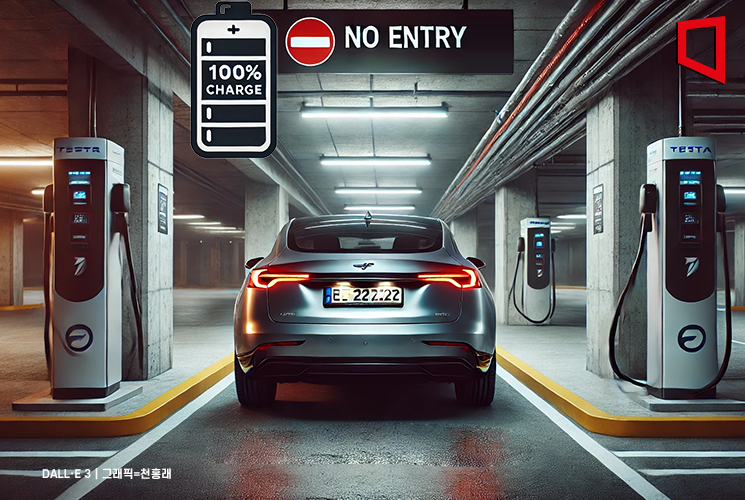
On the 9th, the Seoul Metropolitan Government announced this policy to prevent excessive charging close to full capacity, which is one of the main causes of EV fires. Recently, an EV fire occurred in an underground parking lot of an apartment complex in Incheon, damaging about 100 vehicles and causing harm to residents. As excessive charging has been identified as a major cause of EV fires, the city considers "charging restrictions" at this point to be meaningful in preventing EV fires and has introduced this policy.
A city official stated, "Due to recent EV fires in apartment underground parking lots, prohibiting EV access to underground parking through decisions by residents' representative meetings is becoming a reality. The charging restriction policy promoted by the city aims to reduce the probability of EV fires, alleviate citizens' anxiety, and establish reasonable standards that citizens can agree on, especially in a situation where a complete ban on EV access to underground parking lots may be implemented."
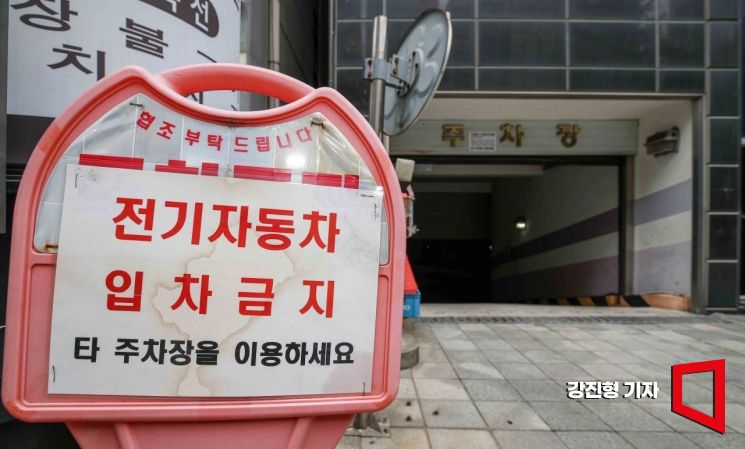 On the 8th, as electric vehicle fires continue to occur, interest in the safety of electric vehicles is growing. At the entrance of an underground parking lot in Incheon, a notice prohibiting electric vehicles from entering is posted. Photo by Jinhyung Kang aymsdream@
First, by the end of September, the city plans to revise the "Standard Rules for Apartment Management" to recommend that only EVs charged up to 90% can enter underground parking lots in apartment complexes. Management entities of apartments and other multi-family housing can issue warnings and impose penalties if residents violate these rules. Although there is no legal basis to enforce or sanction if the standard rules are not reflected in multi-family housing, the city expects voluntary participation amid heightened concerns.
According to the city, most EV chargers installed in multi-family housing are concentrated underground. Among 3,100 complexes with installed chargers, 2,721 complexes (87%) have chargers located in underground parking lots. Of the 39,243 chargers installed in multi-family housing, 91% (35,858 units) are installed in underground parking lots.
To verify the "90% charging limit," the city plans to issue a "Charging Limit Certificate" (tentative name). Although EV owners can set their own target charge levels, continuous verification and management are difficult. The city plans to require manufacturers to raise the durability and safety margin of EVs, currently set at 3-5%, to 10% upon request by EV owners, and to issue certificates for such vehicles. Before revising the rules, the city will also provide related information to multi-family housing to support residents' representative meetings in independently adopting the 90% charging limit for underground parking access.
Public facilities such as city-operated public parking lots will limit fast chargers to 80% charge. Starting with 108 fast chargers owned by Seoul installed by the end of September, this will be applied to 280 chargers by the end of the year. The city plans to gradually expand this to fast chargers operated by district offices entrusted to Seoul Energy Corporation (96 units) and those operated by private charging service providers. A city official explained, "Unlike the 90% charging limit policy, the 80% limit on fast chargers is applied not only to prevent fires but also to reduce charging time since charging speed decreases after 80%, allowing more citizens to use the chargers."
Additionally, the city plans to devise measures to prevent EV fires considering that fires can occur due to battery aging or defects, regardless of charge level. The city is also considering establishing a system to monitor battery status information of parked vehicles in real-time with EV manufacturers and to respond immediately if abnormal signs are detected.
Unannounced inspections and fire safety investigations will be conducted on EV charging facilities installed in multi-family housing. The Fire and Disaster Headquarters will inspect the maintenance status and improvement needs of fire safety facilities such as sprinklers in about 400 multi-family housing complexes with EV charging facilities in Seoul by the end of next month.
By October this year, through revisions to the "Seoul Metropolitan Building Review Standards," safety facility standards considering the risk of large-scale EV fires will be established for new buildings. For new facilities, EV charging stations will be installed above ground as a principle, but if installed underground, they must be located on the top floor of the parking lot. EV-only parking spaces will be limited to three or fewer, separated by firewalls, and equipped with at least two suffocation extinguishers.
Yeo Jang-kwon, head of the Seoul Climate and Environment Headquarters, said, "Recently, residents' anxiety about EV fires has increased, and we expect that charging restrictions will significantly contribute to preventing EV fires. We will continue to enhance safety by promoting the distribution of highly safe EVs and developing and building charging infrastructure systems to minimize citizens' anxiety."
© The Asia Business Daily(www.asiae.co.kr). All rights reserved.
![Clutching a Stolen Dior Bag, Saying "I Hate Being Poor but Real"... The Grotesque Con of a "Human Knockoff" [Slate]](https://cwcontent.asiae.co.kr/asiaresize/183/2026021902243444107_1771435474.jpg)












