Ministry of Education Announces 'Integrated Mental Health Support Plan'
Additional Counseling Staff Assigned per School
Up to 100 'Emergency Support Teams' in Education Offices
Hospital-Linked Agencies Doubled
The Ministry of Education is establishing an integrated support system to monitor the mental health of elementary and middle school students. It plans to increase counseling staff at each school and transform the existing Wee Centers, which have been responding to school violence, into school counseling support institutions. The ministry also aims to expand support teams at the education support office level to 100 by 2027.
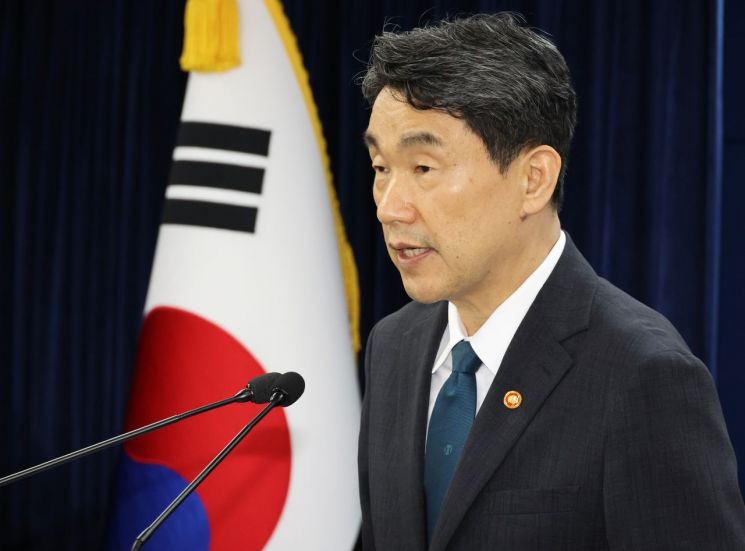
On the 9th, the Ministry of Education held a Social Relations Ministers' Meeting at the Lulu Lala Hospital-type Wee Center in Uijeongbu, Gyeonggi Province, where it announced the 'Student Customized Mental Health Integrated Support Plan.'
The meeting was attended by Lee Ju-ho, Deputy Prime Minister and Minister of Education; Shin Young-chul, Chairman of the Mental Health Policy Innovation Committee; Kim Song-mi, Second Deputy Superintendent of Gyeonggi Provincial Office of Education; Won Soon-ja, Superintendent of Uijeongbu Education Support Office; Ji Soo-hyuk, Head of the Ministry of Education's Mental Health Expert School Visit Project Team; and Park Ok-nam, Superintendent of Sejong City Office of Education, among others.
The Ministry of Education, in collaboration with related ministries (Ministry of Health and Welfare, Ministry of Gender Equality and Family, etc.), has prepared this plan to provide customized integrated support for the mental health of elementary and secondary students. The plan aims to restore the educational function of schools and provide integrated mental health support across all stages from prevention, detection, treatment, to recovery.
First, for students experiencing psychological and emotional crises, the current approach where individual teachers within schools respond will be improved to an integrated support system centered around the principal (or vice principal). Additionally, the deployment of professional counseling teachers will be expanded so that all students can receive counseling, and for schools without assigned counselors, temporary contract teachers and itinerant teachers will provide counseling services. A competency system for professional counseling teachers and counselors will be established, along with field-customized training.
A pilot project will also be launched to expand and reorganize the functions of Wee Centers from focusing on school violence response to becoming dedicated student mental health support institutions. Going forward, Wee Centers will perform school support functions for student mental health. To this end, two additional dedicated personnel will be assigned to each pilot Wee Center. Starting this year, the project will expand to all cities and provinces by 2026, with plans for full implementation by 2027.
To strengthen the school support function of education support offices, 'Emergency Support Teams' (tentative name) composed of mental health experts will be expanded to 100 units by 2027. This year, 36 teams will be established. When schools request intervention for issues requiring the involvement of education support offices, experts will visit the schools directly to assess the situation, provide solutions, and offer consultation.
Furthermore, social-emotional education programs that can be utilized by each class will be developed and supported for use in schools starting next year. The 'Maeum Easy (EASY) Test,' which can be conducted at any time, will be supported to help assess students' mental health issues. For cases requiring professional treatment, connections to regional specialized institutions will be facilitated through Wee Centers. For students in severe psychological and emotional crises, hospital-linked entrusted institutions providing treatment support will be doubled by 2027.
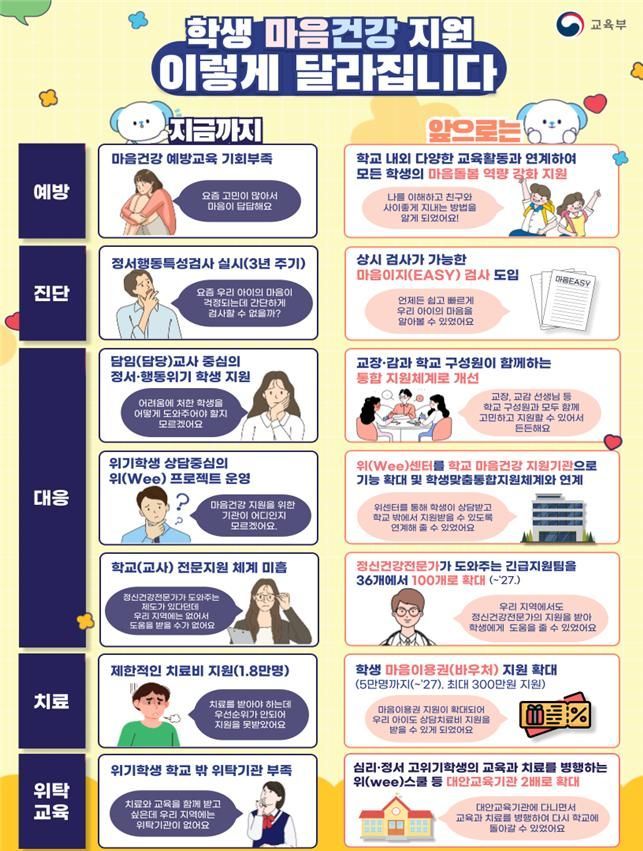
Support for the student 'Maeum Voucher' (voucher) program, which students and parents can use for psychiatric treatment, therapy costs, and counseling fees at specialized institutions, will also be expanded. The number of beneficiaries will be significantly increased from the current 18,000 to 50,000 by 2027, with a maximum payment of up to 3 million KRW per person.
To ensure systematic support for student mental health, the Ministry will also promote the enactment and revision of the 'Mental Health Support Three Acts' (Elementary and Secondary Education Act, Student Mental Health Support Act, Student Customized Integrated Support Act). For students facing psychological and emotional difficulties that threaten their well-being, the system will be improved to allow support without parental consent based on expert opinions, considering the severity and urgency of the situation.
© The Asia Business Daily(www.asiae.co.kr). All rights reserved.


















