Heaven and Hell After the Employment Shock
Tight Outlook Between Economic Recession and Soft Landing
Concerns Over Increased Volatility Amid Accumulated Adverse Factors
Concerns over a US recession triggered by employment data have swept through global financial markets, causing the New York stock market to overreact to single economic indicators. Since last week's shock from the July employment report, the market has been repeatedly swinging wildly on just one piece of news, oscillating between highs and lows. With recession and soft landing forecasts for the US economy sharply divided, and many variables remaining such as AI bubble debates, fears of escalation in the Middle East, and the upcoming November presidential election, there are concerns that the New York stock market's volatility will further increase, continuing a 'rollercoaster market.'
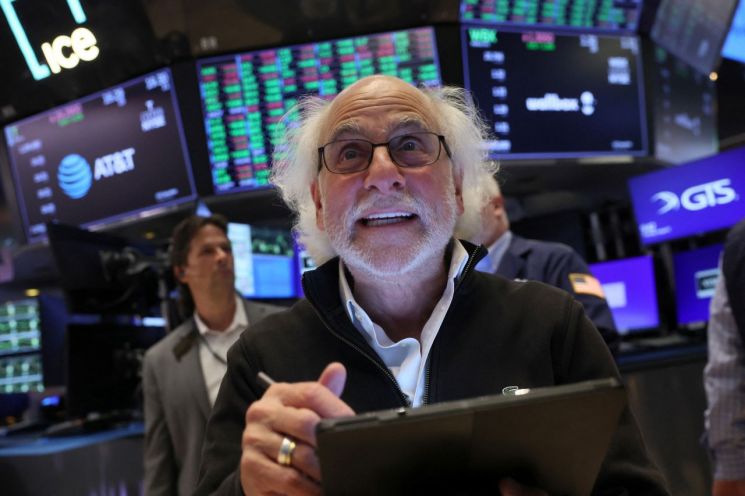
On the 8th (local time), all three major New York stock indices closed higher. The Dow Jones Industrial Average rose 1.76% compared to the previous day, while the S&P 500 and Nasdaq indices surged 2.3% and 2.87%, respectively. This marked a rebound just one day after all three indices had fallen.
The driving force behind the New York stock market's rise that day was an improvement in employment data. According to the US Department of Labor, initial jobless claims last week decreased by 17,000 from the previous week to 233,000, marking the largest decline in a year. This helped alleviate some of the labor market cooling concerns that had rapidly spread after the July employment report, sharply improving investor sentiment.
However, the fact that the stock market moves significantly based on weekly initial jobless claims indicates that the market is in a rather fragile state. In particular, initial jobless claims are heavily influenced by seasonal factors and are insufficient to grasp the broader trends in the employment market. Moreover, continuing jobless claims, which count those claiming benefits for at least two weeks, stood at 1.875 million, exceeding both the forecast (1.87 million) and the revised figure for the previous week (1.869 million). After the employment report showed the unemployment rate jumped from 4.1% in June to 4.3% in July, the recession fears that spread in the market were so large that the market overreacted to a single indicator.
Liz Young Thomas, Chief Investment Strategist at SoFi, analyzed, "The market is becoming more sensitive to every piece of incoming data," adding, "This means that if conflicting data emerges, market volatility will increase further."
The previous day's movement in the New York stock market was also driven by weak demand for US Treasury bonds. Although the market rose in the morning after the Bank of Japan (BOJ) announced it would abandon plans to raise interest rates, it quickly turned bearish and closed lower in the afternoon when news came that demand for the US Treasury's 10-year bond auction was weak, causing bond yields to spike.
Experts predict that the New York stock market will continue its volatile trend due to the uncertain outlook for the US economy and remaining various risk factors. While Federal Reserve (Fed) officials are trying to calm market fears by stating that employment is slowing moderately, Citigroup forecasts that the unemployment rate will soar to 5% within the year. Fatigue from the AI rally is also accumulating.
There are also expectations that a second round of yen carry trade unwinding could occur. According to UBS, the cumulative size of the dollar-yen carry trade since 2011 is about $500 billion (approximately 690 trillion won), of which about $200 billion (approximately 270 trillion won) has been unwound in recent weeks.
The upcoming November presidential election is also a variable. If former President Donald Trump is elected, immigration restrictions and tariff increases could cause inflation to surge, potentially pushing Treasury yields higher and stock markets lower. The possibility of full-scale conflict between Israel and Iran, escalating tensions in the Middle East, is another concern.
Joseph Ferrara, Investment Strategist at Gateway Investment Advisors, said, "The recent volatility shocks in the market may be a preview of the rest of the year," adding, "Concerns about the economy, geopolitical conflicts, and the upcoming November election could keep investors on edge for the next few months." He emphasized, "Investors need to prepare their portfolios for increased volatility from now through the end of the year."
© The Asia Business Daily(www.asiae.co.kr). All rights reserved.
![Clutching a Stolen Dior Bag, Saying "I Hate Being Poor but Real"... The Grotesque Con of a "Human Knockoff" [Slate]](https://cwcontent.asiae.co.kr/asiaresize/183/2026021902243444107_1771435474.jpg)
















